This article is based on a poster originally authored by Xintong Li, Jiawen Xu, Yunlun Gao, Yuhui Wang, Pengwei Pan, and Fang He.
Drug-induced lung disease (DILD) is a potential complication of some medications, including amiodarone and afatinib, that can lead to treatment discontinuation. As a result, in vitro pulmonary models, such as the 3D organoid model and air-liquid interface (ALI) culture model, are essential tools for assessing the pulmonary toxicity of drugs during their development.
This article describes the construction of three in vitro human bronchiole cell models, 1) the 3D human bronchial organoid (HBO), 2) the static human ALI airway model, and 3) the perfused human ALI airway model (bronchi-on-a-chip) and demonstrates their ability to differentiate into mature mucociliary airway structures. The authors also assess the dose-responsiveness of the HBO and static ALI models to reference drug, Afatinib. The work performed establishes these models as robust methods for in vitro pulmonary toxicity screening.
Methods
- The HBO model was initially developed under undifferentiated basal conditions for model characterization and drug screening. It was then differentiated over a 14-day period to form mature airway organoids, which were characterized by immunofluorescence staining, immunohistochemistry staining, and RT-qPCR analysis.
- The static ALI airway model was established by culturing normal human bronchial epithelial (NHBE) cells on a Transwell with an air-liquid interface for 28 days prior to characterization using immunofluorescence labeling and RT-qPCR analysis.
- CN-Bio's PhysioMimix system was used to create the perfused ALI airway model (bronchi-on-a-chip) using NHBE cells over 14 days. The model was compared to the static NHBE model for differentiation outcomes using RT-qPCR and histological staining.
- Afatinib, a reference drug with documented lung toxicity, was tested in the differentiated 3D HBO and static ALI airway models.
1. 3D human bronchial organoids (HBO) showed basal cell characteristics with dose-responsiveness to compounds with pulmonary toxicity
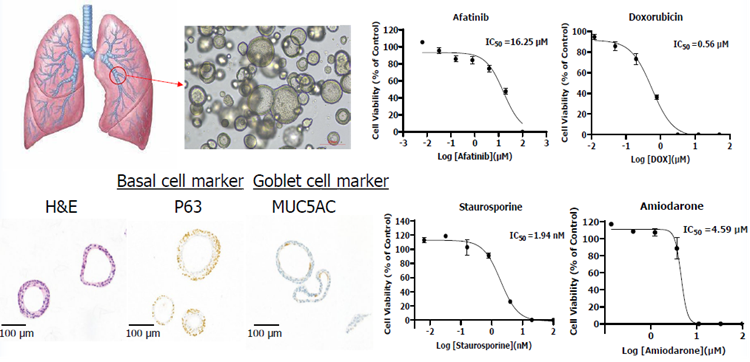
Characterization and toxicity testing of the basal HBO model using a three-dimensional CTG assay. Image Credit: Pharmaron
HBO in the basal state exhibited strong expression of the basal cell marker P63 and low expression of the goblet cell marker MUC5AC. HBO under basal conditions demonstrated dose-responsiveness to drugs with known pulmonary toxicity such as afatinib, doxorubicin, staurosporine, and amiodarone.
2. HBOs can be differentiated into goblet and ciliated cell lineages
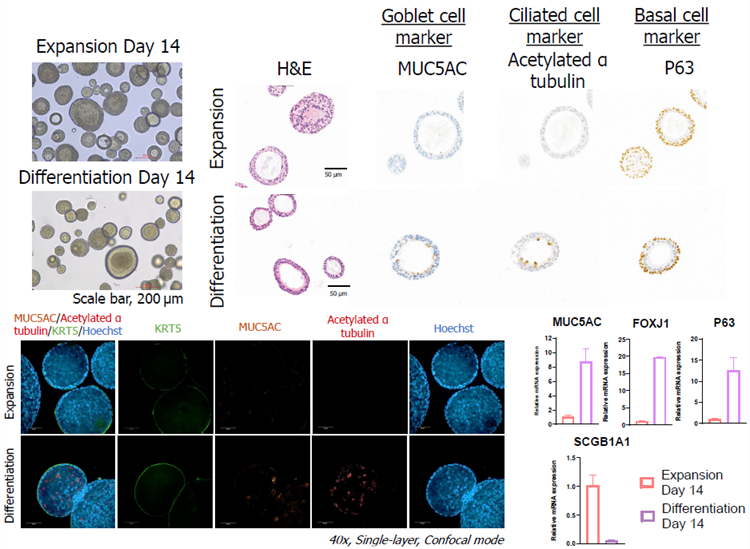
Characterization of differentiated HBO model using IHC labeling, IF staining, and RT-qPCR. Image Credit: Pharmaron
HBO cells exhibited increased expression of goblet cell markers (MUC5AC) and ciliated cell markers (FOXJ1/acetylated α-tubulin) at mRNA and protein levels after 14 days of differentiation.
3. A static NHBE air-liquid interface (ALI) barrier model formed a well-differentiated mucociliary structure with a steady TEER value
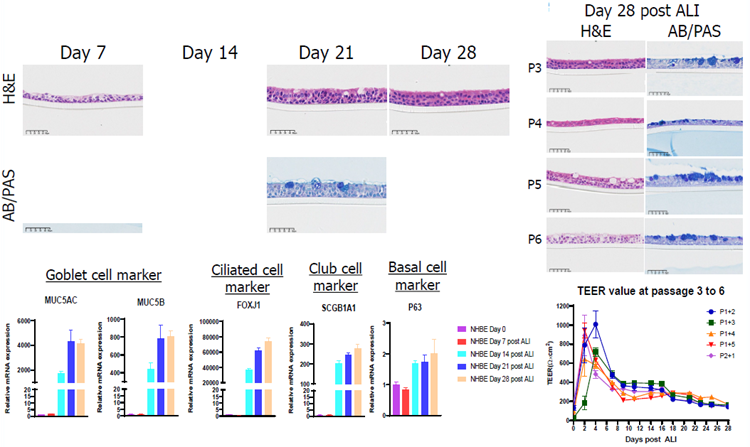
Characterization of a static NHBE ALI barrier model with H&E staining, AB/PAS staining, RT-qPCR analysis, and TEER value over passages. Image Credit: Pharmaron
NHBE cells grew in thickness and goblet cell composition as they differentiated, with increasing expression levels of goblet, ciliated, and club cell markers. This differentiation was demonstrated up to Passage 6 of NHBE cells, with a consistent TEER value throughout.
4. Perfused NHBE ALI model established with CN-Bio PhysioMimix showed superior differentiation compared to static ALI culture
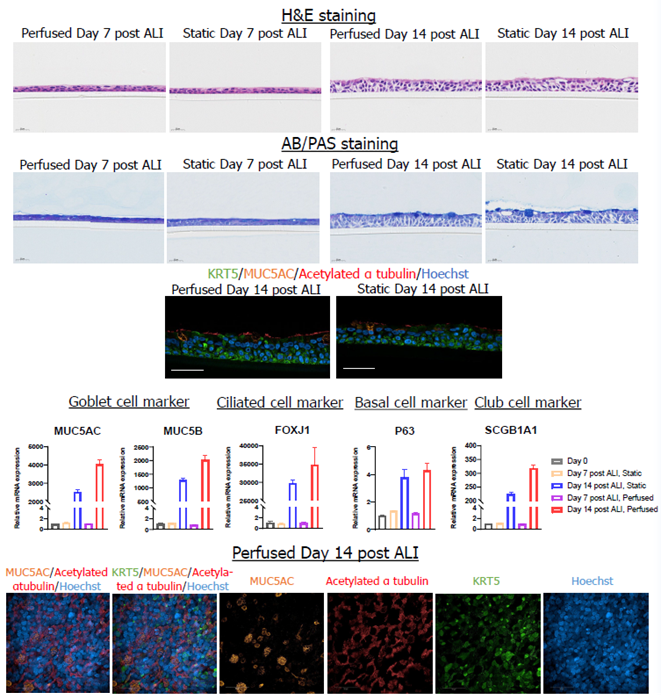
Comparison between static and perfused ALI models. Image Credit: Pharmaron
Perfused culture of NHBE cells resulted in improved differentiation outcomes, including goblet cell, ciliated cell, and club cell differentiation, as well as the creation of mucociliary structures at day 14, when compared to static ALI culture.
5. Afatinib showed toxicity to goblet cells in both the differentiated 3D HBO model and the static NHBE ALI barrier
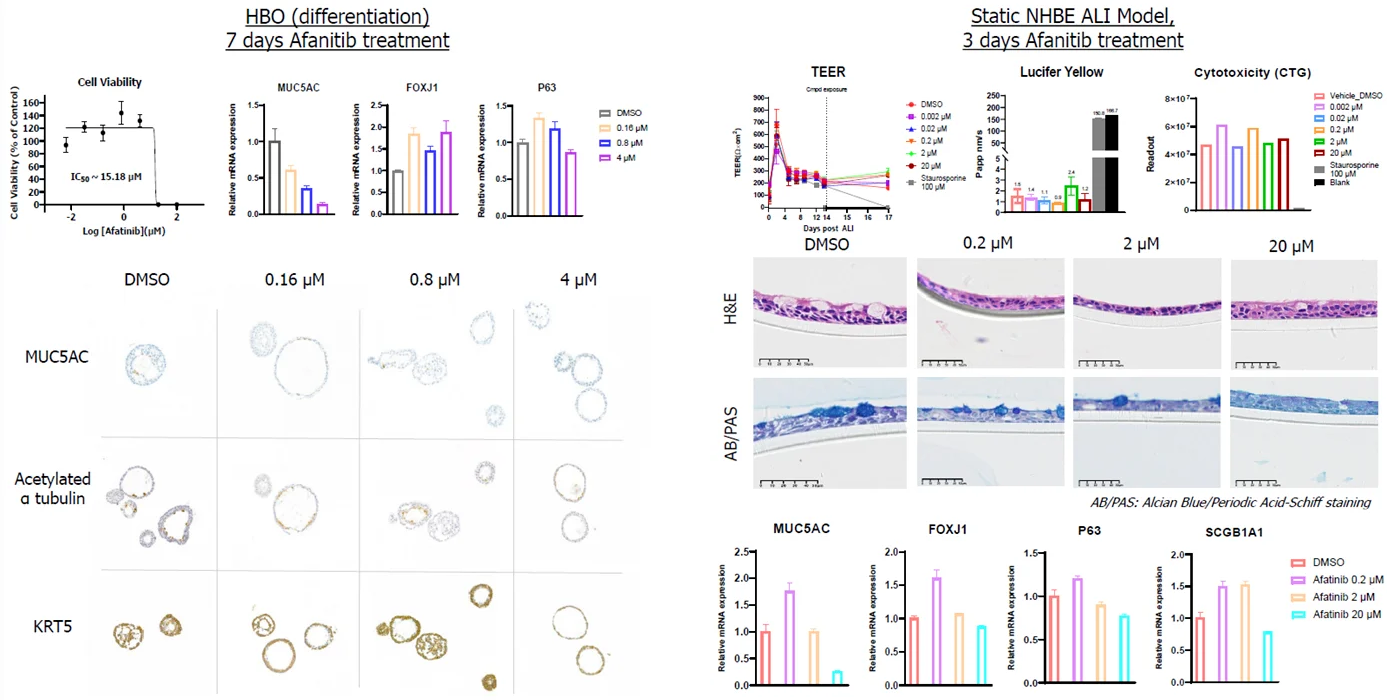
Image Credit: Pharmaron
- Left panel: Effect of Afatinib on differentiated HBO model after seven days of treatment. The IC50 for Afatinib in differentiated HBOs was around 15.18 μM, with a dose-dependent decrease in goblet cell marker MUC5AC expression.
- Right panel: Effect of Afatinib on NHBE ALI model after three days of treatment. Afatinib had no dose-dependent toxicity in the fully differentiated NHBE ALI model in terms of TEER value, permeability, or cell viability. However, it did show a dose-dependent reduction in expression of the goblet cell marker MUC5AC and a significant reduction in goblet cell composition at higher doses with AB/PAS staining.
Conclusion
- The authors generated and assessed three different methods for establishing a three-dimensional in vitro human bronchial model for assessing pulmonary toxicity: the HBO, the static Transwell-based ALI airway model, and the perfused ALI airway model using CN-Bio PhysioMimix technology.
- The HBO and static ALI airway models both demonstrated dose-responsiveness to drugs with known lung toxicity based on goblet-cell makeup, making them useful tools for identifying pulmonary toxicity during early drug development.
Acknowledgments
Produced using materials originally authored by Xintong Li, Jiawen Xu, Yunlun Gao, Yuhui Wang, Pengwei Pan, and Fang He from Pharmaron Beijing Co., Ltd.
About Pharmaron
Pharmaron is a premier R&D service provider for the life sciences industry. Founded in 2004, Pharmaron has invested in its people and facilities, and established a broad spectrum of research, development and manufacturing service capabilities throughout the entire drug discovery, preclinical and clinical development process across multiple therapeutic modalities, including small molecules, biologics and CGT products. With over 17,000 employees and operations in China, the U.S., and the U.K., Pharmaron has an excellent track record in the delivery of R&D solutions to its partners in North America, Europe, Japan and China.
Sponsored Content Policy: News-Medical.net publishes articles and related content that may be derived from sources where we have existing commercial relationships, provided such content adds value to the core editorial ethos of News-Medical.net, which is to educate and inform site visitors interested in medical research, science, medical devices and treatments.
Last Updated: Oct 27, 2026