Sponsored Content by PharmaronReviewed by Maria OsipovaJun 19 2026
Continuous flow manufacturing, also known as 'flow chemistry' or 'continuous flow', is a means of carrying out a chemical reaction using a continuous stream of different reagents contained within a pipe or tube and then mixed within a continuous device, such as a plug flow reactor (PFR) or continuous-stirred tank reactor (CSTR).1
Flow reactors have been used for continuous processing in the petrochemicals industry for decades, following the development of a large-scale Haber-Bosch process for ammonia production.2
These reactors have also been embedded within academia since the early 1990s. However, their adoption in the pharmaceutical, agrochemical, and flavors and fragrances industries has been slow.
Initially, this was because batch-scaling procedures had a proven track record, and users were experienced with maintaining regulatory compliance when using this method. There was also skepticism regarding the benefits of flow methods due to a lack of interdisciplinary knowledge, perceived complexity, and high investment costs.
Over the last decade, CDMOs and large pharma have both grasped the benefits and prospects of implementing a continuous flow approach, notably in drug substance manufacture (Table 1).3
In 2023, the ICH (International Council for Harmonization of Technical Requirements for Pharmaceuticals for Human Use) published guideline Q13, which addresses scientific and regulatory considerations for the development, implementation, operation, and lifecycle management of continuous manufacturing (CM).4
The publication of this detailed document indicates a growing emphasis on establishing continuous-flow production in the pharmaceutical industry.
Table 1. Considerations necessary when using a continuous flow chemistry approach on an industrial scale. Source: Pharmaron
| Advantages |
Challenges |
- Improved processing economics
- Improved delivery speed
- Improved product quality
- Fewer impurities due to competing side reactions
- More consistent product quality
- Option to adapt PAT for real-time process optimization
- Optimization in real time rather than per batch
- Minimal inventories for handling hazardous reagents/improved safety
- Implementation of photo/photoredox, high-temperature/high-pressure, and electrochemical approaches to enable new simplified reactions
- Easier scalability of processes (numbering up)5
- Faster technology transfer
- Better control of heat and mass transfer and mixing regimes
|
- Regulatory hesitance
- Continuous isolation technology is still evolving
- Handling of slurries/heterogeneous mixtures requires larger bore pipe/CSTR approaches
- Less suitable for reactions with long residence times
- Cleaning and maintenance of equipment may need more detailed offline work
- Need for GMP-compatible equipment/ability to validate
- Mixing considerations as scale is increased, with a need for CFD modeling (Aspen, DynoChem, etc.)
|
The advantages of a continuous flow approach
Economics
Continuous flow manufacturing has several economic advantages over traditional batch processes, including improved mass and heat transfer, higher yields, reduced waste streams and PMI (process mass intensity), improved scalability, and excellent reproducibility.1,6
Using process analytical technology (PAT) allows for real-time optimization of process conditions with minimal inventory. Real-time reaction monitoring and kinetic analysis result in high-quality, streamlined processing that can be optimized quickly.7
Flow equipment has a smaller footprint, requires fewer processing facilities, and is modular, making it easy to adapt to different processes and reconfigure units. It can also divert any out-of-specification materials produced, avoiding contamination of other high-value streams.
Safety
Thermal runaway occurs when a reaction rapidly rises in temperature, releasing a substantial amount of heat that can trigger secondary decomposition or other chain reactions. It is a serious concern, especially in large-scale industrial chemistry settings where it can swiftly lead to a catastrophic disaster.8
Scaling up highly energetic, pyrophoric, or toxic materials, such as organic azides,9 ozone,10 or acetyl nitrate,11 can be challenging due to the generation of byproducts or the use of gases as reagents.12
Flow chemistry can significantly improve the safety profile of processes at both large and small scales.
- Excellent heat transport and hot-spot prevention reduce the risk of thermal runaway.17
- Azides and other highly energetic or poisonous compounds can be created and consumed in-line, eliminating the need for isolation.18
- Limited production of active materials, including highly energetic or toxic species, reduces the risk of explosion or poisoning.
- Monitoring techniques, including IR, Raman spectroscopy, and mass spectrometry, can detect high-energy or hazardous intermediates.19
- Flow technology prevents gases and solvent vapors from accumulating in headspace, boosting safety compared to batch containers.
Environmental
Flow chemistry can also provide a substantial advantage by reducing environmental impact and improving process sustainability. A recent study found that using flow resulted in a significant reduction in carbon emissions and a 97% reduction in energy consumption during the synthesis of ibuprofen.20
Using flow can lead to faster reactions, higher yields, less waste (lowering PMI), and a speedier transition from proof-of-concept work to large-scale manufacturing.2
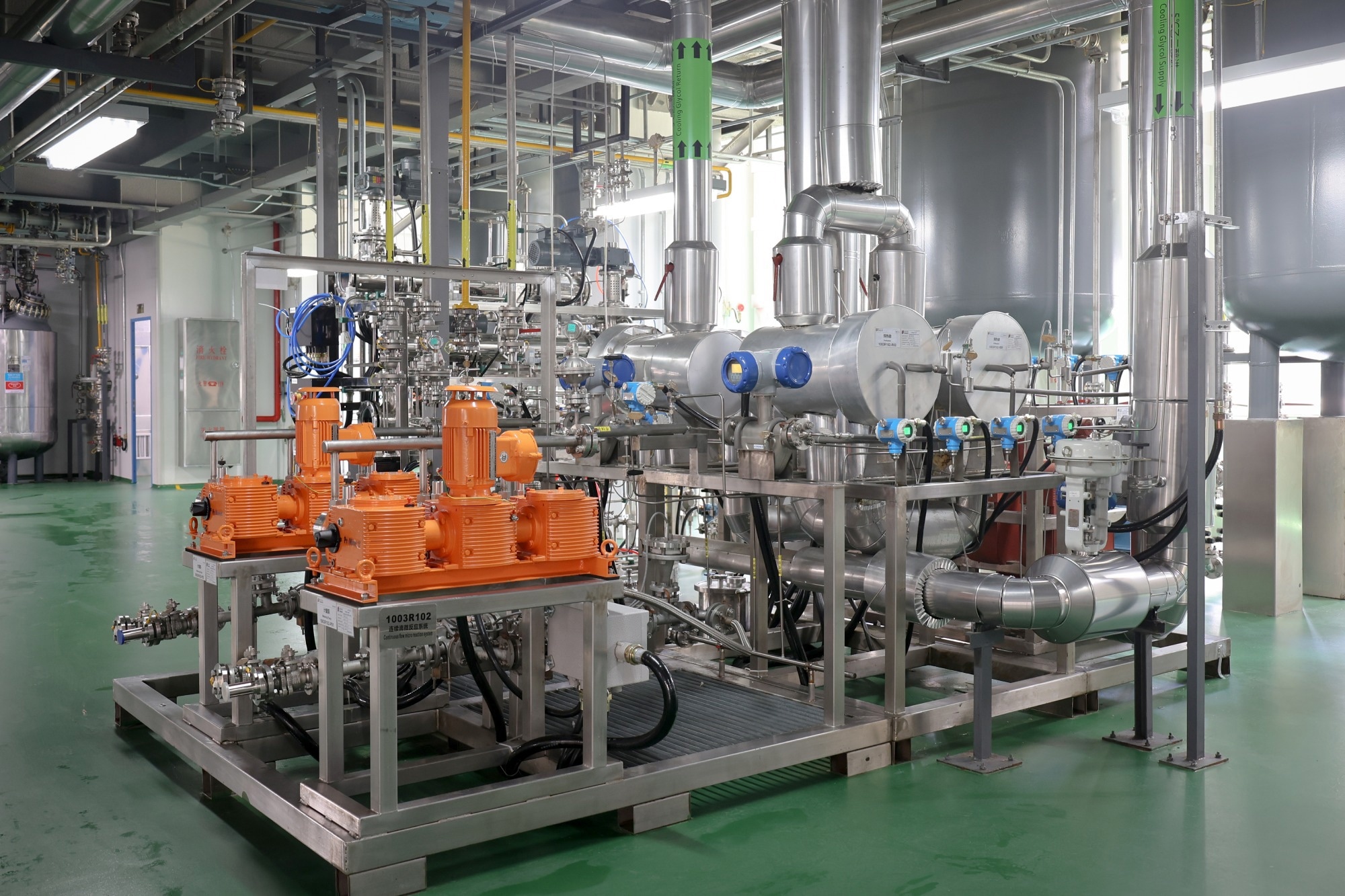
Continuous Flow Chemistry at Pharmaron, Shaoxing, China
Continuous flow at Pharmaron: A core part of the drug substance development and manufacturing capability
The economic, safety, and environmental benefits described above have led Pharmaron to invest extensively in continuous-flow technology in both the UK and China, ensuring that flow chemistry is integrated end to end across processes. This means that Pharmaron’s clients benefit just as much as the team does.
Along with mainstream flow instrumentation for large-scale reaction processing with solid, liquid, and gaseous reagents, Pharmaron also provides more niche techniques on a multi-kilogram to multi-ton scale. These include photochemistry, electrochemistry, ozonolysis, continuous extraction, separation, and distillation, as well as in-line IR, Raman, and mass spectrometric monitoring.
To learn more about continuous flow chemistry, discover visual representations of the safety advantages and read more about how the Pharmaron team used a continuous flow approach for a 40 kg reduction of a nitro group during production of an API, download the full e-brochure.
Download the Full e-brochure
References and further reading
- Noël, T., Capaldo, L. and Wen, Z. (2023). A field guide to flow chemistry for synthetic organic chemists. Chemical Science, 14(16), pp.4230–4247. DOI: 10.1039/d3sc00992k. https://pubs.rsc.org/en/content/articlelanding/2023/sc/d3sc00992k.
- Baumann, M., et al. (2020). A Perspective on Continuous Flow Chemistry in the Pharmaceutical Industry. Organic Process Research & Development, 24(10). DOI: 10.1021/acs.oprd.9b00524. https://pubs.acs.org/doi/10.1021/acs.oprd.9b00524.
- Gutmann, B., Cantillo, D. and Kappe, C.O. (2015). Continuous-Flow Technology-A Tool for the Safe Manufacturing of Active Pharmaceutical Ingredients. Angewandte Chemie International Edition, 54(23), pp.6688–6728. DOI: 10.1002/anie.201409318. https://onlinelibrary.wiley.com/doi/10.1002/anie.201409318.
- European Medicines Agency. ICH guideline Q13 on continuous manufacturing of drug substances and drug products - Scientific guideline | European Medicines Agency. Available at: https://www.ema.europa.eu/en/ich-guideline-q13-continuous-manufacturing-drug-substances-and-drug-products-scientific-guideline.
- Dong, Z., et al. (2021). Scale-up of micro- and milli-reactors: An overview of strategies, design principles and applications. Chemical Engineering Science: X, 10, p.100097. DOI: 10.1016/j.cesx.2021.100097. https://www.sciencedirect.com/science/article/pii/S2590140021000101?via%3Dihub.
- ACS. (2025). Process Mass Intensity (PMI) – ACSGCIPR. Available at: https://acsgcipr.org/tools/process-mass-intensity/.
- (a) Miyai, Y., et al. (2021). PAT Implementation on a Mobile Continuous Pharmaceutical Manufacturing System: Real-Time Process Monitoring with In-Line FTIR and Raman Spectroscopy. Organic Process Research & Development, 25(12), pp.2707–2717. DOI: 10.1021/acs.oprd.1c00299. https://pubs.acs.org/doi/10.1021/acs.oprd.1c00299; (b) Chanda, A., et al. (2014). Industry Perspectives on Process Analytical Technology: Tools and Applications in API Development. Organic Process Research & Development, 19(1), pp.63–83. DOI: 10.1021/op400358b. https://pubs.acs.org/doi/10.1021/op400358b.
- Wang, J., et al. (2025). Kinetic Study and Thermal Hazard Assessment of the Clethodim Synthesis Reaction. Organic Process Research & Development, 29(11), pp.2693–2703. DOI: 10.1021/acs.oprd.5c00196. https://pubs.acs.org/doi/10.1021/acs.oprd.5c00196.
- Porta, R., Benaglia, M. and Puglisi, A. (2015). Flow Chemistry: Recent Developments in the Synthesis of Pharmaceutical Products. Organic Process Research & Development, 20(1), pp.2–25. DOI: 10.1021/acs.oprd.5b00325. https://pubs.acs.org/doi/10.1021/acs.oprd.5b00325.
- Mallia, C.J. and Baxendale, I.R. (2015). The Use of Gases in Flow Synthesis. Organic Process Research & Development, 20(2), pp.327–360. DOI: 10.1021/acs.oprd.5b00222. https://pubs.acs.org/doi/10.1021/acs.oprd.5b00222.
- Hellwig, H., et al. (2025). Continuous Flow Synthesis of Nitrofuran Pharmaceuticals Using Acetyl Nitrate. Angewandte Chemie International Edition, 64(25). DOI: 10.1002/anie.202501660. https://onlinelibrary.wiley.com/doi/10.1002/anie.202501660.
- Broadwith, P. (2025). Fatal incidents at chemical plants in the US, India and Norway. Chemistry World. Available at: https://www.chemistryworld.com/news/fatal-incidents-at-chemical-plants-in-the-us-india-and-norway/4022198.article.
- Zhang, P., et al. (2014). Continuous Flow Total Synthesis of Rufinamide. Organic Process Research & Development, 18(11), pp.1567–1570. DOI: 10.1021/op500166n. https://pubs.acs.org/doi/10.1021/op500166n.
- Köckinger, M., et al. (2020). Optimization and Scale-Up of the Continuous Flow Acetylation and Nitration of 4-Fluoro-2-methoxyaniline to Prepare a Key Building Block of Osimertinib. Organic Process Research & Development, 24(10), pp.2217–2227. DOI: 10.1021/acs.oprd.0c00254. https://pubs.acs.org/doi/10.1021/acs.oprd.0c00254.
- Timo von Keutz, Williams, J.D. and Kappe, C.O. (2021). Flash Chemistry Approach to Organometallic C-Glycosylation for the Synthesis of Remdesivir. Organic Process Research & Development, 25(4), pp.1015–1021. DOI: 10.1021/acs.oprd.1c00024. https://pubs.acs.org/doi/10.1021/acs.oprd.1c00024.
- Uhlig, N., Martins, A. and Gao, D. (2020). Selective DIBAL-H Monoreduction of a Diester Using Continuous Flow Chemistry: From Benchtop to Kilo Lab. Organic Process Research & Development, 24(10), pp.2326–2335. DOI: 10.1021/acs.oprd.0c00158. https://pubs.acs.org/doi/10.1021/acs.oprd.0c00158.
- Kockmann, N., et al. (2017). Safety assessment in development and operation of modular continuous-flow processes. Reaction Chemistry & Engineering, 2(3), pp.258–280. DOI: 10.1039/C7RE00021A. https://pubs.rsc.org/en/content/articlelanding/2017/re/c7re00021a.
- Lehmann, H., Ruppen, T. and Knoepfel, T. (2022). Scale-Up of Diazonium Salts and Azides in a Three-Step Continuous Flow Sequence. Organic Process Research & Development, 26(4), pp.1308–1317. DOI: 10.1021/acs.oprd.2c00016. https://pubs.acs.org/doi/10.1021/acs.oprd.2c00016.
- Lange, H., et al. (2011). A breakthrough method for the accurate addition of reagents in multi-step segmented flow processing. Chemical Science, 2(4), p.765. DOI: 10.1039/c0sc00603c. https://pubs.rsc.org/en/content/articlelanding/2011/sc/c0sc00603c.
- Ince, M.C., Brahim Benyahia and Gianvito Vilé (2025). Sustainability and Techno-Economic Assessment of Batch and Flow Chemistry in Seven Industrial Pharmaceutical Processes. ACS Sustainable Chemistry & Engineering. DOI: 10.1021/acssuschemeng.4c09289. https://pubs.acs.org/doi/10.1021/acssuschemeng.4c09289.
About Pharmaron
Pharmaron is a premier R&D service provider for the life sciences industry. Founded in 2004, Pharmaron has invested in its people and facilities and established a broad spectrum of research, development, and manufacturing service capabilities throughout the entire drug discovery, preclinical, and clinical development process across multiple therapeutic modalities, including small molecules, biologics, and CGT products. With over 17,000 employees and operations in China, the US, and the UK, Pharmaron has an excellent track record in the delivery of R&D solutions to its partners in North America, Europe, Japan, and China.
Sponsored Content Policy: News-Medical.net publishes articles and related content that may be derived from sources where we have existing commercial relationships, provided such content adds value to the core editorial ethos of News-Medical.net, which is to educate and inform site visitors interested in medical research, science, medical devices and treatments.