This article is based on a poster originally authored by Xiaomin Du, Qi Hu, Suhong Zhang, Pengfei Gao, and Fang He.
Antibody-drug conjugates (ADCs) are cancer therapies that use antibodies to precisely deliver cytotoxic payloads. However, their therapeutic value is limited by off-target hematotoxicities, such as neutropenia and thrombocytopenia, which typically occur as dose-limiting adverse effects due to unintentional hematopoietic cell targeting or non-specific payload release
Using human CD34+ hematopoietic stem/progenitor cells (HSPCs) and differentiated erythroid, myeloid, and megakaryocytic lineages, this study evaluates the hematotoxic potential of major ADC classes.
This research aims to identify lineage-specific vulnerabilities by using cell viability and colony formation assays as critical readouts. These findings will aid in the rational design of safer ADCs and the optimization of clinical dosing strategies to reduce hematological toxicity.
Methods
- Human CD34+ cells were cultivated in StemSpan SFEM II (STEMCELL) with cytokines to maintain stemness. They were subsequently differentiated into erythroid, myeloid, and megakaryocytic lineages using specific cytokine combinations for the appropriate durations.
- Four clinically approved ADCs with different payload classes were evaluated: trastuzumab vedotin (MMAE class), trastuzumab deruxtecan (DXd class), trastuzumab duocarmazine (DM class), and trastuzumab emtansine (DM1 class). CD34+ hematopoietic cells were treated with the relevant ADCs during lineage differentiation for seven to 10 days. Cytotoxicity was determined with the CellTiter-Glo Luminescent Cell Viability Assay (Promega).
- For clonogenic experiments, CD34+ cells were plated on a methylcellulose-based medium designed for hematopoietic colony formation. After 14 days of incubation, BFU-E (erythroid burst-forming units) and CFU-GM (granulocyte-macrophage colony-forming units) were scored manually using morphological criteria and an inverted microscope.
1. Hematotoxicity is a common adverse event in antibody-drug conjugate therapy
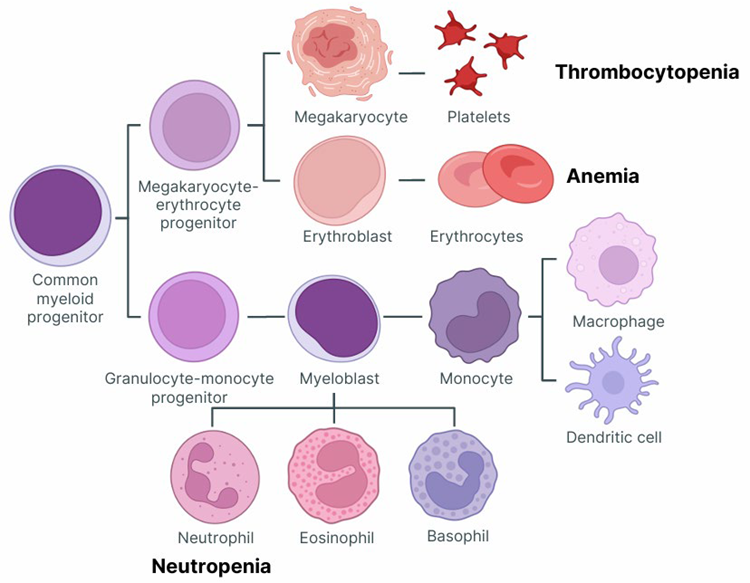
Image Credit: Pharmaron
This figure demonstrates the hierarchical development of hematopoietic cells during proper differentiation of bone marrow-derived hematopoietic stem/progenitor cells into lineage-committed mature cells, as well as the concomitant hematological toxicities.
2. Establishment of an in vitro human hematopoietic differentiation system
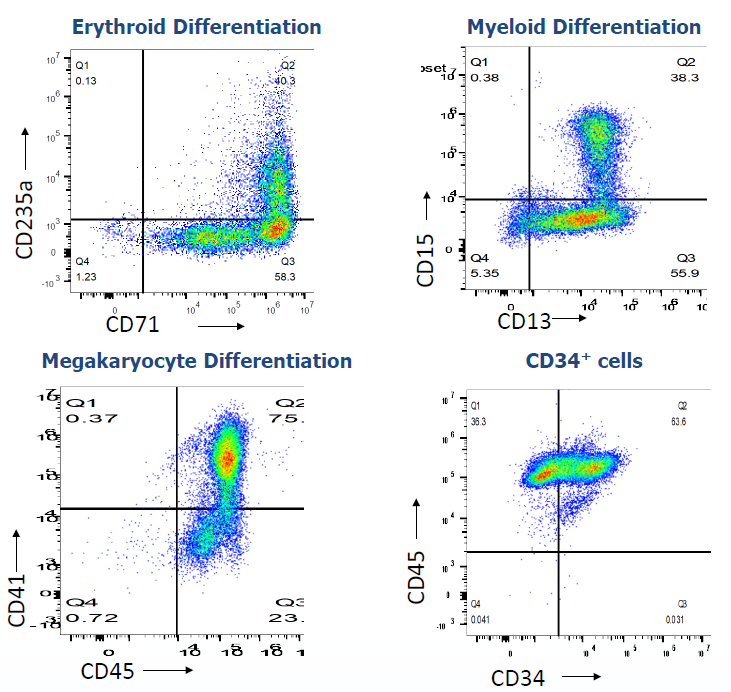
Image Credit: Pharmaron
Human CD34+ HSPCs were differentiated toward erythroid, myeloid, and megakaryocytic lineages and immunophenotypically characterized by flow cytometry. CD71 and CD235a represent the erythroid lineage; CD13 and CD15 represent the myeloid lineage; and CD45 and CD41 represent the megakaryocytic lineage.
3. Payloads exhibit lineage-specific cytotoxicity
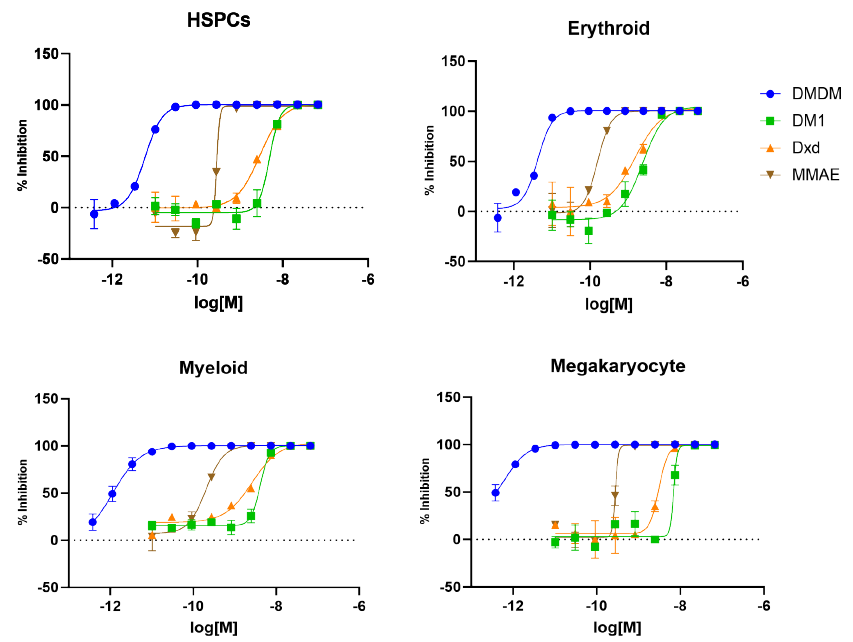
Image Credit: Pharmaron
Source: Pharmaron
| |
Cytotoxicity EC50 (nM) |
| |
HSPC proliferation |
Erythroid differentiation |
Myeloid differentiation |
Megakaryocyte differentiation |
| DMDM |
0.006 |
0.004 |
0.0012 |
0.00068 |
| DM1 |
4.84 |
2.37 |
4.08 |
6.92 |
| DXd |
2.88 |
1.50 |
2.62 |
3.03 |
| MMAE |
0.28 |
0.16 |
0.20 |
0.28 |
DMDM (duocarmycin DM) exhibited preferential cytotoxicity toward the megakaryocytic lineage, whereas DXd (exatecan derivative) and DM1 (mertansine) displayed higher toxicity toward the erythroid lineage. MMAE (monomethyl auristatin E) showed no lineage-restricted cytotoxicity.
4. Trastuzumab ADC payloads differentially impact lineages in HSPC cultures
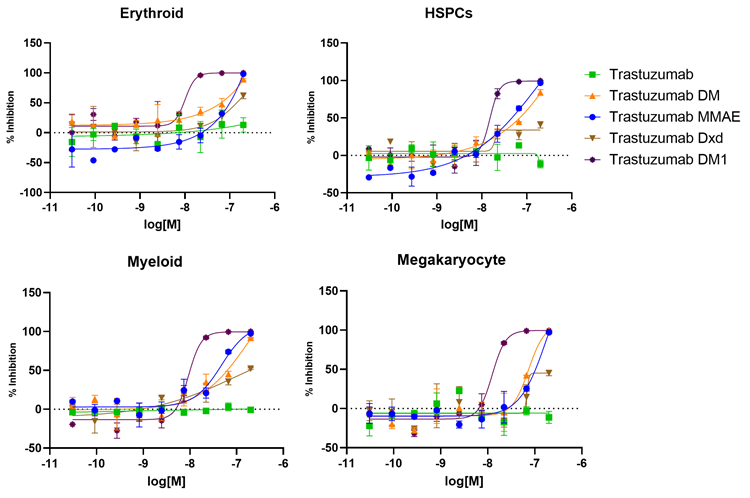
Image Credit: Pharmaron
Source: Pharmaron
| |
Cytotoxicity EC50 (nM) |
| |
HSPC |
Erythroid |
Myeloid |
Megakaryocyte |
| Trastuzumab |
> 200 |
> 200 |
> 200 |
> 200 |
| Trastuzumab-DM |
52.83 |
70.01 |
52.76 |
73.37 |
| Trastuzumab-DXd |
> 200 |
191.70 |
94.09 |
> 200 |
| Trastuzumab-DM1 |
14.45 |
10.11 |
9.31 |
12.45 |
| Trastuzumab-MMAE |
25.76 |
68.32 |
46.93 |
82.77 |
Trastuzumab-DM1 exhibited dominant cytotoxicity across HSPCs and all three lineages, whereas trastuzumab-DXd showed reduced toxicity toward all lineages.
5. The colony formation assays can effectively detect the toxicities of payloads
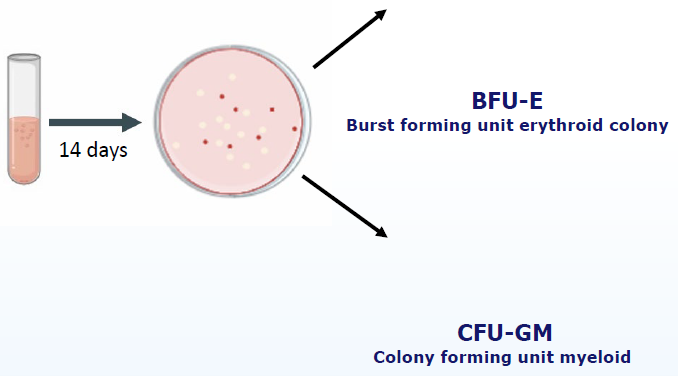
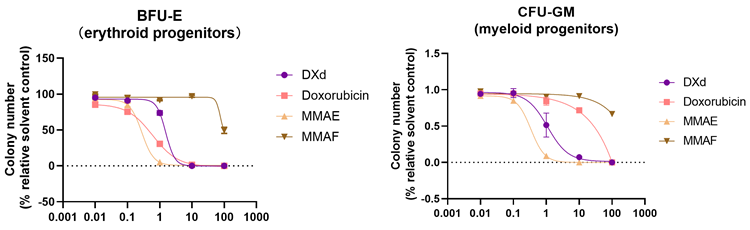
Image Credit: Pharmaron
Source: Pharmaron
| |
Cytotoxicity EC50 (nM) |
| |
BFU-E |
CFU-GM |
| DXd |
1.54 |
1.13 |
| Doxorubicin |
0.60 |
15.89 |
| MMAE |
0.28 |
0.34 |
| MMAF |
74.90 |
24.89 |
Among the payloads evaluated, MMAE exhibited greater cytotoxicity than DXd and MMAF (monomethyl auristatin F), while doxorubicin showed preferential cytotoxicity toward the erythroid lineage relative to the myeloid lineage.
Conclusion
- This study shows that primary CD34+ HSPCs and their differentiated lineages provide a robust in vitro model for evaluating the hematotoxicity of ADCs.
- The model identifies lineage-specific risks and guides preclinical development of ADCs, minimizing hematotoxicity through payload selection and target validation. Future research will involve more ADCs and examine payload release kinetics in lineage-specific niches.
Acknowledgments
Produced using materials originally authored by Xiaomin Du, Qi Hu, Suhong Zhang, Pengfei Gao, and Fang He from Pharmaron Beijing Co., Ltd.
About Pharmaron
Pharmaron is a premier R&D service provider for the life sciences industry. Founded in 2004, Pharmaron has invested in its people and facilities, and established a broad spectrum of research, development and manufacturing service capabilities throughout the entire drug discovery, preclinical and clinical development process across multiple therapeutic modalities, including small molecules, biologics and CGT products. With over 17,000 employees, and operations in China, the U.S., and the U.K., Pharmaron has an excellent track record in the delivery of R&D solutions to its partners in North America, Europe, Japan and China.
Sponsored Content Policy: News-Medical.net publishes articles and related content that may be derived from sources where we have existing commercial relationships, provided such content adds value to the core editorial ethos of News-Medical.net, which is to educate and inform site visitors interested in medical research, science, medical devices and treatments.
Last Updated: Nov 18, 2026