Introduction
Current limitations in cryo-EM sample preparation
Innovations addressing cryo-EM sample preparation limitations
Practical mitigation strategies
Future Perspectives and Commercial Implications
References
Further Reading
Cryo-EM performance is fundamentally constrained not only by technical preparation challenges but also by intrinsic protein disorder, where dynamic and flexible regions remain unresolved despite advances in resolution and automation. Addressing this requires integrated experimental and computational strategies that can better capture structural heterogeneity and improve data interpretability.
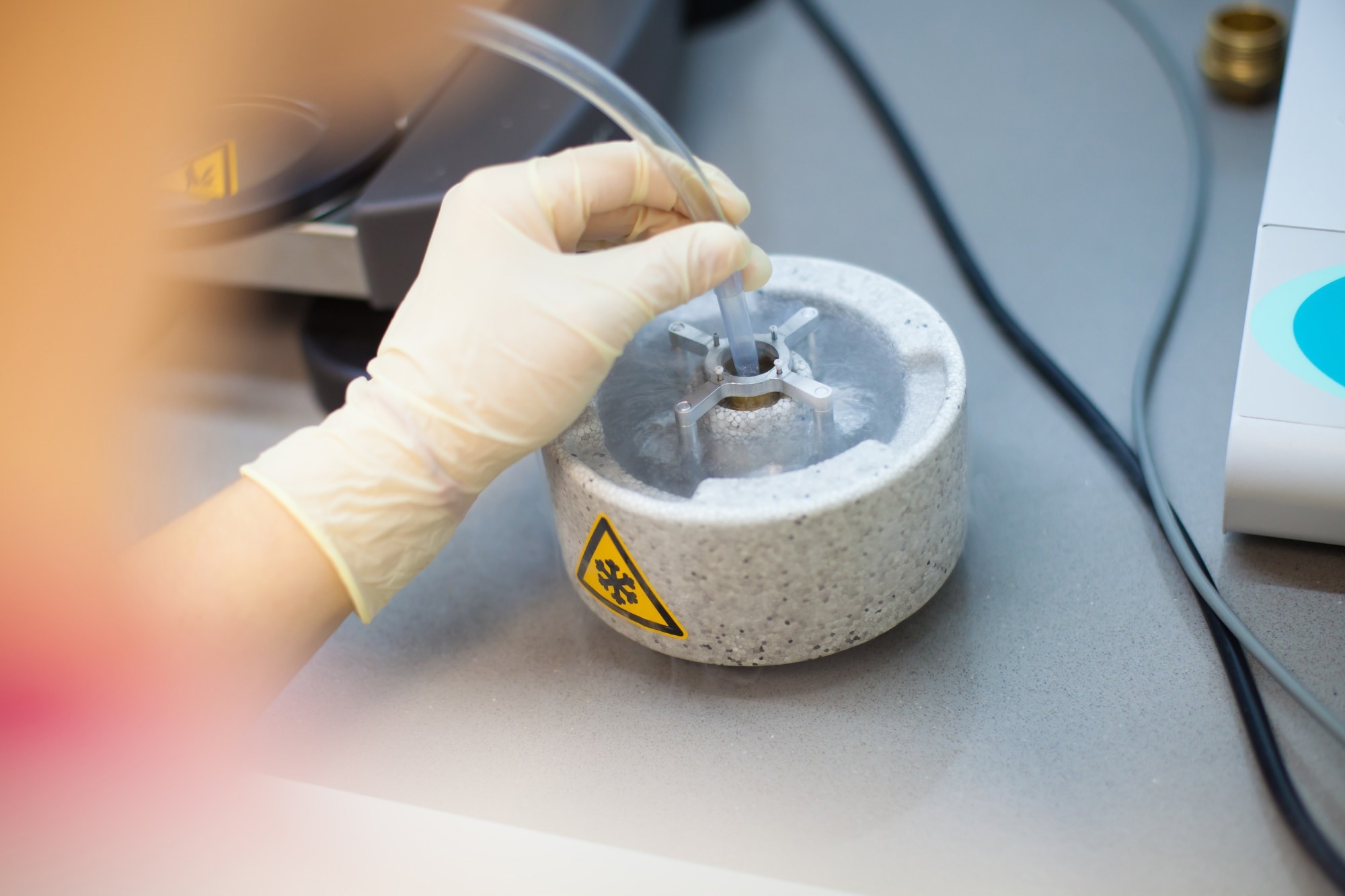 Image credit: PolakPhoto/Shutterstock.com
Introduction
Over the past decade, cryo-electron microscopy (cryo-EM) has transformed structural biology. Today, detectors are more sensitive, workflows have become automated, and artificial intelligence (AI) algorithms process images more efficiently. Due to these advances, cryo-EM can now be used more efficiently to study biological molecules. These advances enable rapid, near-atomic resolution of biological molecules. However, sample preparation remains a key bottleneck, limiting data quality and the reproducibility of findings.1,2
In particular, challenges during vitrification, a rapid freezing process used to preserve native structures, continue to compromise outcomes. Proteins often denature at the air-water interface (AWI), adopt preferred orientations, or exhibit heterogeneity on the grid. In addition, cryo-EM frequently fails to resolve highly dynamic or intrinsically disordered regions, which appear as missing or poorly defined density in reconstructed maps. These unresolved regions reflect conformational heterogeneity and remain difficult to capture even with improved resolution.6
Together, these factors render many particles unusable and limit the clarity with which structures can be reconstructed. These limitations reduce scalability and increase the cost per structure, as large fractions of collected particles must often be discarded during processing. Addressing these fundamental constraints in sample preparation could significantly improve the efficiency of cryo-EM pipelines.1,2,3
Current limitations in cryo-EM sample preparation
Despite the use of advanced instruments, cryo-EM workflows still rely on largely empirical sample-preparation processes that are difficult to standardize. Efficient sample purification and rapid freezing to obtain uniform ice layers remain challenging. Grid preparation is highly sensitive to experimental conditions, and variability in these steps contributes directly to inconsistent particle behavior and structural outcomes. This lack of reproducibility slows throughput and reduces consistency across experiments.1,2,3
While uneven ice layers degrade image quality, excessively thick ice reduces contrast and obscures fine structural details. Conversely, very thin ice can restrict particle distribution, which increases damage risk. Even under optimal conditions, achieving ideal ice thickness and uniform particle distribution remains difficult, contributing to downstream data loss. Striking the right balance remains technically demanding, particularly for delicate or low-abundance samples.1,2,3
Interactions at the AWI can introduce additional complications. Especially during blotting, molecules can migrate to the AWI. Due to repeated collisions with the AWI prior to vitrification, proteins may partially unfold or aggregate, further increasing structural heterogeneity. These effects can compromise structural integrity before imaging begins.2,3
Preferred orientation further limits the reconstruction of high-resolution molecules. When particles adsorb to the AWI in specific arrangements, they yield an incomplete range of views and result in uneven data representations along the three directional axes. This often requires significantly larger datasets to compensate for missing orientations, increasing computational and experimental burden.1
Beyond these technical issues, intrinsic conformational heterogeneity introduces a deeper limitation. In cryo-EM datasets, residues may be classified as consistently resolved, intermittently missing, or entirely absent across reconstructions, reflecting a continuum between ordered and disordered states. Notably, a substantial fraction of residues remain unresolved even as resolution improves, indicating that disorder is an inherent biological property rather than solely an experimental artifact.6 Together, these interlinked challenges underscore why sample preparation continues to define the practical limits of cryo-EM performance.2,3
Cryo-Electron Microscopy at NIEHS
Video credit: NIH_NIEHS/Youtube.com
Innovations addressing cryo-EM sample preparation limitations
Recent advances are shifting cryo-EM sample preparation from a manual, trial-and-error process to more controlled, reproducible workflows. A central focus has been vitrification, where automated, blot-free approaches aim to minimize sample loss and limit exposure to the AWI. Reducing the time between sample application and freezing has been shown to mitigate both denaturation and conformational rearrangements.1,3
High-speed jet vitrification cools grids from the center outward, enabling more uniform ice formation. Complementary strategies such as picoliter droplet deposition and self-wicking grids reduce the time between sample application and freezing to milliseconds, thereby limiting particle denaturation and preserving transient conformations.3,4
Suction-based systems replace filter paper blotting and enable real-time monitoring before freezing, while foam-based vitrification produces uniform films that reduce particle adsorption. Real-time monitoring of ice thickness and sample behavior is increasingly used to optimize preparation conditions within a single experiment.1 In parallel, mix-and-inject spray approaches enable rapid mixing immediately before vitrification, allowing capture of short-lived biological states.3,4
Grid design and surface engineering have also advanced. Conductive, mechanically stable materials are replacing traditional holey carbon supports to reduce beam-induced motion and specimen charging. Metal-based supports with matched thermal properties minimize deformation during cooling, improving image stability. At the same time, affinity-based surface modifications enable selective capture of target molecules directly on the grid, improving particle distribution and reducing reliance on extensive purification.3,4
Support films have evolved to address AWI effects and orientation bias. Atomically thin materials such as graphene provide robust, low-background substrates that enhance particle density and reduce charging. Functionalized surfaces and two-dimensional crystalline layers further sequester particles away from interfaces, promoting more uniform orientations. However, while these approaches improve particle behavior, they do not fully resolve the challenges posed by intrinsic disorder and dynamic heterogeneity. Notably, enclosed architectures such as nanofluidic chips and graphene liquid cells eliminate the AWI altogether by introducing controlled solid–liquid environments with consistent ice thickness.3-5,6
Practical mitigation strategies
While emerging technologies are reshaping cryo-EM workflows, several practical strategies are already helping researchers minimize sample damage and orientation bias at the bench. Adding surfactants and stabilizing agents can reduce AWI interactions and improve particle integrity.2,3
Support films and affinity grids can improve particle orientation distributions, while tilting strategies during imaging can partially compensate for missing views. However, these approaches often introduce trade-offs in noise and resolution.3
Importantly, these mitigation strategies are less effective for intrinsically disordered or highly flexible regions, which remain difficult to stabilize or reconstruct due to their dynamic nature.6
Future Perspectives and Commercial Implications
The future of cryo-EM sample preparation is increasingly defined by automation, integration, and standardization. Automated systems reduce operator variability and improve reproducibility, enabling broader adoption across research and industry.1
Advances in materials and microfabrication further reinforce these trends, while microfluidic and time-resolved approaches enable capture of transient states. However, fully resolving dynamic structural ensembles remains a major unresolved challenge, requiring integration of experimental and computational approaches.6
These developments carry important commercial implications, particularly in drug discovery. Improved reproducibility and throughput will be critical for translating cryo-EM into a routine industrial tool.3,5
Although these advances are steadily reducing barriers, sample preparation is unlikely to cease being a constraint in the near term. Instead, it is evolving from an empirical bottleneck into a more predictable, engineering-driven step, yet one still fundamentally limited by the challenge of capturing biological dynamics and disorder.6
References
- Zheng, S. (2025). Exploring the Bottleneck in Cryo-EM Dynamic Disorder Feature and Advanced Hybrid Prediction Model. Biophysica, 5(3). DOI:10.3390/biophysica5030039, https://www.mdpi.com/2673-4125/5/3/39
- Iqbal, S., Eng, E.T., Kamal, M.A. et al. (2026). Artificial intelligence in cryo-EM: emerging deep neural network methods from sample preparation, particle picking, map reconstruction, modelling to enhanced resolution. BMC Artif. Intell. 2, 2, DOI:10.1186/s44398-025-00017-2, https://link.springer.com/article/10.1186/s44398-025-00017-2
- Isobel J. H., William J.R.T., Rhiannon A. D., and Stephen P. M. (2024). CryoEM grid preparation: a closer look at advancements and impact of preparation mode and new approaches. Biochem Soc Trans (2024) 52 (3): 1529–1537. DOI:10.1042/BST20231553, https://portlandpress.com/biochemsoctrans/article/52/3/1529/234559/CryoEM-grid-preparation-a-closer-look-at?guestAccessKey=
- Xu, Y., & Dang, S. (2022). Recent Technical Advances in Sample Preparation for Single-Particle Cryo-EM. Frontiers in Molecular Biosciences, 9, 892459. DOI:10.3389/fmolb.2022.892459, https://www.frontiersin.org/journals/molecular-biosciences/articles/10.3389/fmolb.2022.892459/full
- Namba, K., & Makino, F. (2022). Recent progress and future perspective of electron cryomicroscopy for structural life sciences. Microscopy, 71(Supplement_1), i3-i14. DOI:10.1093/jmicro/dfab049, https://academic.oup.com/jmicro/article/71/Supplement_1/i3/6530477
Further Reading
Last Updated: Mar 30, 2026
 FEI, NovAliX to jointly provide cryo-EM-based structural analysis services for pharmaceutical and biotech industry