In microfluidics, motor selection directly impacts precision, reliability, efficiency, and overall system lifespan. The industry’s two main motor technologies – brushed DC and brushless DC (BLDC) – provide fundamentally different architectures and performance characteristics.
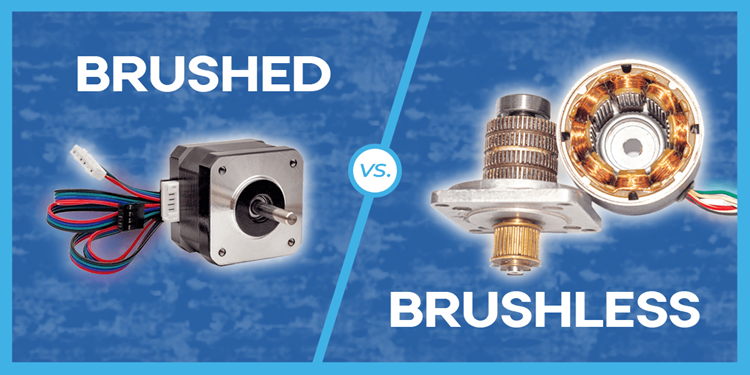
Image Credit: Fluid Metering, Inc.
Key takeaways:
Knowing their internal structure and commutation mechanics is essential for choosing the best motor for a given application.
- In microfluidic systems, brushless motors for precision dispensing deliver more control, higher efficiency, and a longer lifespan than brushed motors, which are more suitable for low-cost, rugged use cases.
- Fluid Metering’s use of stepper motors in OEM pump systems guarantees fluid displacement happens quietly and with precision, with minimal maintenance, making it ideal for pharmaceutical and diagnostic platforms alike.
- Engineers examining motor selection for microfluidic pumps should think about trade-offs in control precision, EMI, maintenance, and integration complexity to meet application requirements.
Brushed DC motor
Structure and operation
Brushed DC motors make use of mechanical commutation to transform electrical energy into rotational motion. The stator consists of permanent magnets, while the rotor (also known as the armature) contains windings that are linked to a segmented commutator.
Carbon brushes make sliding contact with the commutator, alternately energizing different windings, which enables continuous rotation.
Essential components:
- Stator: permanent magnets that generate a stationary magnetic field
- Rotor: wound coils that are mounted atop a shaft
- Commutator: a segmented ring that is attached to the rotor; converts current to various windings
- Brushes: carbon contacts that transfer current from the power source to the rotor
Characteristics:
- Simple, cost-effective design
- Mechanical wear from brush/commutator friction
- Produces electrical noise (EMI)
- Short lifespan from brush erosion
- Ideal for low-cost, intermittent use
Brushless DC motor (BLDC) & stepper motor
Structure and operation
Brushless motors make use of electronic commutation controlled by an external driver. In BLDC motors, the rotor consists of permanent magnets, while the stator is built with fixed windings.
Current is electronically switched through a control algorithm that is based on rotor position (sensed via Hall sensors or inferred via back-EMF).
Stepper motors – which are used a lot in precision dispensing and continuous metering – are a subgroup of brushless motors. They include a multi-pole stator and a toothed rotor, which enable rotation in discrete phases with superb positional precision.
Key parts:
- Stator: multiple windings (coils) arranged in stages that remain stationary
- Rotor: permanent magnets or soft iron with teeth that rotate inside the shaft
- Driver/Controller: controls the current switching sequence
- Feedback (optional): Hall sensors or encoders for closed-loop control
Properties:
- No brushes means no friction or dust generation
- Broadly adopted and supported in industrial automation, OEM pumping systems, and medical device sectors
- Easily integrated with standard digital communication protocols such as step/direction, UART, CANLarge ecosystem of off-the-shelf drivers, controllers, and tuning tools
- Elevated efficiency and torque density
- High-speed and continuous operation
- Needs a driver for commutation
- Optimal for high-precision, long-life needs
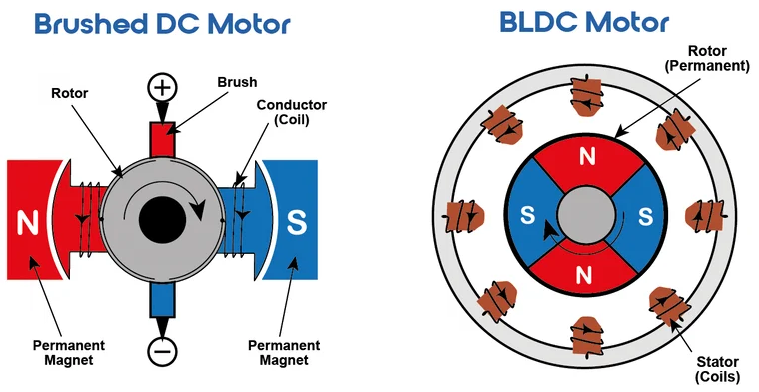
Image Credit: Fluid Metering, Inc.
Comparative analysis: Effects on pump performance
1. Lifespan & maintenance
- Brushed: Brushes wear out over time, making replacement necessary and lengthening downtime.
- Brushless: Practically maintenance-free; bearings are the only parts that face wear and tear.
2. Control precision
- Brushed: Speed varies with load; requires closed-loop feedback for precision.
- Brushless: Delivers precise speed and position control, particularly with stepper motors.
3. Noise & EMI
- Brushed: Mechanical contact enables electrical noise and audible buzzing.
- Brushless: Smooth operation with low EMI, optimal for lab settings.
4. Efficiency
- Brushed: Energy lost as heat from contact resistance and friction.
- Brushless: Higher efficiency, cooler operation, and superior thermal stability.
5. Complexity & cost
- Brushed: Simple electronics; less cost upfront
- Brushless: Needs a controller; elevated initial cost that is offset by long-term reliability.
Use case examples: Performance dictates fit
Knowing each motor’s strengths helps when clarifying selection. Brushed motors are ideally suited for durable, low-cost portable devices that run continuously without sophisticated control needs.
These needs include field sampling pumps, basic dosing units, and disposable devices. Their simplicity and affordability mean that they are ideal for rugged settings where uptime is more important than fine-tuned precision, and where maintenance intervals are possible.
At the same time, brushless motors work best in OEM systems where maintenance is not always possible, and stringent performance criteria should be met over time with consistency. This includes sophisticated lab equipment, pharmaceutical metering systems, and automated diagnostic platforms.
Here, the brushless motor's precise control, lengthy lifespan, and quiet operation mean higher accuracy, more system stability, and reduced ownership costs.
Fluid Metering’s motor integration strategy
At Fluid Metering, brushless stepper motors are the gold standard thanks to their strong fluid displacement capabilities and high-quality, low-maintenance operation. These motors fuel many of Fluid Metering's signature valveless piston pumps, where each motor revolution correlates with a fixed fluid volume. This step-based dosing guarantees superior repeatability.
By steering clear of mechanical commutation, Fluid Metering gets rid of wear-prone parts, producing pumps and motors that are ideal for, but not constrained by, pharmaceutical, analytical, and biotech use cases. This choice is symbolic of a performance-first mindset: long life with easy operation and dependable metering and dispensing.
Conclusion
Both brushed and brushless motors are useful in different contexts, each carrying distinct advantages according to application needs. When it comes to microfluidics, engineers should consider the trade-offs between simplicity and precision, cost and control, and serviceability and longevity.
Brushless motors, especially the stepper variant, offer incredible performance in terms of both accuracy and durability, making them the optimal choice for long-term OEM use cases where reliability is crucial. Conversely, brushed motors constitute a reliable solution in low-cost or disposable devices where sophisticated control is unnecessary, and maintenance is acceptable.
Ultimately, there is no one-size-fits-all solution. Fluid Metering offers a range of motor options, including brushed and brushless technologies, to accommodate each use case’s performance, cost, and maintenance needs. Their team of engineers tailors pump-motor pairings to guarantee optimal results according to each specific application.
About Fluid Metering, Inc.
Fluid Metering, Inc is a leading manufacturer of precision fluid control solutions, with a legacy of innovation dating back to 1959. As the pioneer of the first valveless rotating and reciprocating piston metering pump, Fluid Metering has continually refined its technology to meet the evolving needs of advanced applications.
Today, the company specializes in the design and production of high-performance dispensing pumps and metering systems, delivering exceptional accuracy, precision, and reliability across a wide range of industries. ISO 9001:2015 certified.
Sponsored Content Policy: News-Medical.net publishes articles and related content that may be derived from sources where we have existing commercial relationships, provided such content adds value to the core editorial ethos of News-Medical.net, which is to educate and inform site visitors interested in medical research, science, medical devices, and treatments.