Finding it difficult to decide between Fluid Metering pumps and diaphragm pumps? Although both are used in a variety of industries, understanding what makes each distinct can help improve performance, lower maintenance costs, and guarantee fluid handling system reliability.
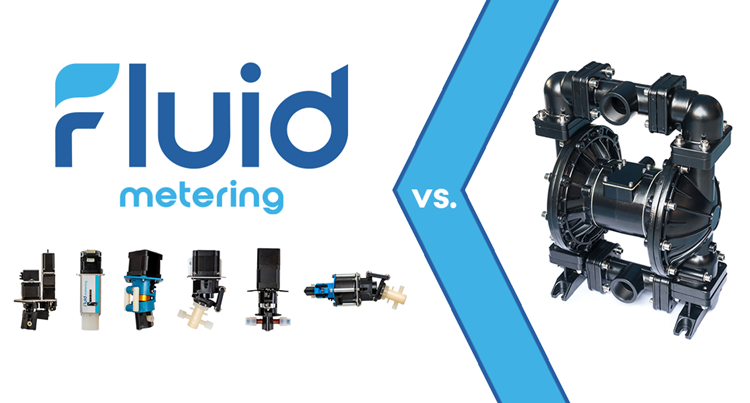
Image Credit: Fluid Metering, Inc.
Key takeaways:
- For valveless piston pumps vs. diaphragm pumps, Fluid Metering’s CeramPump® technology delivers higher precision, more clog resistance, and elevated volumetric efficiency – exactly what is needed for diagnostic, medical, and analytical use cases.
- Different from diaphragm pump options for OEM fluid systems, Fluid Metering pumps make use of viscous and abrasive fluids with ceramic parts that are chemically inert.
- Engineers who want high-accuracy fluid-handling solutions that are easy to maintain benefit from Fluid Metering’s simplified design, which eliminates valves, reduces downtime, and ensures greater reliability in high-throughput settings.
Differences in design
Fluid Metering's rotating, reciprocating piston pumps are valveless and have just one moving part in their fluidic path. This helps them avoid clogging, seizures, downtime, and issues that can ramp up costs.
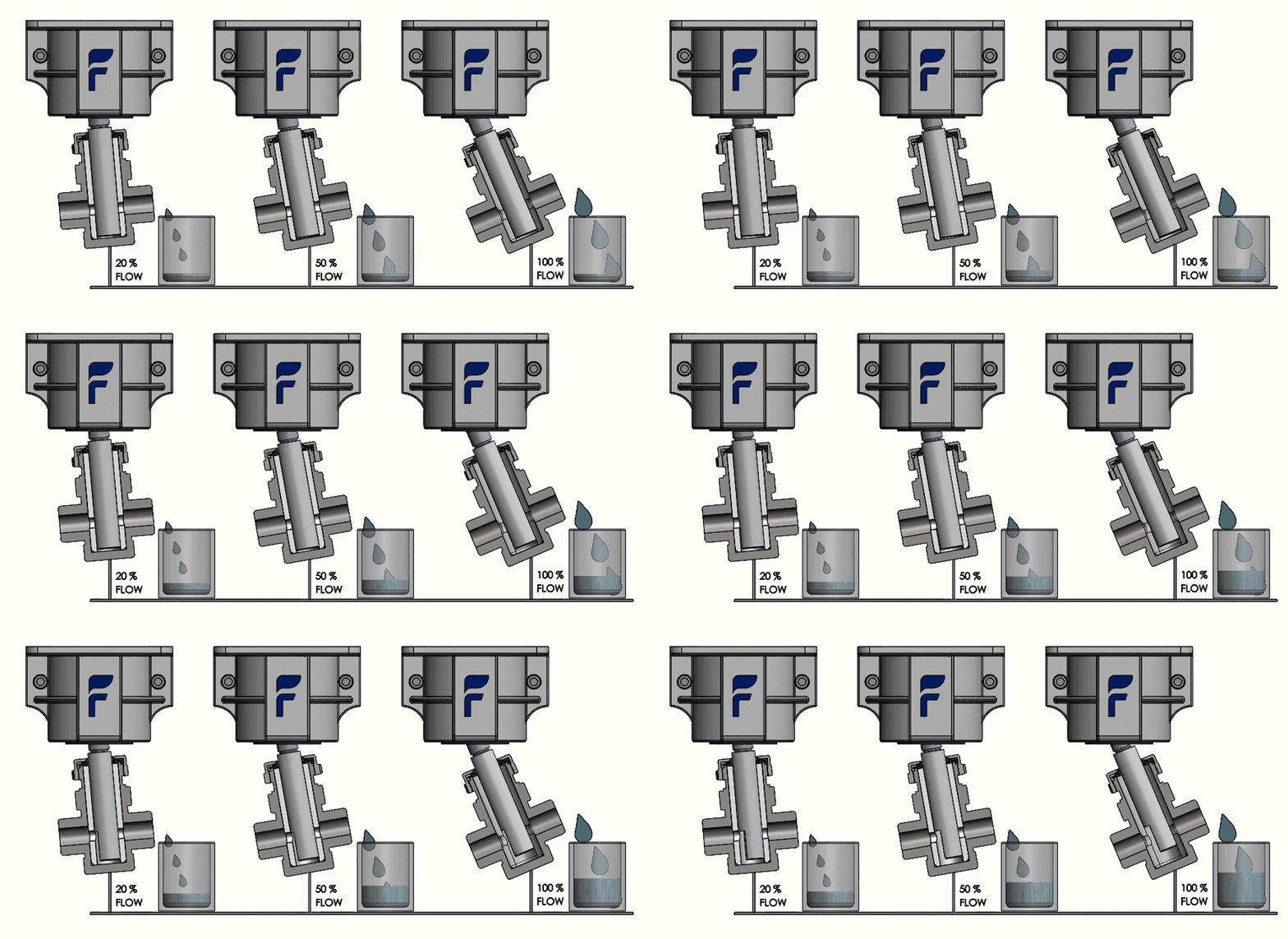
Image Credit: Fluid Metering, Inc.
In contrast, diaphragm pumps depend on passive flapper valves for positive displacement. These pumps are fitted with internal inlet and exit valves that must function correctly for the system to sustain flow. This, however, makes diaphragm pumps susceptible to clogging, particularly when dealing with fluids that contain particulates or crystallizing substances.
For instance, long, stringy particles can get stuck in the valves, leading to blockages. Parts of the manifold system (often plastic) and bottle cap piercings (in blood sample use cases) can also get trapped in the diaphragm pump’s aspiration phase.
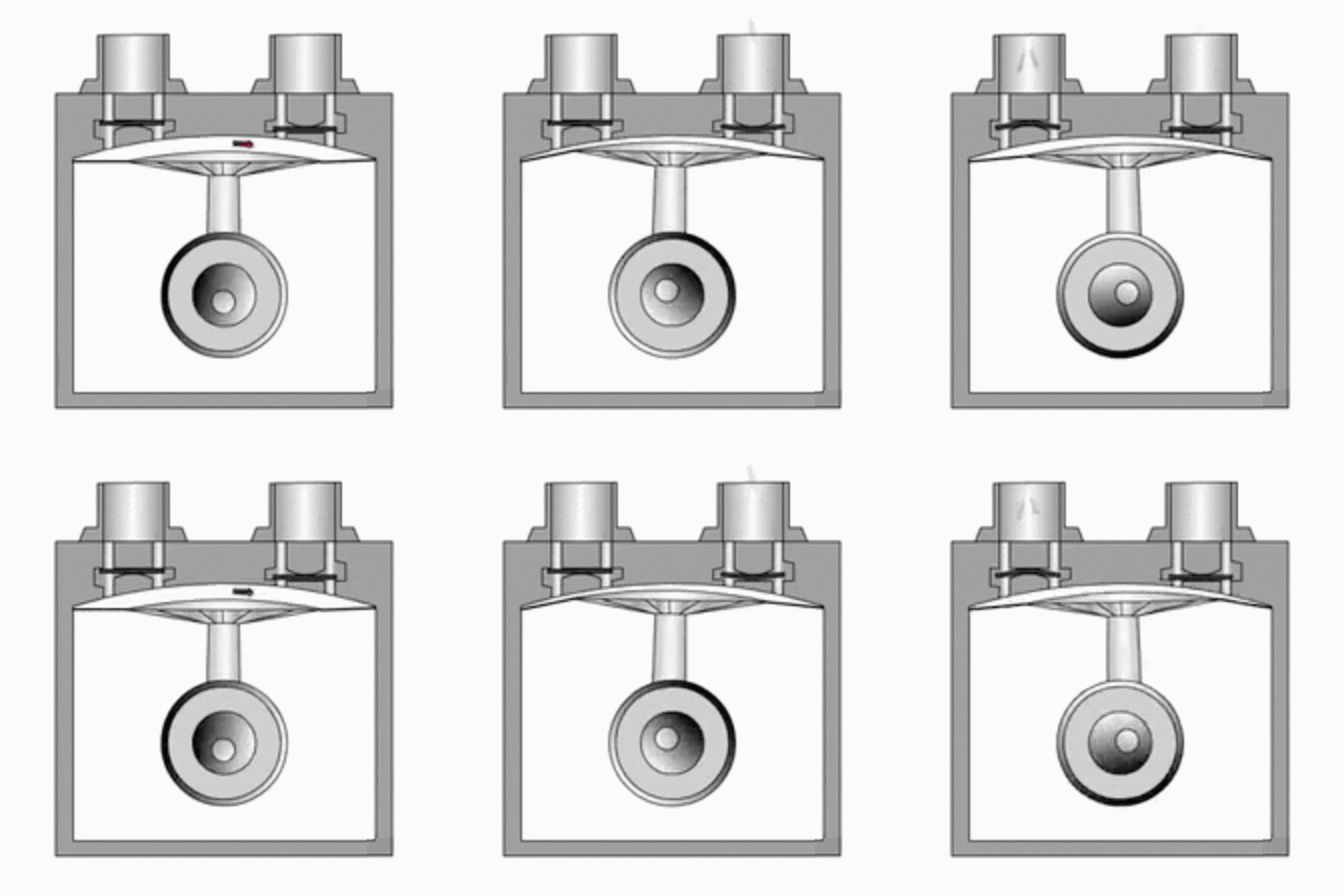
Image Credit: Fluid Metering, Inc.
Functional changes
Although the two pumps are similarly pulsatile in terms of reciprocating, Fluid Metering's CeramPump® valveless piston design has more volumetric efficiency than competitor pumps, and this includes diaphragm pumps. It has a comparatively flat flow rate curve with just a 2-4 % flow rate difference regardless of back pressure.
At the same time, diaphragm, peristaltic, and gear pumps all have a 30-80 % flow rate drop-off with rising back pressure, which leads to lower reliability and a higher chance of performance inconsistencies.
While the two kinds of pumps have similar installation and integration criteria, valveless piston pumps typically utilize stepper motors, which are both more reliable and offer more torque. This is beneficial in use cases that require frequent on/off cycles.
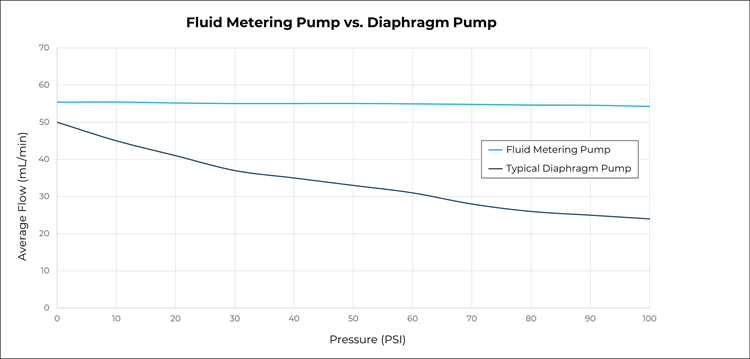
Image Credit: Fluid Metering, Inc.
Fluid handling
Often, diaphragm pump viscosity-handling abilities are maxed out at roughly 150cPs. Fluid Metering pumps, on the other hand, are viscosity-independent, allowing them to handle a broad spectrum of fluids, including highly viscous ones such as peanut butter.
This versatility makes them better suited for a wider spectrum of use cases.
The pump components’ material properties also play a key role in how they perform when exposed to abrasive and corrosive fluids. Fluid Metering pumps are built with chemically inert, dimensionally stable, and abrasion-resistant ceramics that can handle both aggressive and abrasive media without significant wear and tear.
Diaphragm pumps often struggle with these kinds of fluids, which typically lead them to failure prematurely.
Maintenance & lifespan
Diaphragm pumps may need an annual predictive maintenance schedule, including the replacement of passive flapper valves. This difficult task ramps up higher field service charges, increasing the cost of a process that is already both inconvenient and pricey.
The diaphragm itself often forms cracks before it fails, leading to leaks, contamination, and inaccuracies.
Meanwhile, Fluid Metering's valveless piston pumps are built to withstand the instrument’s lifetime*, while maintaining 0.5 % precision without the need for maintenance or recalibration. This significantly reduces costs over time, particularly in use cases that require high throughput.
Applied advantages
Despite their widespread use across industries, diaphragm pumps are typically bound by susceptibility to clogging and breakdowns. Valveless piston pumps overcome these limitations across many use cases, including, but not constrained by:
- Diagnostics & IVD: dispensing reagents into microwells
- Medical: cleaning and purging of pipetting devices; washing needles
- Analytical: chromatography columns
Although diaphragm pumps and Fluid Metering's valveless piston pumps have their place in some settings, Fluid Metering's innovative designs are superior when it comes to efficiency, precision, and long-term reliability, making them the clear solution for multiple industries.
About Fluid Metering, Inc.
Fluid Metering, Inc is a leading manufacturer of precision fluid control solutions, with a legacy of innovation dating back to 1959. As the pioneer of the first valveless rotating and reciprocating piston metering pump, Fluid Metering has continually refined its technology to meet the evolving needs of advanced applications.
Today, the company specializes in the design and production of high-performance dispensing pumps and metering systems, delivering exceptional accuracy, precision, and reliability across a wide range of industries. ISO 9001:2015 certified.
Sponsored Content Policy: News-Medical.net publishes articles and related content that may be derived from sources where we have existing commercial relationships, provided such content adds value to the core editorial ethos of News-Medical.net, which is to educate and inform site visitors interested in medical research, science, medical devices, and treatments.