Cancer research relies on the ability to preserve viable cells and tissues for several reasons: long-term study, therapeutic development, and reproducibility. Cryopreservation is crucial for maintaining the integrity of tumor samples, functional assays, and patient-derived models.
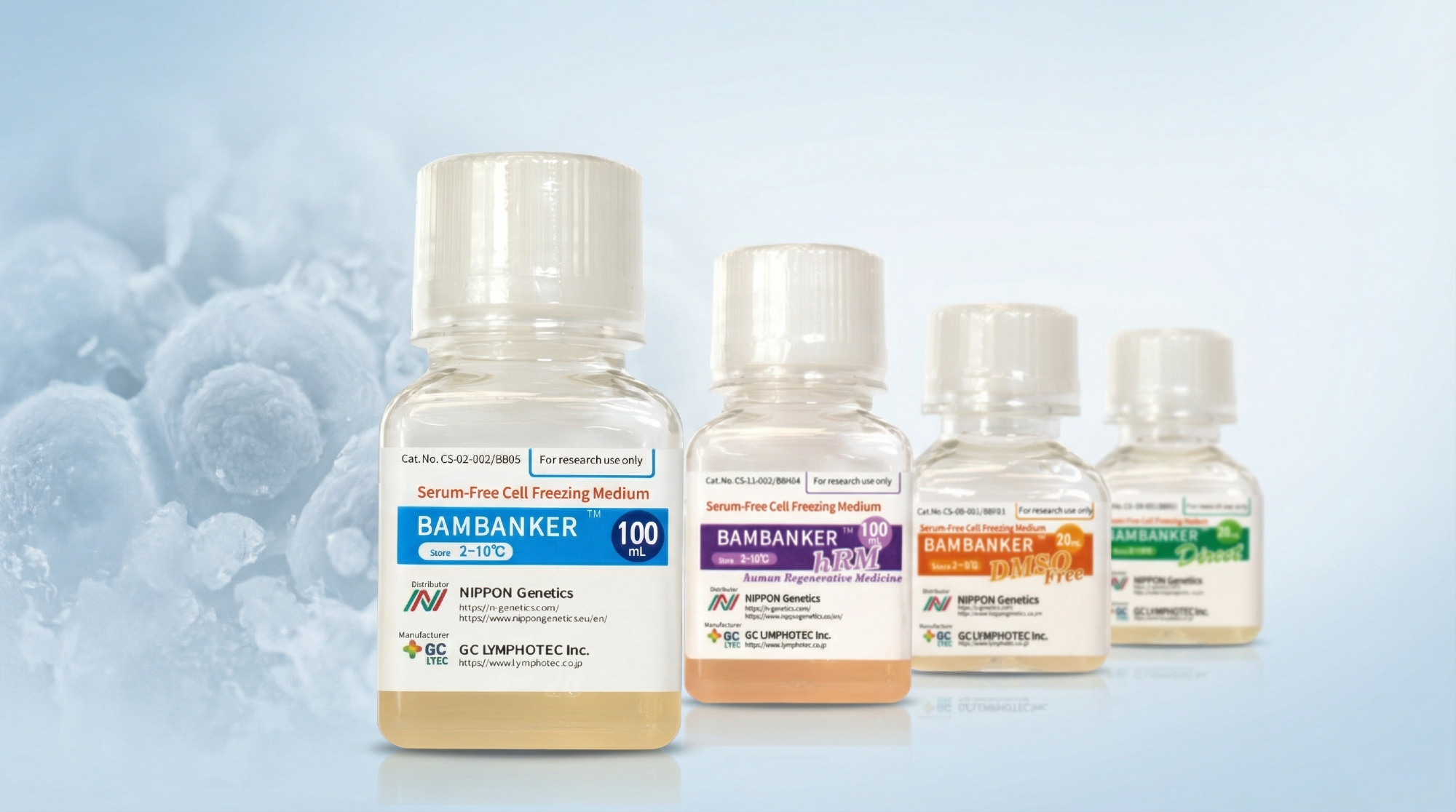
Image Credit: NIPPON Genetics EUROPE GmbH
Bambanker™ is a ready-to-use, serum-free cryopreservation medium increasingly being adopted in oncology research settings for its high post-thaw viability, compatibility with a wide range of sample types, and ease of use.
This article brings together key findings from peer-reviewed publications that used Bambanker™ for cryopreserving cancer cells and tissues, including tumor fragments, organoids, stromal components, and cell suspensions.
This article sets out to inform and guide researchers in selecting effective preservation strategies by outlining how Bambanker™ maintains experimental fidelity and cell viability across a diverse range of cancer research applications.
Literature review: Case studies cryopreserving with Bambanker™
Across multiple studies, Bambanker™ has been consistently shown to support high-viability cryopreservation of diverse cancer samples - including solid tumor fragments, dissociated cells, fibroblasts, organoids, and established cell lines - using straightforward workflows such as slow freezing at –80 °C and rapid thawing at 37 °C. Post-thaw, samples retain key biological characteristics comparable to fresh material, including gene expression profiles, cell-type diversity, and functional activity. This enables seamless use in a wide range of downstream applications, from 2D and 3D culture systems and organoid regeneration to advanced analyses such as single-cell RNA sequencing, flow cytometry, enzyme activity assays, and in vivo tumor modeling. Importantly, Bambanker™ also supports long-term storage, batch processing, and experimental reproducibility, making it a reliable solution for preserving clinically relevant samples and maintaining continuity across complex cancer research workflows.
Table 1. Summary of publications with Bambanker™ used for cryopreservation in cancer research. Source: NIPPON Genetics EUROPE GmbH
| Study |
Sample Type |
Cancer Type |
Applications |
Title |
PubMed ID |
Restivo
et al. 2022 |
Small pieces of human tumor tissue (∼2–3 mm3) frozen in Bambanker cryopreservation medium |
Multiple (melanoma, colorectal carcinoma, basal cell carcinoma;
also breast
cancer tissue) |
2D cell culture; 3D organoid culture; ex vivo tissue culture; single- cell RNA sequencing |
Live slow-frozen human tumor tissues are viable for 2D, 3D, ex vivo cultures and single-cell RNAseq |
36307545 |
| Yasuda et al. 2021 |
Primary CAFs (fibroblasts from gastric tumor tissue) frozen in Bambanker |
Gastric
cancer |
Culture expansion; cytokine-induced senescence; senescence assays |
Protocol to establish cancer-associated fibroblasts from surgically resected tissues and generate senescent fibroblasts |
34136831 |
| Saito et al. 2022 |
Tumor digest (dissociated tumor cells) frozen in Bambanker |
Gastric
cancer |
Immune profiling and cytokine assays via flow cytometry |
Selection of RNA-based evaluation methods for the tumor microenvironment by comparing with histochemical and flow cytometric analyses in gastric cancer |
35595859 |
| Hu et al. 2024 |
∼3 mm3 tumor tissue pieces (patient-derived gastric tumor and ovarian metastasis specimens) |
Gastric
cancer
(ovarian
metastases) |
Single-cell RNA sequencing of tumor microenvironment; primary fibroblast culture and estrogen stimulation assay; cancer cell migration/ invasion assays; in vivo metastasis model |
The estrogen response in fibroblasts promotes ovarian metastases of gastric cancer |
39349474 |
| Sato et al. 2015 |
HepG2 cells (adenovirus-transduced to express CYP3A4) |
Liver (hepatocellular carcinoma) |
CYP3A4 activity inhibition assay (luciferin-based), gene expression & protein analysis |
Development of a highly reproducible system to evaluate inhibition of cytochrome P450 3A4 activity by natural medicines |
26626238 |
| Przystupski et al. 2019 |
SKOV-3 ovarian cancer cells (cryopreserved suspension) |
Ovarian
cancer
(cell line) |
Neutral comet assay for DNA damage analysis after thawing (post-treatment) |
The Cytoprotective Role of Antioxidants in Mammalian Cells Under Rapidly Varying UV Conditions During Stratospheric Balloon Campaign |
31427965 |
| Barnes et al. 2021 |
Patient-derived ovarian cancer cells and stromal cells (from ascites or tumors) frozen in Bambanker |
Ovarian
cancer |
Ex vivo culture expansion and bulk RNA-seq for transcriptional subtype analysis |
Distinct transcriptional programs stratify ovarian cancer cell lines into the five major histological subtypes |
34470661 |
| Seth et al. 2019 |
Patient-derived pancreatic tumor cells (clonal, barcoded) – frozen at early passage (P2) |
Pancreatic
cancer
(PDAC) |
In vitro regrowth of clones; in vivo tumor formation (clonal xenografts); lineage tracing and chemoresistance analysis after thaw |
Pre-existing Functional Heterogeneity of Tumorigenic Compartment as the Origin of Chemoresistance in Pancreatic Tumors |
30726735 |
| Singh et al. 2021 |
NEPC prostate organoids (patient-derived and mouse) – frozen as organoid fragments (post-passage) |
Prostate cancer
(NEPC subtype) |
Revival and expansion of organoids; formation of organoid-derived xenograft tumors in mice; molecular assays on tumors (IHC, RNA-seq) post-thaw |
The long noncoding RNA H19 regulates tumor plasticity in neuroendocrine prostate cancer |
34934057 |
| Chen et al. 2023 |
Murine glioblastoma tumor cells (from the brain of orthotopic GL261 gliomas) – frozen as single-cell suspensions |
Glioma (mouse GBM model) |
Flow cytometry analysis of tumor-infiltrating immune cells and tumor cells after thaw; evaluation of immunotherapy efficacy on thawed samples |
Protocol to assess the antitumor efficacy of an immunotherapeutic peptide in syngeneic orthotopic glioma mouse models |
36861832 |
| Martínez-Sabadell et al. 2022 |
PDX tumor pieces/cells (breast, pancreatic, colorectal, gastric cancers) – frozen after each mouse passage (and optionally pre-implant) |
Multiple solid cancers (PDX models) |
Re-implantation into mice to continue PDX propagation (preserving an immunotherapy-resistant tumor model); comparative in vivo trials and multi-omics on thawed resistant tumors |
Protocol to generate a patient-derived xenograft model of acquired resistance to immunotherapy in humanized mice |
36317178 |
Bambanker™ proves successful for cryopreservation in cancer research
As demonstrated in a variety of studies, Bambanker™ successfully cryopreserves solid tumor tissues and single-cell cancer-derived suspensions, including those from melanoma, glioblastoma, and cancers of the colorectum, breast, prostate, stomach, and pancreas.
Study researchers leveraged Bambanker™ to freeze tumor pieces, organoids, dissociated tumor digests, cancer-associated fibroblasts (CAFs), and genetically modified cell lines, generally without needing a programmable freezer.
After thawing, the cells and tissues were used in a wide array of functional assays, including flow cytometry, senescence modeling, 2D and 3D cultures, enzyme activity assays, scRNA-seq, and in vivo xenograft implantation.
Significantly, studies reported high viability after thawing, consistent functional responses, and minimal loss in gene expression fidelity, compared to fresh samples. This includes recovery of immune and stromal populations for microenvironment analysis, and successful engraftment of patient-derived xenografts.
Conclusion
The Bambanker™ cryopreservation medium provides a reliable, user-friendly solution for preserving cancer tissues and cells across a variety of experimental workflows. Its established performance in preserving cellular viability, functional responsiveness, and transcriptomic integrity post-thaw makes it a fitting choice for preclinical modeling, biobanking, and downstream molecular analysis.
The established literature supports the use of Bambanker™ in basic cancer research and translational applications, delivering reliable sample preservation without the complexity required in conventional cryopreservation protocols.
Download the Accompanying App Note
References
- Restivo, G., et al. (2022). Live slow-frozen human tumor tissues viable for 2D, 3D, ex vivo cultures and single-cell RNAseq. Communications Biology, 5(1). DOI: 10.1038/s42003-022-04025-0. https://www.nature.com/articles/s42003-022-04025-0.
- Yasuda, T., et al. (2021). Protocol to establish cancer-associated fibroblasts from surgically resected tissues and generate senescent fibroblasts. STAR Protocols, 2(2), p.100553. DOI: 10.1016/j.xpro.2021.100553. https://www.sciencedirect.com/science/article/pii/S2666166721002604?via%3Dihub.
- Saito, N., et al. (2022). Selection of RNA-based evaluation methods for tumor microenvironment by comparing with histochemical and flow cytometric analyses in gastric cancer. Scientific Reports, (online) 12(1). DOI: 10.1038/s41598-022-12610-w. https://www.nature.com/articles/s41598-022-12610-w.
- Hu, S., et al. (2024). The estrogen response in fibroblasts promotes ovarian metastases of gastric cancer. Nature Communications, 15(1). DOI: 10.1038/s41467-024-52615-9. https://www.nature.com/articles/s41467-024-52615-9.
- Sato, Y., et al. (2015). Development of a highly reproducible system to evaluate inhibition of cytochrome P450 3A4 activity by natural medicines. Journal of Pharmacy & Pharmaceutical Sciences, 18(4), pp.316–316. DOI: 10.18433/j3vk5g. https://journals.library.ualberta.ca/jpps/index.php/JPPS/article/view/24786.
- Dawid Przystupski, et al. (2019). The Cytoprotective Role of Antioxidants in Mammalian Cells Under Rapidly Varying UV Conditions During Stratospheric Balloon Campaign. 10. DOI: 10.3389/fphar.2019.00851. https://www.frontiersin.org/journals/pharmacology/articles/10.3389/fphar.2019.00851/full.
- Barnes, B.M., et al. (2021). Distinct transcriptional programs stratify ovarian cancer cell lines into the five major histological subtypes. Genome Medicine, 13(1). DOI: 10.1186/s13073-021-00952-5. https://link.springer.com/article/10.1186/s13073-021-00952-5.
- Seth, S., et al. (2019). Pre-existing Functional Heterogeneity of Tumorigenic Compartment as the Origin of Chemoresistance in Pancreatic Tumors. Cell Reports, 26(6), pp.1518-1532.e9. DOI: 10.1016/j.celrep.2019.01.048. https://www.cell.com/cell-reports/fulltext/S2211-1247(19)30066-X?_returnURL=https%3A%2F%2Flinkinghub.elsevier.com%2Fretrieve%2Fpii%2FS221112471930066X%3Fshowall%3Dtrue.
- Singh, N., et al. (2021). The long noncoding RNA H19 regulates tumor plasticity in neuroendocrine prostate cancer. Nature Communications, 12(1). DOI: 10.1038/s41467-021-26901-9. https://www.nature.com/articles/s41467-021-26901-9.
- Chen, A., et al. (2023). Protocol to assess the antitumor efficacy of an immunotherapeutic peptide in syngeneic orthotopic glioma mouse models. STAR Protocols, 4(1), pp.102049–102049. DOI: 10.1016/j.xpro.2023.102049. https://linkinghub.elsevier.com/retrieve/pii/S2666166723000072.
- Martínez-Sabadell, A., et al. (2022). Protocol to generate a patient derived xenograft model of acquired resistance to immunotherapy in humanized mice. STAR Protocols, 3(4), p.101712. DOI: 10.1016/j.xpro.2022.101712. https://www.sciencedirect.com/science/article/pii/S2666166722005925?via%3Dihub.
About NIPPON Genetics EUROPE GmbH
Our contribution to your success – we are committed to ensuring that you can achieve your goals!
NIPPON Genetics EUROPE is a global biotech company founded in 2005 with its own research, development, and production based in Germany. By providing an extensive range of selected and groundbreaking products for the life science sector, we would like to be a reliable partner and contribute to achieving our customers' individual goals. The majority of our employees have a scientific background because we want to understand which problem solutions our customers care about.
Sponsored Content Policy: News-Medical.net publishes articles and related content that may be derived from sources where we have existing commercial relationships, provided such content adds value to the core editorial ethos of News-Medical.net, which is to educate and inform site visitors interested in medical research, science, medical devices, and treatments.