From late-night symptom worries to help with appointments and paperwork, this study shows how people are turning to AI chatbots for far more than simple health facts.
Study: Public use of a generalist LLM chatbot for health queries. Image Credit: Azurhino / Shutterstock
In a recent study published in the journal Nature Health, researchers at Microsoft AI, Redmond, WA, USA, analyzed more than 500,000 de-identified health-related conversations with Microsoft Copilot to characterize what people ask about health.
Health is one of the high-stakes domains about which people ask artificial intelligence (AI) chatbots. Conversational AI, particularly those powered by large language models (LLMs), such as ChatGPT, Copilot, and Gemini, is playing an increasingly important role for many users, ranging from the first point of contact during symptom onset to questions about medications and understanding interactions with healthcare professionals and the health system. Conversational AI represents a major shift in how humans interact with digital technology and information platforms.
Copilot Health Query Study Design
In the present study, researchers analyzed health-related conversations using Microsoft Copilot to characterize what people ask about health. A random sample of conversations with Copilot was drawn daily in January 2026. Each conversation was assigned a general topic, general intent, and a privacy-preserving summary, and conversations classified as “health and fitness” were included in this study.
Further, each conversation was assigned to one of the 12 general health intent categories using an LLM-based classifier. Next, an LLM-based clustering method was applied to a random sub-sample of 10,000 conversations. Each conversation in this sub-sample was annotated with additional attributes. The LLM received about 250 conversation summaries and attributes and grouped them by user journey.
Health Information and Personal Intent Findings
Overall, the analytic dataset included 617,827 conversations classified as health and fitness. The largest health intent category was health information and education, accounting for about 41% of conversations.
This category captured non-personalized health queries, including general nutrition information, causes of medical conditions, and how medicines work. Since some general queries may reflect personal concerns, the true share of personal concerns could be higher, making the reported proportion a likely lower bound.
Moreover, many queries were about specific conditions and treatments rather than general health information, suggesting that people may seek general health information for personal decision-making. Conversations on mobile were more prevalent at night, while those on desktop primarily occurred during the day. The distribution of health intents differed significantly across platforms.
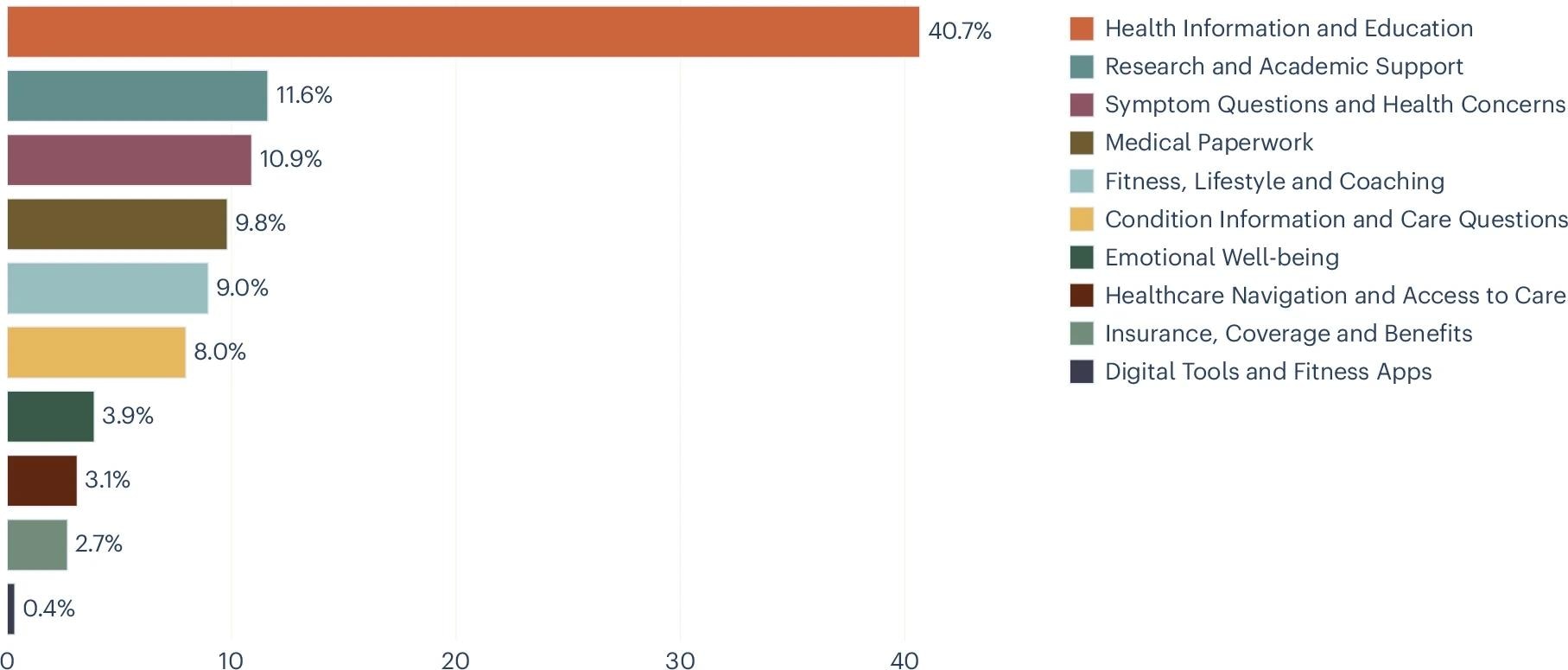
Distribution of health intent usage, in percentage of conversations.
Device Type and Time-of-Day Usage Patterns
Excluding health information and education, which accounted for around 40% on both device types, usage patterns varied between devices. The differences were most notable in terms of personal and professional intent. For instance, academic support and research accounted for 16.9% of conversations on desktop but 5.3% on mobile, whereas symptom questions and health concerns accounted for 15.9% on mobile but 6.9% on desktop.
Stratifying health intents by hour revealed that Copilot use on desktop often occurred alongside other activities, such as research, thesis writing, or paperwork. For example, medical paperwork conversations peaked during working hours, while those related to academic support and research increased throughout the day, especially after school/working hours. Moreover, personal intents increased in the evening or at nighttime, whereas scholarly intents decreased.
The authors noted, however, that these temporal patterns were based on cross-sectional data and could reflect differences in who uses Copilot at different times of day rather than within-person changes alone.
Personal Health Queries and Care Navigation Implications
Finally, the team investigated who the health queries were about using a sub-sample of 2,165 conversations. This sub-sample included three personal intents: emotional well-being, symptom questions and health concerns, and condition information and care questions.
In each category, most questions were about personal concerns; however, 1 in 7 queries was on behalf of others, such as a partner, child, or parent, for symptom questions and condition information categories.
Taken together, the findings reveal distinct patterns of AI engagement for health-related conversations. Personal health queries, especially about symptoms and emotional well-being, increased in the evening and night hours. This pattern of well-being queries is consistent with prior research on a diurnal rhythm in negative affect, in which negative affect tends to be lowest in the morning and increases throughout the day, peaking at nighttime, although the study could not determine whether this reflected changing feelings within the same users or differences between users active at different times.
Nearly one-fifth of conversations involved users describing personal symptoms, test results, or conditions. Further, usage patterns varied substantially by device type. Personal health intents were more common on mobile, while desktop usage mainly included academic support, medical paperwork, and research.
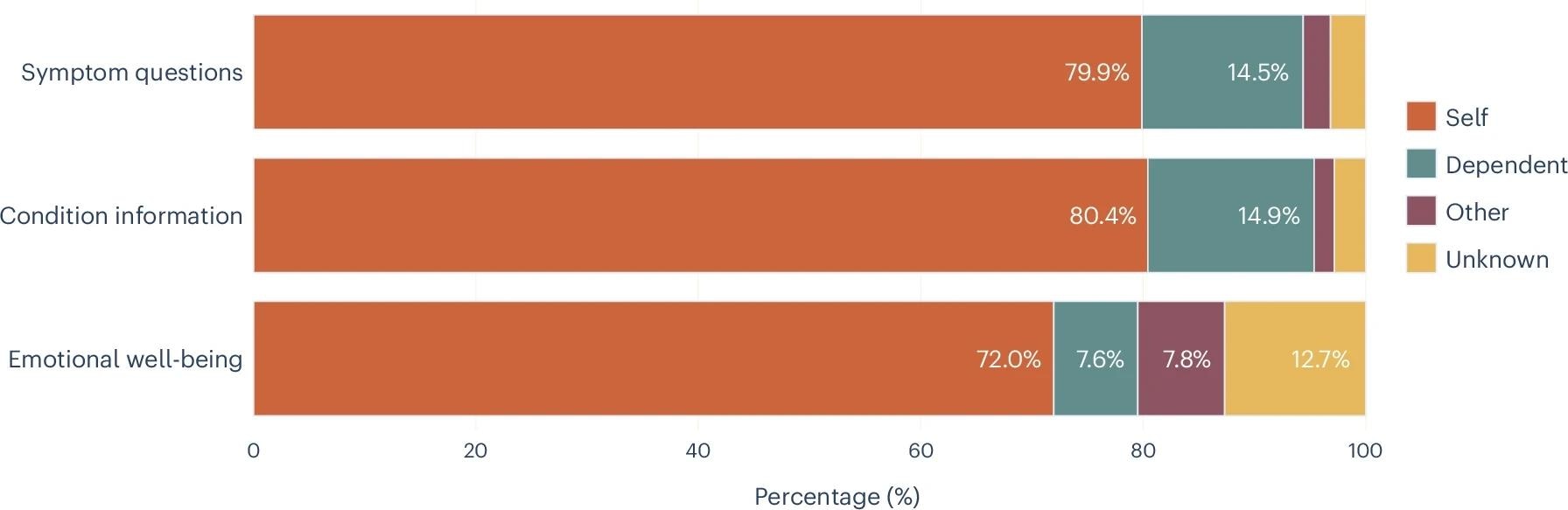
Percentage of conversations on three intents (symptom questions, condition information and emotional well-being) related to the user, a dependent, other or unknown.
The study also found that many users were asking Copilot for help navigating healthcare systems, including finding providers, understanding coverage, and managing appointments or paperwork, suggesting that conversational AI is being used to address administrative friction as well as health questions.
The study has several limitations; first, the analysis relied exclusively on Copilot logs, which reflect a specific platform and user context.
Second, the sample included conversations from a single month; as such, seasonal effects could influence intent distributions.
Third, the study examined only queries, not outcomes, and therefore, whether users sought subsequent care or whether the information received improved their decision-making could not be determined.
Future research should aim to determine whether information provided by conversational AI actually helps users.
Journal reference:
- Costa-Gomes, B., Tolmachev, P., Taysom, E., Sounderajah, V., Richardson, H., Schoenegger, P., Liu, X., Nour, M. M., Spielman, S., Way, S. F., Shah, Y., Bhaskar, M., Nori, H., Kelly, C., Hames, P., Gross, B., Suleyman, M., & King, D. (2026). Public use of a generalist LLM chatbot for health queries. Nature Health, 1-8. DOI: 10.1038/s44360-026-00117-x, https://www.nature.com/articles/s44360-026-00117-x
 Philosophical study redefines moral distress in modern healthcare systems