Proteomics is beginning to reach the level of maturity achieved by genomics 10 years ago. As a result, the upcoming decade of clinical care, diagnostics, and drug development is set to be grounded in proteomics.
Image Credit: Evosep
Summary
In five years, plasma proteomics has expanded by roughly a thousandfold, from research involving a few hundred subjects to studies involving groups of up to half a million. Per-sample coverage has kept pace, with thousands of proteins measured at clinical processing rates on equipment available today.
In mass spectrometry, artificial intelligence (AI) has progressed at a similar pace, but through an alternative approach: extensive pre-trained models that recognize disease signatures, estimate peptide properties, and analyze spectra using datasets that were not yet created when the modern generation of cohorts was being designed.
These dual paths of development are beginning to converge, with implications for how proteomics is used, analyzed, and performed.
Genomes reveal what may occur while proteomes detail what is taking place. AI will convert this functional, shifting output into determinations about biologics, therapies, patients, trials, and targets that emerge from production workflows.
In the coming decade, AI combined with standardized liquid chromatography-mass spectrometry (LC–MS)-based proteomics is expected to serve as precision medicine’s functional measurement layer: the mechanism by which human biology is widely interpreted, hypotheses are produced, drugs are designed and quality checked, and clinical choices are determined.
Multiple prerequisites must be in place for this to occur. In order to develop effective models, AI relies on reproducibility via standardization and high volumes of data. Proteomics requires analytical techniques to be able to learn from billions of spectra and convert them into helpful data points.
The cost per sample must decrease to a level where LC-MS proteomics is not the high-end choice but the routine one. Custom-made processes cannot meet these demands, and affinity panels are only able to fulfill them in part, as practical as they are within their scope.
The necessary changes are LC–MS procedures that generate uniform data across years, equipment, and locations; AI models trained on this type of data; and per-sample costs that are more appealing than affinity-based options.
None of these factors are unusual in isolation. The challenge faced by researchers has been getting them embedded simultaneously. Standardization is the foundational element, which all other aspects rely on.
MS proteomics remains a niche research tool in the absence of substantial comparability. It is effective, but challenging to expand into manufacturing or clinical environments. Uniform measurement is what translates the identical workflow into a system that manufacturing and clinical laboratories can rely on.
Evosep was created to advance precisely this shift.
1. The genomics precedent
Proteomics is experiencing a transition, similar to that recently experienced by genomics. During the 2010s, the costs of sequencing plummeted, datasets became easier to share and standardize, and the AI models trained on that data, initially early genome-wide association studies (GWAS) pipelines and then AlphaFold, had a uniform substrate to build on at last.
Thanks to these advancements, studies that used to take 10 years are now completed in just a few, and human genetic evidence today approximately doubles the probability of clinical success in drug development.1
Proteomics is now following the same trajectory, using an analysis that is in numerous ways more biologically insightful.
For example, the UK Biobank Pharma Proteomics Project (UKB-PPP) used the Olink Explore 3072 affinity-based platform to assess roughly 54,000 volunteers, quantifying ∼2923 unique proteins, and demonstrating that proteomics at population scale could yield meaningful biology at a rapid pace.2
UK Biobank reported an extension of that project in January 2025 to 500,000 volunteers, with an extra 100,000 repeat samples and a goal of quantifying up to 5400 proteins across each of the 600,000 samples using the Olink Explore HT.3 The expanded dataset is projected to become the largest prospective human molecular dataset ever compiled.
However, affinity-based platforms have imposed the analytical ceiling for this data, as they report only what their binders were designed to detect. The next level of proteomic biology, including proteoforms that alter with treatment response or disease state, post-translational modifications (PTMs), and isoforms, rests mostly beyond that limit.
The very relationship that makes the proteome insightful for precision medicine also makes it analytically challenging.
Contrary to a genome that is analyzed once but helpful for life, a proteome must be analyzed continually in a uniform manner across years, instruments, and locations, and at a resolution that can separate proteoforms that might vary by one PTM.
Provided that those requirements are fulfilled, contemporary AI techniques enable analytical opportunities that were not viable even a few years ago. However, if they are not, AI cannot bridge the gap, as the data sets the limits on what is possible to learn.
Image Credit: Evosep
2. AI has arrived in MS proteomics
Historically, machine learning in mass spectrometry (MS) involved comparatively small, specialized models such as classifiers used for rescoring, fragmentation models, and retention-time predictors.
That family of models is now being enhanced, and in a few workflows superseded, by modern foundation models: massive architectures trained beforehand on tens to hundreds of millions of spectra and refined for later tasks. Recent cases include:
- A transformer known as DIA-BERT trained in advance on 276 million peptide precursors (sourced from available data-independent acquisition mass spectrometry (DIA-MS) files) shows a 22% rise in peptide precursors and a 51% rise in protein identifications measured against the standard DIA-NN baseline over five datasets on human cancer.4
Spectral library coverage was once the primary practical constraint on protein identification. Foundation models are beginning to alter this.
- Developed from de novo sequencing data, the Sanders et al. tandem MS model creates data-driven representations of spectra that apply to later tasks in which tagged data has traditionally been limited, covering PTM calling, chimericity detection, and quality prediction.5
- Models that predict peptide properties (MS2PIP, AlphaPeptDeep, Prosit, and later versions)6 have rendered in silico spectral libraries a viable replacement to experimental ones, to the extent that a large number of data-independent analysis (DIA) workflows are now structured around them. In those examples, the analytical technique is itself partially a model.
AI is also advancing earlier in the pipeline into instrument control. iDIA-QC reaches an area under the curve (AUC) of 0.97 for MS faults and 0.91 for liquid chromatography (LC) faults during live quality monitoring.7 Deep visual proteomics (DVP), first produced in the Mann laboratory,8 combines a vision-transformer foundation model with mass spectrometry and laser microdissection.
Working with MD Anderson Cancer Center, the DVP spin-out Resolute Biosciences (formerly OmicVision Biosciences) recently employed the system to identify KRAS G12A peptides in histologically normal pancreatic ducts prior to any visible pathology.9
At present, the DVP pipeline runs on an Evosep Eno paired with an Orbitrap Astral, operating on 40 to 120 samples per day using Whisper Zoom uniform gradients. The fact that this high-profile leading AI-proteomics workflow functions on standardized LC is precisely what is needed when the data must be sufficiently comparable for foundation models to be trained on.
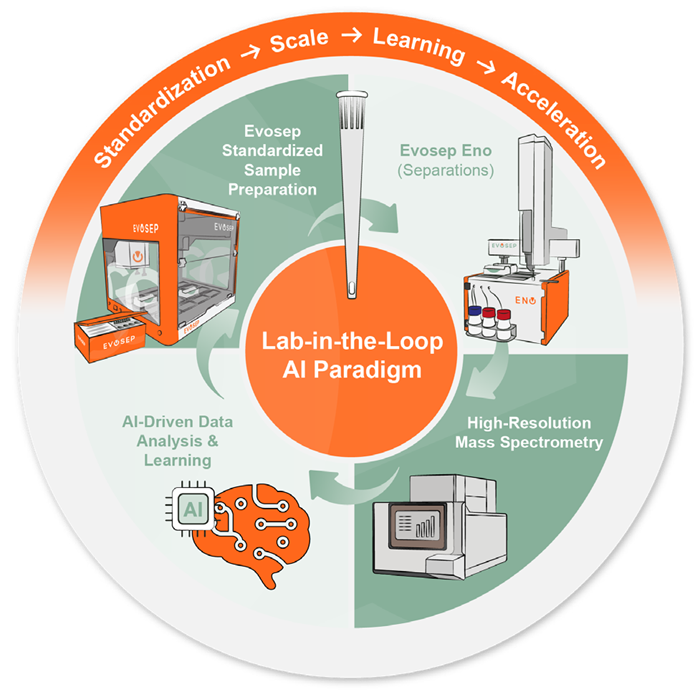
Figure 1. This workflow follows a sample through standardized preparation and LC separation, then into a mass spectrometer for unbiased peptide measurement. AI models interpret the results and feed back into the design of subsequent experiments. Each stage informs the others, and the iteration allows the workflow to learn. Image Credit: Evosep
What proteomics analysis is experiencing closely resembles earlier developments in protein-structure prediction, computer vision, and language modeling: results are now mainly determined by the scale and uniformity of the foundational data, not always by the creativity of the model.
This suggests that funding for data infrastructure may be more important in the coming generation of this discipline than investments in developing algorithms.
3. Standardization is the gating constraint
The foundation models outlined above are only as precise as the spectra they are trained on. The majority of the undesired variation in LC–MS-based proteomics is introduced upstream from MS, during liquid chromatography and sample preparation. The way sample preparation is performed will alter which peptides the MS instrument identifies.
Batch effects and protocol differences can be considerable when uniform and standardized sample preparation is lacking. All types of LC variability become apparent downstream, including sample load variation, gradient irregularity, and retention-time deviation.
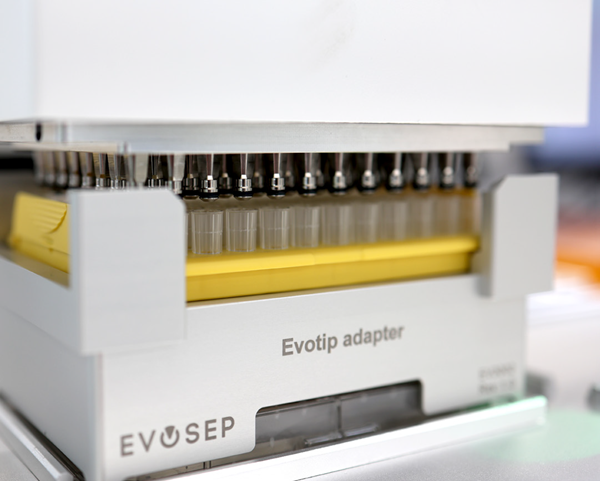
Image Credit: Evosep
No statistical approach can rescue what the mass spectrometer failed to reliably capture to begin with. Evosep describes standardization as a ready-to-use system in which techniques, consumables, and hardware are pre-tuned to operate together from the outset.
This technique turns sample separation and preparation from a variable into a constant, enabling distinct laboratories to obtain equivalent results without the need for hands-on optimization.
Small studies at one site have long managed this variability with rigorous batch design and careful handling; population-level studies are unable to. They last for years, spanning several laboratories, with the type of variability no degree of batch design compensates for.
References and further reading
- Nelson, M.R., et al. (2015). The support of human genetic evidence for approved drug indications. Nature Genetics, 47(8), pp.856–860. DOI:10.1038/ng.3314. https://www.nature.com/articles/ng.3314.
- Sun, B.B., et al. (2023). Plasma proteomic associations with genetics and health in the UK Biobank. Nature. DOI:10.1038/s41586-023-06592-6. https://www.nature.com/articles/s41586-023-06592-6.
- UK Biobank. (2025). Disease prediction and new drugs: Why UK biobank’s huge new protein project matters. Available at: https://www.ukbiobank.ac.uk/research-stories/disease-prediction-and-new-drugs-why-uk-biobanks-huge-new-protein-project-matters/.
- Liu, Z., et al. (2025). DIA-BERT: Pre-trained end-to-end transformer models for enhanced DIA proteomics data analysis. Nature Communications, 16(1), pp.3530–3530. DOI:10.1038/s41467-025-58866-4. https://www.nature.com/articles/s41467-025-58866-4.
- Sanders, J., et al. (2025). Foundation model for mass spectrometry proteomics. arXiv. Available at: https://arxiv.org/abs/2505.10848v2.
- Angelis, J., et al. (2025). Peptide property prediction for mass spectrometry using AI: An introduction to state of the art models. Proteomics, 25(9–10), p.e202400398. DOI:10.1002/pmic.202400398. https://analyticalsciencejournals.onlinelibrary.wiley.com/doi/10.1002/pmic.202400398.
- Gao, H., et al. (2025). iDIA-QC: AI-empowered data-independent acquisition mass spectrometry-based quality control. Nature Communications, 16(1). DOI:10.1038/s41467-024-54871-1. https://www.nature.com/articles/s41467-024-54871-1.
- Mund, A., et al. (2022). Deep visual proteomics defines single-cell identity and heterogeneity. Nature Biotechnology, 40(8), pp.1231–1240. DOI:10.1038/s41587-022-01302-5. https://www.nature.com/articles/s41587-022-01302-5.
-
About Evosep
At Evosep we aim to improve quality of life and patient care by radically innovating how protein based clinical diagnostics are performed, initially through collaborations with world-leading scientists about developing new technologies and solutions to make sample separation 10 times faster and 100 times more robust than todays’ alternatives.
Proteomics is about the study of proteins in a biological mechanism, both their individual function and their combined interactions. For clinical proteomics the goal is to be able to quickly and efficiently compare a biological sample against a profile panel of selected proteins in order to deliver a diagnose / verdict of healthy or diseased (within given statistical margins). Such a profile is typically called a biomarker and for official approval, it must be demonstrated successfully on a large population.
This calls for fast sample processing and because such clinical samples, in the form of blood or biopsies, are much more crude that the relatively clean cell cultures used in basic research, very robust protocols and consumables are also required.
Sponsored Content Policy: News-Medical.net publishes articles and related content that may be derived from sources where we have existing commercial relationships, provided such content adds value to the core editorial ethos of News-Medical.net, which is to educate and inform site visitors interested in medical research, science, medical devices and treatments.