The Quartet® multi-site miniscope offers cellular-resolution imaging of various brain regions in freely behaving animals.
Bruker enhanced the design and operation of their Inscopix miniscopes to allow for imaging of up to four fields of view in a single session. The device uses ultralight, flexible, and electronic-free fiber bundles to monitor neuron subtypes and subpopulations during realistic activity to understand how the brain integrates information across regions.
Only Quartet provides:
- Ultralight and compact fiber endings to image at an angle and in difficult-to-reach regions of the brain
- Four flexible, separately illuminated fibers to image at various depths or fluorophore expression
- A special design that expands free-behavior research applications, such as the water maze and neonates
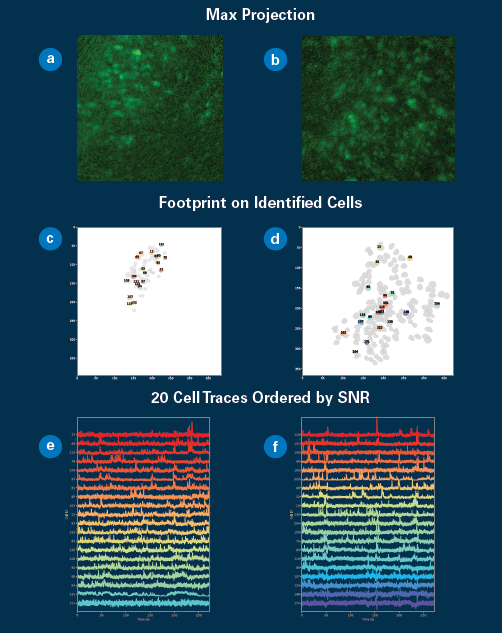
Representative field of view acquired with the Quartet system showing the maximum intensity projection image of: (a) the Anterior Cingulate Cortex; and (b) Hippocampus CA1. Using CNMF-e to extract cells from the image, users obtain the respective cell maps (c-d) and cell traces (e-f). Image Credit: Bruker Nano Surfaces and Metrology
Complete solution for functional insights
Increased flexibility for multi-site experiments
Quartet is a comprehensive solution designed for multi-site imaging in neuroscience research.
The system utilizes individual LEDs to illuminate each fiber independently, enabling researchers to target different brain regions - regardless of their depth or fluorescent marker concentration.
Quartet’s integrated software handles data acquisition, pre-processing, and manual annotation, providing real-time feedback on image quality and experimental success. With support for TTL signals, researchers can synchronize behavioral environments with neuronal activity, making it easier to correlate brain signals with specific actions or responses.
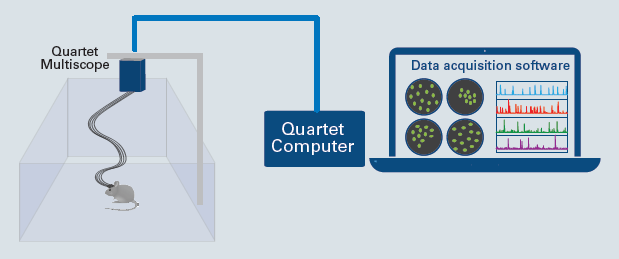
Imaging fibers transfer optical signals to and from the multi-site miniscope as the software enables live image processing. Image Credit: Bruker Nano Surfaces and Metrology
Specialized neurobehavioral applications
The design of Quartet’s imaging fiber bundles offers flexibility across a wide range of behavioral paradigms and animal models.
A magnetic fiber connection and manual focus at the animal’s head make it compatible with water-based experiments, such as the Morris water maze. Its compact connection footprint supports imaging of neighboring brain regions and allows for angled implantation without adding strain to the animal’s neck.
Weighing in at under 2 grams, the device is light enough for use with small animals, including zebra finches and mouse pups, allowing them to move comfortably during experiments.
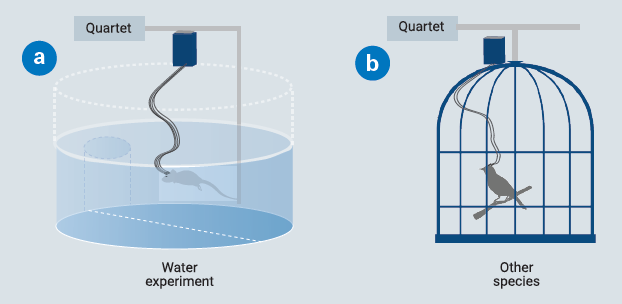
Diverse behavioral paradigms and animal models are now enabled with the Quartet system. a) Morris maze; and b) Multi-site zebra finch experiment. Image Credit: Bruker Nano Surfaces and Metrology
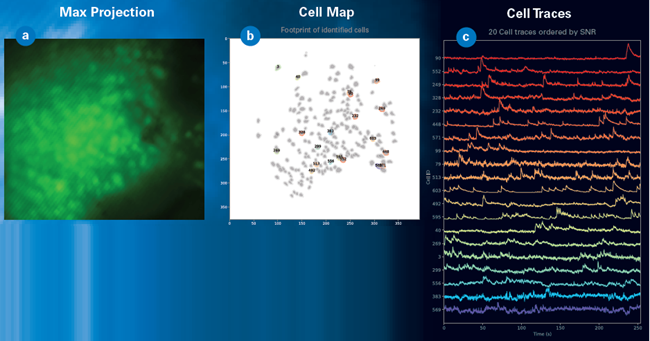
(a) Maximum intensity projection of field of view acquired with Quartet in hippocampus of mouse expressing GCaMP8. Images show relative fluorescence (ΔF/F); (b) Related cell map using CNMF-e automatic cell extraction to identify 203 individual cells in the field of view; and (c) Related cell traces with representative traces showing high signal-to noise-ratio and neuronal depolarization events overtime. Image Credit: Bruker Nano Surfaces and Metrology
Extensive accessories and software
Quartet is compatible with a wide range of surgical tools, including Piccolo® and various GRIN lenses, selected by length and diameter to provide optimal optical access for imaging.
Every Quartet system also includes Inscopix Data Processing Software (IDPS), optimized explicitly for neuronal calcium imaging. The software supports video processing, ROI selection, and calcium trace extraction.
For deeper analysis and collaboration, the data collected can also be imported into the Inscopix Data Exploration, Analysis, and Sharing (IDEAS) platform, which offers an extended suite of analysis tools.
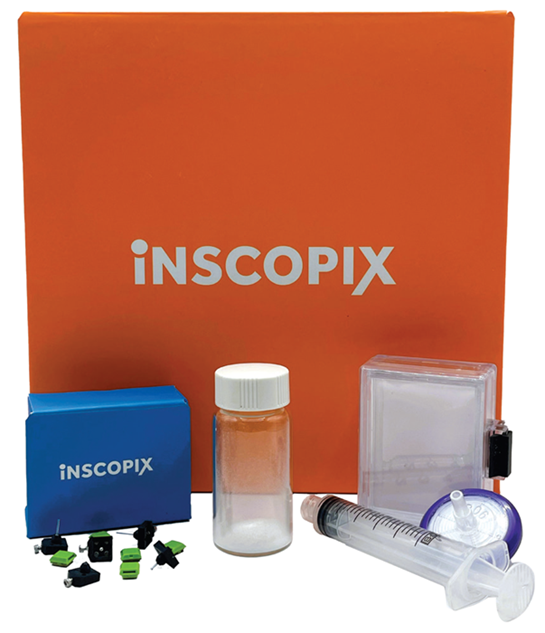
Image Credit: Bruker Nano Surfaces and Metrology
Unmatched scientific support
Quartet users get full access to Inscopix Scientific Support, which includes:
- iQ, a self-paced online learning platform covering system use and best practices
- Field Scientific Consultants, experienced scientists available for surgical training and experimental design review
- Technical Support, with system experts ready to assist with troubleshooting and resolving technical issues
Quartet specifications
Source: Bruker Nano Surfaces and Metrology
| Hardware |
| 4 imaging probes |
| 84 cm imaging fiber bundles |
| 3 cm bending radius (for each fiber bundle) |
| <1.5 g fiber bundle (<1 g carried by animal) |
| 0.5 to 1.0 mm FOV in each region |
| 7 μm fibers, 18,000 individual fibers per bundle |
| 3.2 MP per frame |
| 20 fps in continuous mode |
| 2 m camera electric wire |
| 1.5 m LED wire |
| 470±15 nm illumination wavelength |
| Spectral Characteristics |
| 517±13 nm to 590±20 nm detection wavelength |
| 1.2 mW illumination power at tissue |