Bruker’s xView™ Module for the Ultima 2Pplus multiphoton microscope delivers a major leap in large-scale, high-resolution imaging.
By expanding the field of view by more than 2.5 times the standard area, xView allows researchers to capture neural activity and structural detail across millimeter-scale brain regions without compromising imaging speed or sensitivity.
Designed for cutting-edge neuroscience systems, xView opens new possibilities in brain-wide connectivity studies, circuit mapping, and disease research. It’s also fully compatible with Bruker’s NeuraLight 3D Ultra® Module for holographic optogenetics, enabling simultaneous large-area imaging and multi-site photostimulation.
Together, these tools offer powerful new ways to functionally map and manipulate neuronal networks in vivo.
xView technology features
- Patented ETL compensation: Compatible with the ETL module for correcting aberrations in large FOV scans
- Optogenetics capabilities: Compatible with NeuraLight 3D Ultra SLM
- High-resolution imaging: Up to 8 K × 8 K pixels in galvo mode and 5 K × 5 K in resonant mode with xCore FPGA electronics
- Exchangeable lens sets: FN 28, 36, and 45 mm equivalent for flexible FOV, resolution, and speed trade-offs
Expanding the scale of imaging
xView’s user-exchangeable lens sets give researchers the flexibility to choose the optimal balance between resolution and field of view (FOV) for each experiment.
Traditionally, expanding FOV meant switching to lower magnification objectives, sacrificing resolution due to lower numerical aperture (NA). With xView, that tradeoff is no longer necessary. Researchers can now achieve the wide FOV typical of a 10X objective while retaining the high NA (and high resolution) of a 16X lens.
When operating in large FOV mode, xView leverages Bruker’s patented ETL module, which compensates for resolution loss in real time. This process is tightly synchronized and managed through Prairie View software. In effect, xView redefines the typical limits between resolution, speed, and FOV.
As a field-upgradeable module for the Ultima 2Pplus, xView expands imaging capability to cover broader regions, ideal for tracking cell signaling dynamics across previously inaccessible areas.
It also increases throughput for large tissue scans that once required stitching multiple images. Powered by Ultima xCore FPGA electronics, xView supports frame rates up to the kilohertz range for regional imaging and up to 8K resolution when high-detail acquisition is needed.
Whether your study demands fast acquisition or fine structural detail, xView brings next-level adaptability to the Ultima platform, meeting the needs of advanced neuroscience research as they continue to evolve.
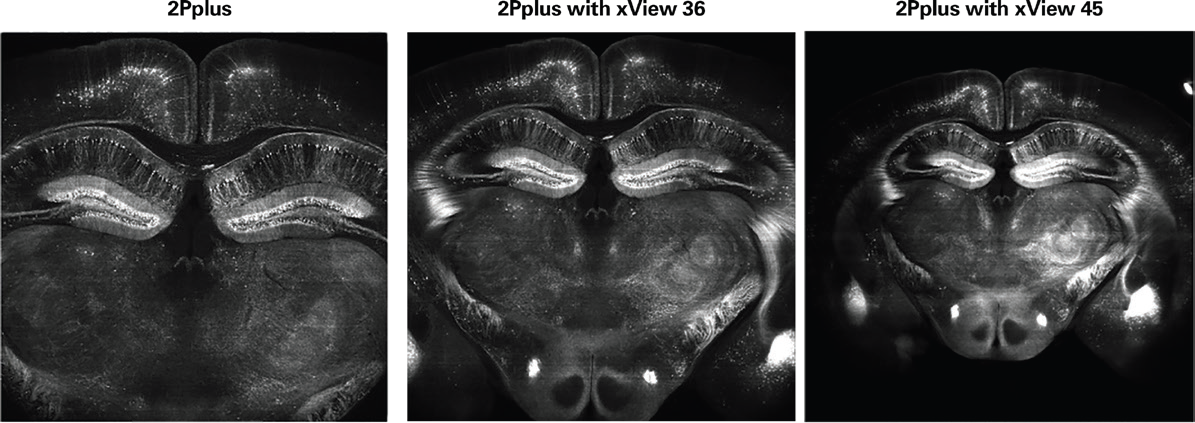
Mouse brain imaged with Ultima 2Pplus and a 4× 0.28 NA Olympus objective using xView 36 and xView 45 lenses, revealing a larger FOV without loss of resolution. Image Credit: Bruker Nano Surfaces and Metrology
Enabling emerging applications
The xView module, together with Ultima 2Pplus or when integrated with other techniques and modules, allows scientists to carry out various neuroscience applications, including:
- Simultaneous 3D optogenetics and large-area imaging for input-output studies
- Whole-tissue montages at enhanced throughput (e.g., with Atlas Imaging software)
- Mesoscale neural circuit mapping with improved temporal and spatial resolution
- Analyzing neural disease pathways (e.g., Alzheimer’s, epilepsy, and Parkinson’s)
- Imaging of 3D cell culture and large organoids
xView specifications
Source: Bruker Nano Surfaces and Metrology
| . |
. |
| FOV Modules |
FN 28, 36, and 45 mm equivalent lens sets |
| Wavelength |
400 to 1300 nm |
| Transmission |
>90% @ 700 to 1100 nm |
| Requirements |
- Ultima 2Pplus microscope
- xCore electronics
- ETL module
- Resonant scanner
|
| Objective Compatibility |
Olympus, Nikon, and other infinity-corrected confocal/multiphoton objectives |
| Objective Threading |
RMS, M25, M27, and M32 |
| Common Objectives FOV* |
- Olympus 20X 1.0 NA
- xView 36: 1.27 x 1.27 mm
- xView 45: 1.58 x 1.58 mm
- Nikon 16x 0.8 NA
- xView 36: 1.77 x 1.77 mm
- xView 45: 2.2 x 2.2 mm
- Nikon 10x 0.5 NA
- xView 36: 2.83 x 2.83 mm
- xView 45: 3.52 x 3.52 mm
|
*FOV achievable may be limited by objective aperture.