From SamplixReviewed by Olivia Frost
This article and associated images are based on a poster originally authored by Mette Juul Jacobsen, Anastasios Glaros, Abrahan Hernandez-Hernandez, Anja Mezger, Tina Friis, and Peter Mouritzen and presented at ELRIG Drug Discovery 2025 in affiliation with Samplix ApS, SciLifeLab Karolinska Institute, and Statens Serum Institut.
This poster is being hosted on this website in its raw form, without modifications. It has not undergone peer review but has been reviewed to meet AZoNetwork's editorial quality standards. The information contained is for informational purposes only and should not be considered validated by independent peer assessment.

Introduction
High-throughput functional screening of antibody-secreting cells (ASCs) accelerates antibody discovery, overcoming the slow, labor-intensive limitations of hybridoma and memory B cell screening, and capturing rare, high-affinity clones. Here, we present a new Xdrop protocol that enables rapid functional screening of plasma cells from immunized animals.
With a throughput of over eight million droplets in a few minutes, Xdrop compartmentalizes single cells, along with the antibody discovery assay, inside FACS-compatible droplets.
This approach preserves cell viability, detects secreted antibodies within droplets, and supports direct V(D)J repertoire analysis as well as recovery of antigen-specific cells. With a streamlined, same-day workflow, this method dramatically reduces discovery timelines and enhances the identification of functional antibody candidates.
Xdrop single-cell antibody screening workflow

Image Credit: Image courtesy of Mette Juul Jacobsen et al., in partnership with ELRIG (UK) Ltd.
Antibody discovery assay
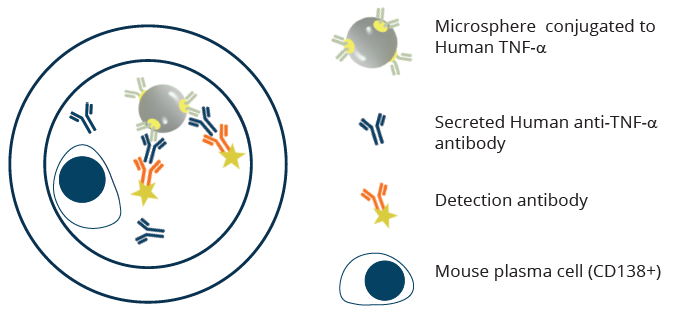
Figure 2. Antibody discovery assay in droplets. Secreted human anti-TNFα-specific antibodies bind to the hTNFα-coated microspheres, allowing fluorescent detection via a labeled goat anti-mouse detection antibody, generating a concentrated and identifiable signal on the spheres. Image Credit: Image courtesy of Mette Juul Jacobsen et al., in partnership with ELRIG (UK) Ltd.
Droplets with encapsulated plasma cells and an antibody discovery assay
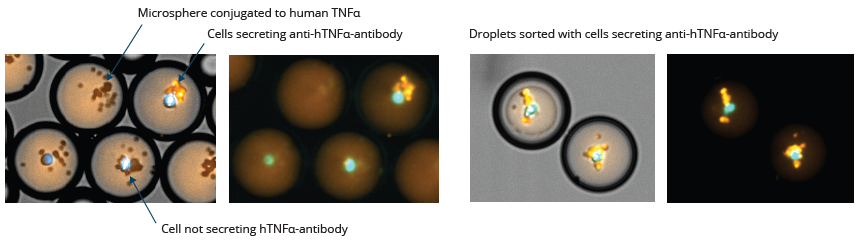
Figure 3. Image of droplets containing the Xdrop ASC screening assay taken with Xcyto®5 (ChemoMetec). For imaging, cells were stained post-droplet production with Calcein Blue, AM. Cells secreting anti-hTNFα-antibodies clearly show an accumulated fluorescent signal on the TNFα-coated microspheres. Image Credit: Image courtesy of Mette Juul Jacobsen et al., in partnership with ELRIG (UK) Ltd.
Sorting of plasma cells in droplets
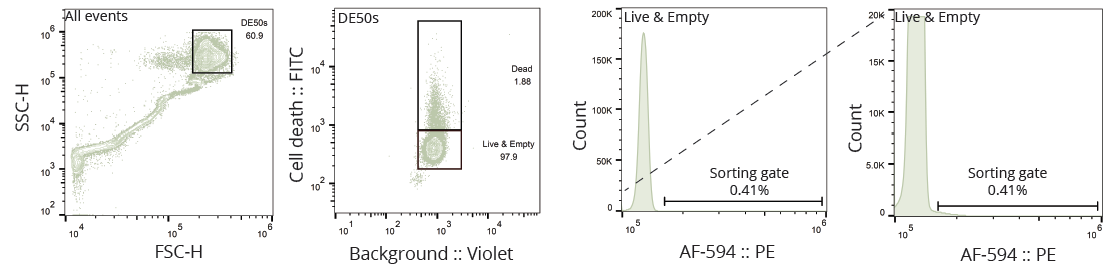
Figure 4. Gating strategy for sorting Xdrop DE50 droplets containing plasma cells sorted on Sony MA900 Cell Sorter with Large Particle Sorting upgrade. The DE50 droplets are identified on a scatter plot. Since only dead cells are labeled, both droplets containing live cells as well as empty droplets are gated. From these, droplets containing plasma cells that secrete anti-hTNFα antibodies clearly show an accumulated fluorescent signal from the AF594-labeled detection antibody. The plot on the far right is a zoom-in. Image Credit: Image courtesy of Mette Juul Jacobsen et al., in partnership with ELRIG (UK) Ltd.
V(D)J sequencing of sorted plasma cells
Table 1. Summary of results of ASC screening in two mice. Source: ELRIG (UK) Ltd.
|
Mouse A |
Mouse B |
| Macs-purified plasma cells (CD138+) |
3,530,000 |
3,640,000 |
| Screened plasma cells |
1,149,418 |
993,906 |
| Sorted droplets with antigen-specific antibodies |
16,449 |
10,048 |
| Obtained single-cell V(D)J sequences |
2,510 |
1,153 |
| Number of clonotypes |
739 |
432 |
| Theoretically obtainable sequences |
7,709 |
4,223 |
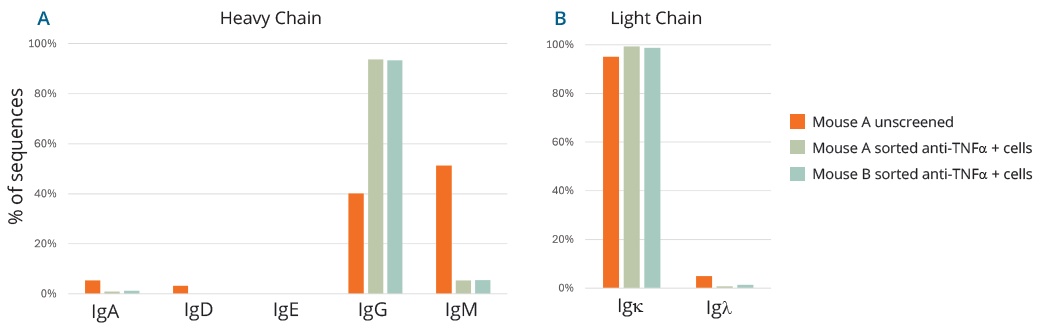
Figure 5. A. Heavy chain isotype distribution showing enrichment of IgG in TNFα-specific ASCs. B. Light chain isotype distribution frequency was uniform as expected. Image Credit: Image courtesy of Mette Juul Jacobsen et al., in partnership with ELRIG (UK) Ltd.
Result of ASC screening
From approximately one million CD138+ B cells screened per mouse, droplets with the strongest TNFα-specific signal yielded ~16,000 (Mouse A) and ~10,000 (Mouse B) sorted droplets (Table 1). V(D)J sequencing produced 2,510 and 1,153 paired sequences, corresponding to 739 and 432 clonotypes, respectively. This represents roughly one-third of each mouse’s plasma cell pool, suggesting over 10,000 sequences could be obtained in total.
Sequencing showed a clear enrichment of class-switched IgG plasma cells within the antigen-specific fraction, whereas the non-screened ASCs displayed a more mixed profile dominated by IgM (Figure 5). This pattern indicates that the screening method preferentially isolates mature, class-switched plasma cells that are likely to secrete high-affinity anti-TNFα antibodies.
Clonotype distribution
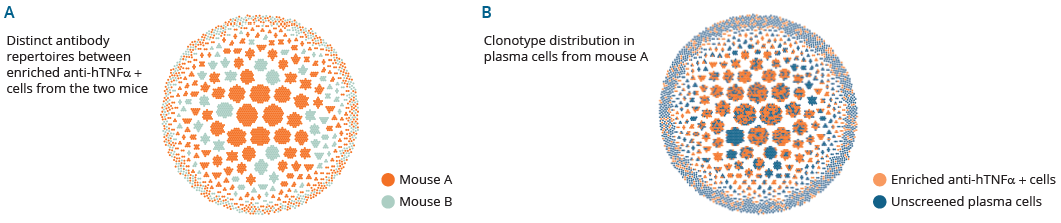
Figure 6. Clonotype distribution plots. Each cluster represents a unique clonotype, with cluster size proportional to its relative frequency within the repertoire. Expanded clonotypes are represented by larger clusters concentrated toward the centre, whereas rare clonotypes appear as smaller symbols at the periphery. A. Enriched anti-hTNFα plasma cells from Mouse A and Mouse B display distinct clonotype repertoires. B. The Xdrop ASC screen enriches specific clonotypes shared with the unscreened population, while others remain dominant only in unscreened ASCs and are not enriched by the screen. Image Credit: Image courtesy of Mette Juul Jacobsen et al., in partnership with ELRIG (UK) Ltd.
Conclusion
This study demonstrates a rapid, one-day workflow for screening and isolating targeted plasma cells based on their secreted antibody specificity, yielding thousands of high-quality V(D)J sequences.
The method effectively enriches for class-switched, antigen-specific clonotypes, enabling focused analysis of functional antibody repertoires. Based on the number of paired V(D)J sequences obtained, it is estimated that over 10,000 sequences can be acquired from the full plasma cell population of the two animals.
About Samplix 
Samplix offers a cutting-edge droplet-based instrument for single-cell analysis in immunotherapy research. Their double emulsion technology enables seamless analysis and sorting on flow cytometers. Empower your research today!
Xdrop encapsulates living cells and reactive molecules in highly stable double-emulsion droplets that act as microenvironments for rapid cell–cell and cell–molecule interactions during incubation. The droplets are suitable for flow cytometry and sorting.
About ELRIG (UK) Ltd.
The European Laboratory Research & Innovation Group (ELRIG) is a leading European not-for-profit organization that exists to provide outstanding scientific content to the life science community. The foundation of the organization is based on the use and application of automation, robotics, and instrumentation in life science laboratories, but over time, we have evolved to respond to the needs of biopharma by developing scientific programs that focus on cutting-edge research areas that have the potential to revolutionize drug discovery.
Comprised of a global community of over 12,000 life science professionals, participating in our events, whether it be at one of our scientific conferences or one of our networking meetings, will enable any of our community to exchange information, within disciplines and across academic and biopharmaceutical organizations, on an open access basis, as all our events are free of charge to attend!
Our values
Our values are to always ensure the highest quality of content, that content will be made readily accessible to all, and that we will always be an inclusive organization, serving a diverse scientific network. In addition, ELRIG will always be a volunteer-led organization, run by and for the life sciences community, on a not-for-profit basis.
Our purpose
ELRIG is a company whose purpose is to bring the life science and drug discovery communities together to learn, share, connect, innovate, and collaborate on an open-access basis. We achieve this through the provision of world-class conferences, networking events, webinars, and digital content.
Sponsored Content Policy: News-Medical.net publishes articles and related content that may be derived from sources where we have existing commercial relationships, provided such content adds value to the core editorial ethos of News-Medical.net, which is to educate and inform site visitors interested in medical research, science, medical devices, and treatments.
Last Updated: Dec 19, 2025