This article and associated images are based on a poster originally authored by Gary Wu, Anna Hopkins, Jason Pembroke, Megan Ashley, Ausra Jablonskyte, Coral Munday, Alicia Galvan Alvarez, Christopher Matheson and Andrew Ratcliffe and presented at ELRIG Drug Discovery 2026 in affiliation with Domainex Ltd.
This poster is being hosted on this website in its raw form, without modifications. It has not undergone peer review but has been reviewed to meet AZoNetwork's editorial quality standards. The information contained is for informational purposes only and should not be considered validated by independent peer assessment.

Fragment-based drug discovery has been increasingly used for providing novel leads for biological targets. Covalent fragment-based studies by mass spectrometry (MS) have been shown to be a powerful tool, demonstrated by the discovery of KRAS(G12C) inhibitors. Here we describe our LC-MS workflows, which we can utilize to screen covalent fragment libraries (including our in-house covalent fragment library), enabling identification and characterization of both irreversible and reversible covalent fragments.
Covalent fragment screening by LC-MS
- Following method optimization, the target protein was incubated with pools of fragments for 18 hours at +4 ºC, covalent binding measured by rapid intact LC-MS under denaturing conditions.
- Fragment pooling was performed using an automatic sample handler, fragments are pooled into groups of 5 with > 5 dalton mass difference.
- LC-MS data was acquired on a Waters G2-XS Q-ToF, after chromatographic separation on a Waters ACQUITY UPLC Protein BEH C4 VanGuard Pre-column, 300Å, 1.7 μm, 2.1 mm X 5 mm on a Waters Acquity H-Class Plus Bio.
- LC-MS data was analyzed and visualized by an in-house developed data processing pipeline.
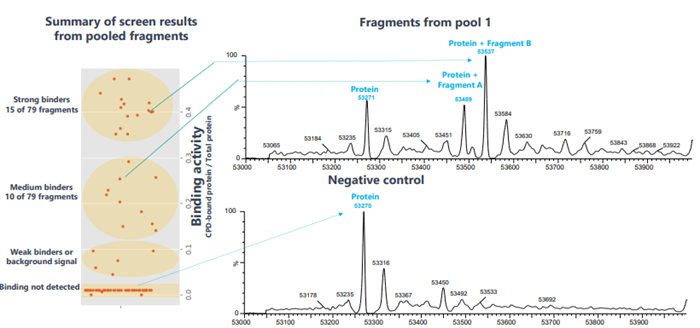
Results generated from the screening of Domainex’s internal covalent library against Transglutaminase 2. Image Credit: Gary Wu et al., in partnership with ELRIG (UK) Ltd.
Routine GSH assay of irreversible covalent fragments
- Identified hits from the covalent screen were assessed for Glutathione (GSH) reactivity in real time by LC-UV-MS.
- Glutathione half-life gives an indication of the intrinsic reactivity of the warhead with readily available cysteines.
- Compounds with high reactivity (T1/2 < 100 minutes) are unlikely to exhibit desirable drug properties and were discarded at this stage.
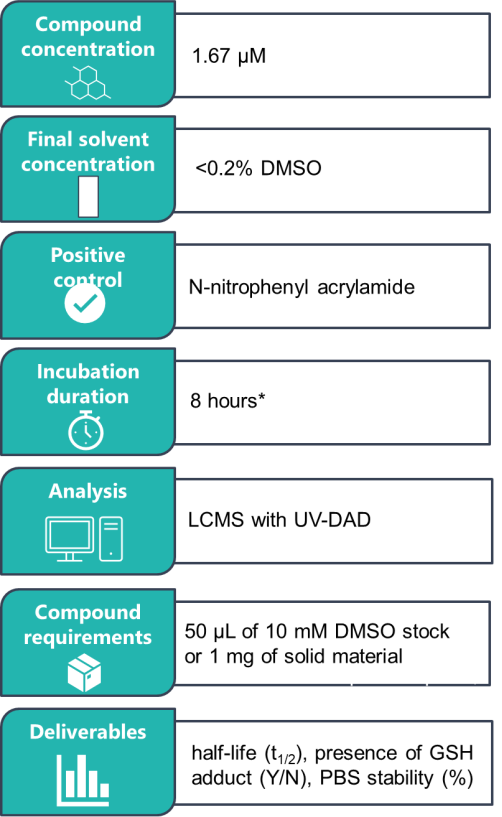
Image Credit: Gary Wu et al., in partnership with ELRIG (UK) Ltd.
Table 1: GSH assay results for the 10 fragments identified as strong binders against Transglutaminase 2.
| Fragment |
T1/2 |
PBS Stability (% remaining) |
| A |
>5000 |
110 |
| B |
>5000 |
117 |
| C |
2923 |
109 |
| D |
>5000 |
110 |
| E |
>5000 |
114 |
| F |
1023 |
114 |
| G |
1118 |
113 |
| H |
148 |
110 |
| I |
>5000 |
106 |
| J |
473 |
114 |
GSH assay results for the 10 fragments identified as strong binders against Transglutaminase 2. Image Credit: Gary Wu et al., in partnership with ELRIG (UK) Ltd.
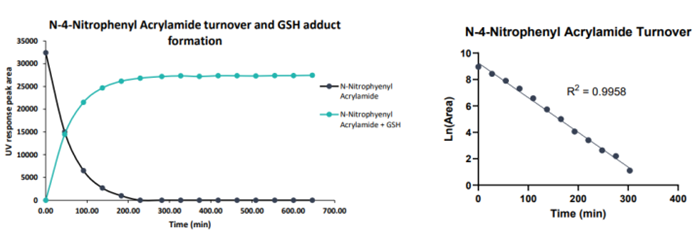
Exemplar real-time data generated for the assay control compound N-4-Nitrophenyl Acrylamide. Image Credit: Gary Wu et al., in partnership with ELRIG (UK) Ltd.
Novel GSH assay to confirm reversible covalent fragments
The covalent bond between the fragment and GSH is reversible and fragment-GSH adduction reaches an equilibrium point, which can be detected by real-time LC-MS analysis
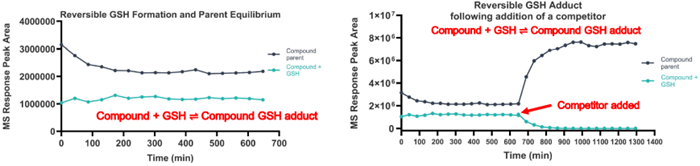
Exemplar real-time data generated for a reversible covalent fragment binding to GSH. Image Credit: Gary Wu et al., in partnership with ELRIG (UK) Ltd.
After the reversible binding reaches its equilibrium point, a known irreversible competitor is added, and the dissociation of the fragment-GSH adduct is detected by LC-MS
Binding site identification
- Fragments of interest were individually incubated with the target protein using previously optimized conditions.
- The samples were then denatured with urea, reduced with TCEP, alkylated with IAA and digested overnight at +37 ºC with trypsin.
- Data acquisition was performed on a Xevo G2-XS Q-ToF in data-independent acquisition mode (MSe).
- Data processing was performed within waters UNIFI Peptide Mapping software.
- MS/MS data can be used to identify the exact amino acid residue involved, allowing binding site identification to be achieved even when multiple cysteines are present within the peptide.
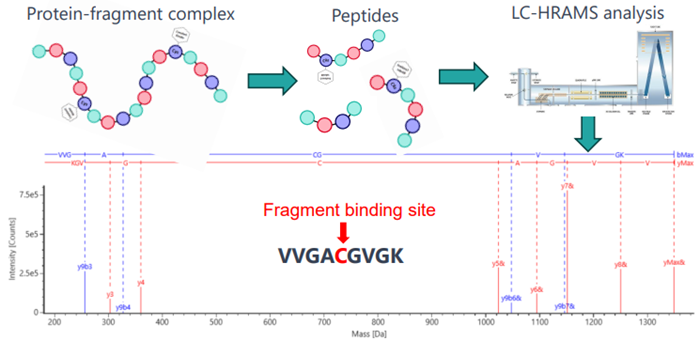
MS/MS Spectra identifying the location of Sotorasib binding with KRAS-G12C. Image Credit: Gary Wu et al., in partnership with ELRIG (UK) Ltd.
kinact/KI for irreversible covalent binding kinetics
- Covalent inhibition is time-dependent, so the preferred measure of potency is the second-order rate constant kinact/KI , rather than IC50.
- Selected fragments were individually incubated with 0.1 μM of target protein at a range of concentrations, samples were injected at various time points and the percentage of binding was calculated at each time point via intact LC-MS analysis.
- The resulting data points were then plotted to generate kobs and kinact/KI plots.
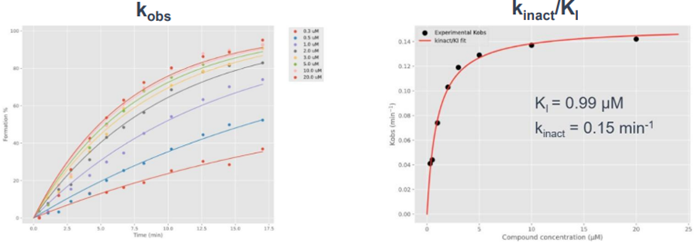
kobs and kinact/KI plots generated for a Domainex compound against a client's target protein. Image Credit: Gary Wu et al., in partnership with ELRIG (UK) Ltd.
Characterization of reversible covalent binding kinetics
kobs and plateau analysis: 2 μM target protein was incubated with 50 μM fragment. The reversible nature of the fragments means the binding does not reach completion as an equilibrium is established; this results in a plateau of the binding curve at a particular point. The binding percentage at each time point was measured by LC-MS. The resulting plot provides information on the adjusted kobs and the percentage at which the binding plateaus.
koff estimation: Once the initial binding had reached a plateau, the remaining non-bound fragment was removed from the sample by ultrafiltration. At this point, the initial fragment binding starts to reverse to restore the equilibrium of the system. The decreasing binding percentage over time was measured by LC-MS. The resulting plot was used to estimate the koff rate of the fragment.
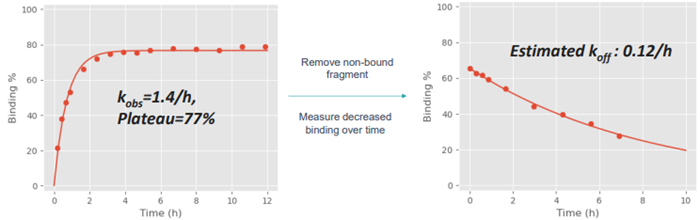
Adjusted kobs and koff plots generated for a Domainex compound against a client's target protein. Image Credit: Gary Wu et al., in partnership with ELRIG (UK) Ltd.
Conclusions
- Domainex LC-MS platform can identify both reversible and irreversible covalent fragments
- Highly reactive warheads of irreversible covalent fragments are triaged out by routine GSH assay
- Reversible covalent fragments are confirmed by a novel GSH assay
- Binding site of selected hits is determined by proteolytic digestion and peptide mapping
- kinact/KI is successfully determined for selected irreversible hits and can be used in combination with routine GSH assay to optimize compound potency of the identified hits
- kobs, % plateau and koff are used for characterization of reversible covalent hits
About Domainex
Domainex is a fully integrated drug discovery CRO based near Cambridge, UK. It serves pharmaceutical, biotechnology, academic and patient foundations globally. Domainex’s drug discovery service business was established in 2001 and since that time has continued to expand to serve a wider range of international clients including UCB, FORMA Therapeutics, St George’s University, and The Institute of Cancer Research.
Our expertise and commitment to providing high-quality services have resulted in a strong success record in drug discovery, delivering an average one candidate drug every year.
Domainex’s highly experienced molecular biologists, assay biologists, medicinal, computational and analytical chemists can be leveraged through our CRO services. Domainex’s focus is on providing highly efficient and well-considered scientific solutions to enable successful drug discovery programmes against a wide range of drug targets.
Whether your project is at an early stage of drug discovery or has already identified chemical matter, our processes have been shown to result in a 30% time-saving compared to industry standards and use less resource, allowing effective management of your own budget.
About ELRIG (UK) Ltd.
The European Laboratory Research & Innovation Group (ELRIG) is a leading European not-for-profit organization that exists to provide outstanding scientific content to the life science community. The foundation of the organization is based on the use and application of automation, robotics and instrumentation in life science laboratories, but over time, we have evolved to respond to the needs of biopharma by developing scientific programs that focus on cutting-edge research areas that have the potential to revolutionize drug discovery.
Comprised of a global community of over 12,000 life science professionals, participating in our events, whether it be at one of our scientific conferences or one of our networking meetings, will enable any of our community to exchange information, within disciplines and across academic and biopharmaceutical organizations, on an open access basis, as all our events are free-of-charge to attend!
Our values
Our values are to always ensure the highest quality of content and that content will be made readily accessible to all, and that we will always be an inclusive organization, serving a diverse scientific network. In addition, ELRIG will always be a volunteer led organization, run by and for the life sciences community, on a not-for-profit basis.
Our purpose
ELRIG is a company whose purpose is to bring the life science and drug discovery communities together to learn, share, connect, innovate and collaborate, on an open access basis. We achieve this through the provision of world class conferences, networking events, webinars and digital content.
Sponsored Content Policy: News-Medical.net publishes articles and related content that may be derived from sources where we have existing commercial relationships, provided such content adds value to the core editorial ethos of News-Medical.net, which is to educate and inform site visitors interested in medical research, science, medical devices and treatments.
Last Updated: Oct 29, 2026
 Domainex has core intellectual property rights granted for Europe