This poster is being hosted on this website in its raw form, without modifications. It has not undergone peer review but has been reviewed to meet AZoNetwork's editorial quality standards. The information contained is for informational purposes only and should not be considered validated by independent peer assessment.

Contracted research
Screening of drug candidates and other compounds on human and animal muscle organs, including 3D human skeletal muscle, iPSC-derived systems, and neuromuscular junction models. We provide a comprehensive assessment of muscle morphology and function, delivering high-quality data on toxicity and efficacy.
Research and development
Development of bespoke assays to enable drug discovery against specific modalities, including disease, exercise, injury, and rehabilitation.
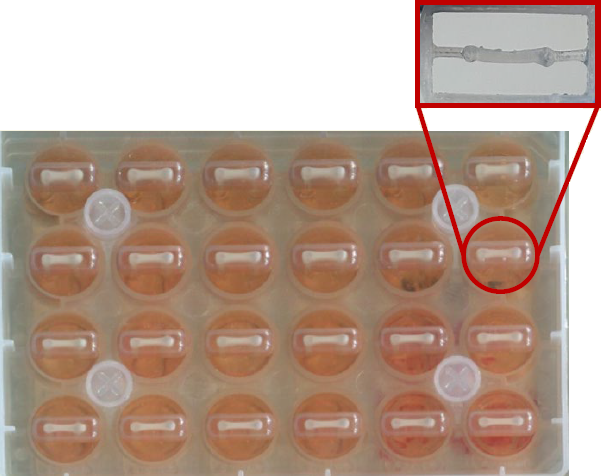
Image Credit: Myomaker Bio
Muscle organs
- 3D human-derived muscle organs
- Designed for bespoke preclinical assays
- Organs are cultured in multi-well plate format
Validation of pharmaceutical agents including:
- Barium Chloride
- Leucine
- d-tubocurarine
- Insulin
- Resolvin E1 (RvE1)
- Testosterone
Organ cell types:
- Human: Primary, cell line and iPSC
- Animal
- Rodent (rat, mice)
- Small mammal (rabbit)
- Other: Zebra Fish
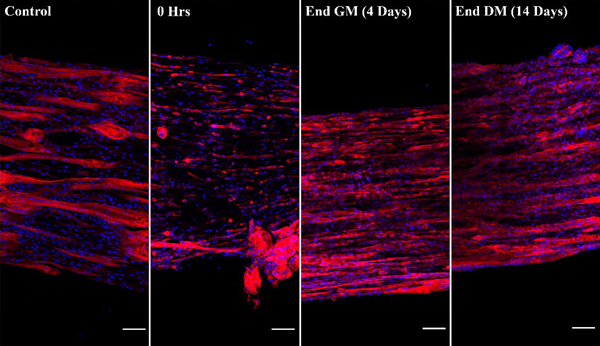
Myomaker organ 1: Chemical injury has been modelled using barium chloride, cardiotoxin and tubocurarine. Barium chloride ablates muscle fibres (left), this injury is followed by regeneration. Image Credit: Myomaker Bio
Neuromuscular organs
- Skeletal muscle organ with functional neuromuscular junctions
- Demonstrated by pre- and post synaptic colocalization
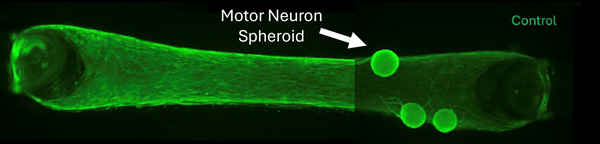
Image Credit: Myomaker Bio
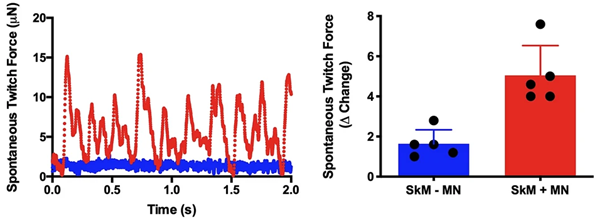
Myomaker organ 2: Spontaneous twitch in muscle organs with iPSC motor neurons (red) and without (blue). Inhibition of acetylcholine receptor in spontaneously contracting neuromuscular tissues demonstrated with the addition of d-Tubocurarine. Image Credit: Myomaker Bio
Model outputs
- Morphology (cryosectioning, immunocytochemistry)
- Functional analysis (evoked and spontaneous contraction)
- Gene and protein expression (inc. RNAseq)
- Media analysis (inc. creatine kinase, lactate)
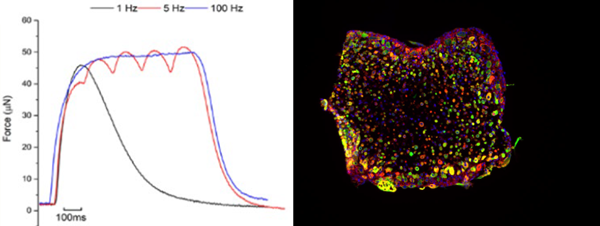
Image Credit: Myomaker Bio
Model development
Muscle organs can be combined with other human cells (including disease modalities) to generate multifunctional organs. Myomaker Bio has extensive experience in the development of novel models for understanding muscle biology.
Models developed:
- Mechanical and electrical loading
- Chemical Injury
- Shockwave Injury
- Metabolic Disease
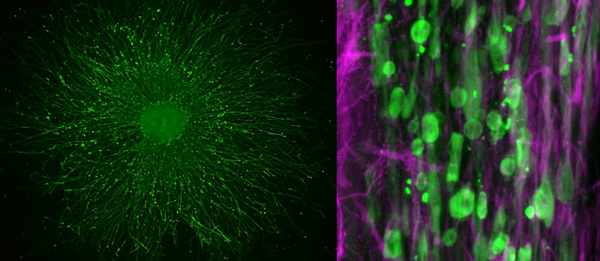
Myomaker Organ 3: Sensory innervated muscle. Image Credit: Myomaker Bio
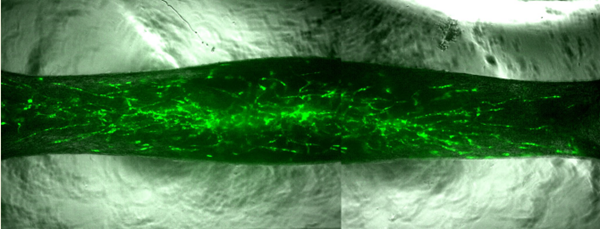
Myomaker Organ 4: Vascularised Muscle. Image Credit: Myomaker Bio
About Myomaker Bio
Myomaker Bio is a spinout from Loughborough University and a recognized leader in muscle biology. The team brings decades of scientific, managerial, and leadership experience, with deep expertise in muscle organ research. Myomaker Bio provides comprehensive support across all stages of drug discovery and development where muscle testing is required.
About ELRIG (UK) Ltd.
The European Laboratory Research & Innovation Group (ELRIG) is a leading European not-for-profit organization that exists to provide outstanding scientific content to the life science community. The foundation of the organization is based on the use and application of automation, robotics and instrumentation in life science laboratories, but over time, we have evolved to respond to the needs of biopharma by developing scientific programmes that focus on cutting-edge research areas that have the potential to revolutionize drug discovery.
Comprised of a global community of over 12,000 life science professionals, participating in our events, whether it be at one of our scientific conferences or one of our networking meetings, will enable any of our community to exchange information, within disciplines and across academic and biopharmaceutical organizations, on an open access basis, as all our events are free to attend!
Our values
Our values are to always ensure the highest quality of content, that content will be made readily accessible to all, and that we will always be an inclusive organization, serving a diverse scientific network. In addition, ELRIG will always be a volunteer-led organization, run by and for the life sciences community, on a not-for-profit basis.
Our purpose
ELRIG is a company whose purpose is to bring the life science and drug discovery communities together to learn, share, connect, innovate and collaborate, on an open access basis. We achieve this through the provision of world-class conferences, networking events, webinars, and digital content.
Sponsored Content Policy: News-Medical.net publishes articles and related content that may be derived from sources where we have existing commercial relationships, provided such content adds value to the core editorial ethos of News-Medical.Net which is to educate and inform site visitors interested in medical research, science, medical devices and treatments.
Last Updated: Dec 1, 2025