Introduction
What Determines Absorption Through the Navel?
Local Effects, Absorption, and Clinical Evidence
Safety Hazards, Risks, & Contraindications
Evidence Gaps & Clinical Recommendations
References
Further reading
From traditional Ayurvedic practice to laboratory studies of skin permeability, navel oiling raises questions about how topical ingredients enter the body and what that means for health.
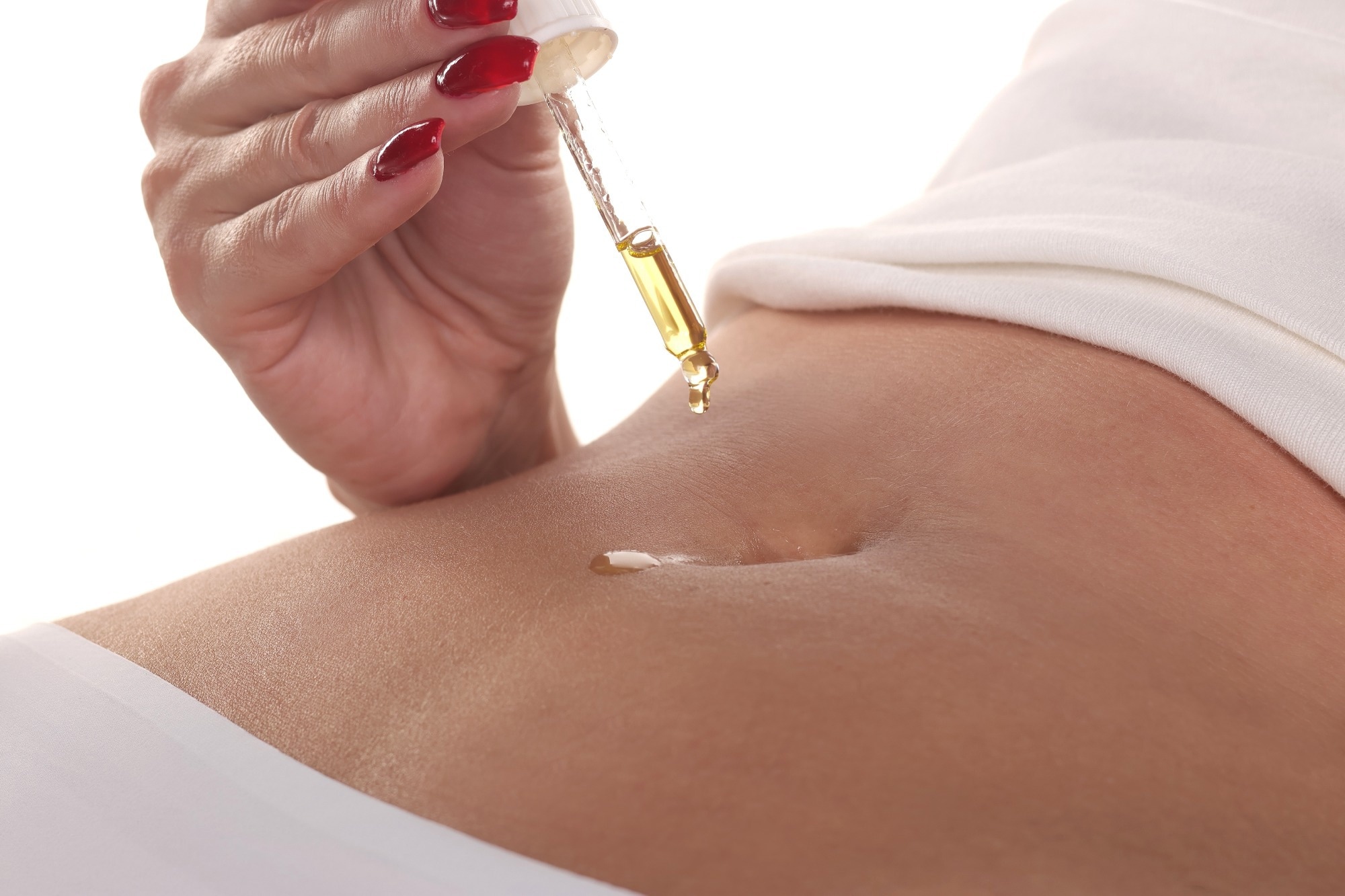 Image Credit: Vladimir Gjorgiev / Shutterstock.com
Introduction
Navel oil pulling has gained popularity for purported benefits ranging from better digestion and sleep to improved skin health, though the scientific basis for these claims remains uncertain. The navel is covered by skin, with the stratum corneum, its outermost layer, the main barrier to substances applied to it. Research into absorption at this site does not demonstrate that ordinary oils reach therapeutic concentrations in the bloodstream.1,2,3
In traditional Indian Ayurveda, Nabhi is classified as a Marma point, or energy junction, that, when stimulated through herbal oils, positively influences energetic channels, or Nadis, to support physical, emotional, and spiritual healing. According to classical texts such as the Charaka Samhita and Sushruta Samhita, the Nabhi is a foundational center from which life energy (Prana) flows, influencing functions such as digestion, metabolism, mood, and sleep.2
Nabhi therapy involves applying herbal oils locally to the navel. Practitioners suggest that stimulating this region may influence the gut-brain axis (GBA), a bidirectional communication network between the gastrointestinal system and central nervous system, potentially affecting digestion, mood, and sleep through vagal and neurotransmitter pathways. These mechanisms remain hypotheses, as no direct experimental data show that applying navel oils stimulates the vagus nerve or changes neurotransmitter levels.2
 Image Credit: Vera Prokhorova / Shutterstock.com
What Determines Absorption Through the Navel?
The umbilicus has a distinctive venous network in which the para-umbilical veins of Sappey connect with the portal system through the round ligament, providing an anatomical basis for investigating umbilical drug delivery, as the portal system carries blood toward the liver. Importantly, these vascular connections alone cannot show how much of a substance crosses the skin or where it travels after absorption.3
Transdermal drug delivery systems (TDDSs) can bypass gastrointestinal absorption and first-pass hepatic metabolism, the liver's processing of an absorbed drug before it reaches systemic circulation. Successful delivery requires a suitable active compound and formulation, as molecular size, lipid solubility, formulation, skin thickness, and contact time influence penetration. Findings from experimental medicinal formulations cannot be extrapolated to ordinary navel oils, whose absorption, delivered dose, and systemic effects remain unestablished.1,4
Local Effects, Absorption, and Clinical Evidence
The potential benefits of navel oil application range from simple local effects to proposed systemic effects. Carrier oils may act as emollients, softening the skin and reducing dryness; however, this local skin-care function provides no evidence of effects on internal organs.1,2,3
Ayurvedic practices have traditionally used medicated oils, ghee, and other lipophilic vehicles around the umbilical region, with these preparations differing in their ingredients and application methods. Gentle abdominal massage may provide relaxation, though this is a separate intervention. Studies combining oil application with touch or warmth need appropriate comparison groups to determine which component accounts for any symptom improvement.2,3
Umbilical skin exhibits greater cumulative penetration and faster permeation than non-umbilical skin. Proposed explanations include differences in the stratum corneum, skin lipids, keratin, and tight junction proteins, which help seal spaces between skin cells.1
Umbilical paste application has also been shown to increase local skin blood flow by activating mast cells, which are immune cells involved in local inflammatory responses. Increased blood flow may help move absorbed compounds from skin tissue into capillaries; however, this finding does not demonstrate symptom relief. Clinical interpretation requires measurements of the amount absorbed, its distribution in the body, and whether concentrations are sufficient to produce the intended effect. Increased permeability alone cannot answer these questions.1
Human clinical research has mainly examined medicinal preparations. Across 33 trials involving 4,490 children with diarrhea, Chinese medicine belly-button applications shortened symptom duration and dehydration recovery time. Notable limitations include poorly described randomization, limited blinding, and varied treatment combinations.4,5
Evidence for digestive, psychological, pain, and menstrual benefits from Ayurvedic navel oils is less readily assessable. Although medicated oil application has been linked to improvements in functional dyspepsia, anxiety, and sleep, it remains unclear whether navel application delivers comparable amounts of active compounds to other application routes.2
 Image Credit: New Africa / Shutterstock.com
Safety Hazards, Risks, & Contraindications
Navel application of medicinal preparations may cause localized irritation, erythema, pruritus, or contact dermatitis. In the chronic-diarrhea review, reported skin reactions were commonly associated with adhesive plasters used to secure herbal preparations.
The childhood-diarrhea meta-analysis reported mild allergic reactions and abdominal pain, but only six of its 33 trials mentioned adverse events. In the chronic-diarrhea review, 349 of 416 reports provided no adverse-reaction information. Incomplete reporting limits conclusions about the frequency and severity of harm.4,5
Reported adverse effects in the chronic-diarrhea review include headache and abdominal distension, though these occurred with medicinal preparations and cannot be assumed to reflect ordinary oil use. Neither review supports a general claim that irritation resolves within 24 hours.
The reviews did not adequately assess burns and bacterial or fungal infections from routine oil use, and their frequency remains uncertain. Thus, missing safety data cannot be interpreted as evidence that these complications do not occur.4,5
People with active skin infections or inflammation at the application site, recent surgery, or known allergies to vehicle components should avoid unsupervised navel oil application. Pregnant individuals should consult their healthcare provider before using medicated preparations. The available evidence does not establish safety in infants or safe dilution rates for concentrated aromatic oils.3,4,5
For people who use navel oils, basic skin care matters more for safety than claims of systemic detoxification. Keeping the navel clean and dry, removing excess oil, and stopping use if irritation develops are precautionary measures, not evidence of therapeutic benefit.3,4
Evidence Gaps & Clinical Recommendations
Nabhi oil therapy has a long history in Ayurveda; however, modern clinical evaluation remains limited. Additional research is needed to characterize absorption through adult umbilical skin and measure whether active compounds reach therapeutic concentrations.
Laboratory studies should distinguish skin penetration from delivery into the bloodstream. Human trials should use clearly defined formulations, suitable controls, and outcomes relevant to the condition being treated, with enough follow-up to assess whether any benefits persist.1,2,3
Researchers should also address the disconnect between social media claims of organ "detoxification" and localized weight loss with verified randomized controlled trials. Standardized protocols need to define formulation and concentration, dosage, frequency, safety precautions, contraindications, hygiene guidelines, and appropriate carrier-oil dilution rates. Active monitoring of skin reactions and other adverse events is needed, rather than relying on the absence of spontaneously reported problems.2,4,5
Ordinary navel oil application remains unproven as a treatment for digestive disorders, anxiety, insomnia, pain, or menstrual irregularities. Research into umbilical drug delivery supports further testing of defined preparations, with clinical benefit and safety requiring direct confirmation in humans.1,2,3,4,5
References
- Yang, C., Peng, X., Shi, Y., et al. (2024). Umbilical therapy for promoting transdermal delivery of topical formulations: Enhanced effect and underlying mechanism, International Journal of Pharmaceutics 652; 123834. DOI: 10.1016/j.ijpharm.2024.123834, https://www.sciencedirect.com/science/article/abs/pii/S0378517324000681
- Warty, C. & Bhagat, A. (2026). Role of Nabhi Oil Therapy in regulating Serotonin and other Neurotransmitters affecting Mood, Sleep, and Digestion, Journal of Ayurveda and Integrated Medical Sciences 11(3):302-311. DOI: 10.21760/jaims.11.3.48, https://jaims.in/jaims/article/view/5640
- Rajurkar, M. (2026). Nabhi poorana (navel filling therapy): classical references, methodology, and evidence-based appraisal of an ayurvedic therapeutic technique. International Journal of Development Research 16(6), 70621-70626. DOI: 10.37118/ijdr.30971.06.2026. https://www.journalijdr.com/nabhi-poorana-navel-filling-therapy-classical-references-methodology-and-evidence-based-appraisal
- Chen, M.-r., Zhao, J., Fu, S.-f., et al. (2019) Clinical practice of Chinese medicine navel therapy for chronic diarrhea: A literature review. Journal of Gastroenterology and Hepatology 34; 643-649. DOI: 10.1111/jgh.14549. https://onlinelibrary.wiley.com/doi/10.1111/jgh.14549
- Bu, Z., Liu, Y., Shahjalal, M., et al. (2023) Comparative effectiveness and safety of Chinese medicine belly button application for childhood diarrhea: a Bayesian network meta-analysis of randomized controlled trials. Frontiers in Pediatrics 11. DOI: 10.3389/fped.2023.1180694. https://www.frontiersin.org/journals/pediatrics/articles/10.3389/fped.2023.1180694/full
Further Reading
Last Updated: Nov 23, 2026