This article and associated images are based on a poster originally authored by Ravinder K. Bhardwaj, Eline Koers, Alexander Krull, David Sykes, Dmitry Veprintsev and Neil V. Morgan and presented at ELRIG Drug Discovery 2025 in affiliation with University of Birmingham and University of Nottingham.
This poster is being hosted on this website in its raw form, without modifications. It has not undergone peer review but has been reviewed to meet AZoNetwork's editorial quality standards. The information contained is for informational purposes only and should not be considered validated by independent peer assessment.

IP receptor physiologically contributes to the prevention of Cardiovascular events
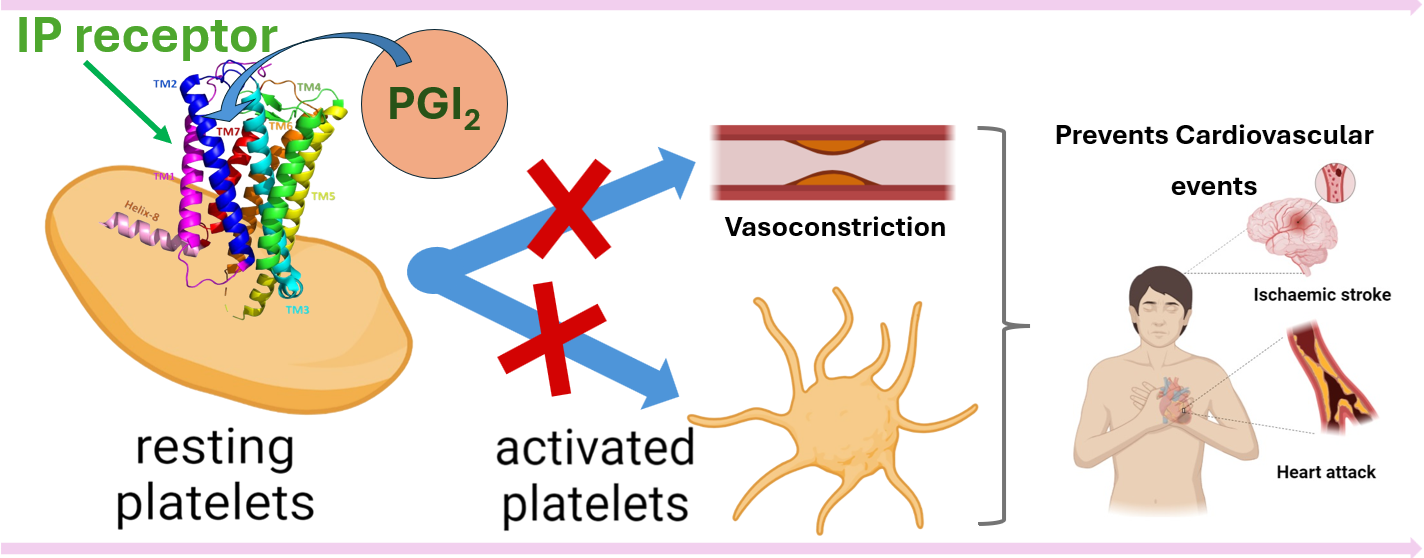
Image Credit: Image courtesy of Ravinder K. Bhardwaj et al., in partnership with ELRIG (UK) Ltd.
Why investigate IP receptors?
- Prostaglandin I2 is an endogenously produced (by blood vessels) ligand for the prostacyclin receptor (IP receptor)
- keeps vessels and platelets in their physiologically required state, that is, dilated and inactive states, respectively (JB Smith, 1981).
- IP receptor is the first and only cell surface receptor on human platelets that prevents platelets from aggregating otherwise may lead to pathological thrombus formation.
- Despite the acknowledgement of their importance in vessels and platelet physiology, the receptor has remained an understudied therapeutic target
- This study has recognised some ultra-rare novel single nucleotide variations (SNVs) in patients with mild bleeding disorders
- Thus, the study aims to develop an assay to investigate the impact of SNVs on receptor binding and interaction with its ligands, receptor folding, structural integrity and signaling
Aims
- To develop an assay to investigate the impact of SNVs on receptor binding and interaction with its ligands, receptor folding, structural integrity and signaling
- To investigate the association of these mutations to abnormal bleeding phenotype observed in patients and explore their role in platelet dysfunction
Methods and experimental setup

Image Credit: Image courtesy of Ravinder K. Bhardwaj et al., in partnership with ELRIG (UK) Ltd.
BRET mechanism in the developed assay
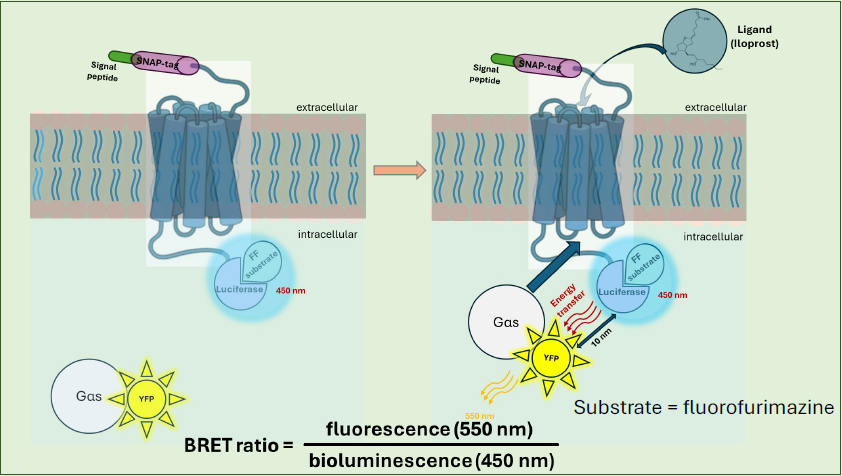
Image Credit: Image courtesy of Ravinder K. Bhardwaj et al., in partnership with ELRIG (UK) Ltd.
Experimental setup (96-well plate-based format)
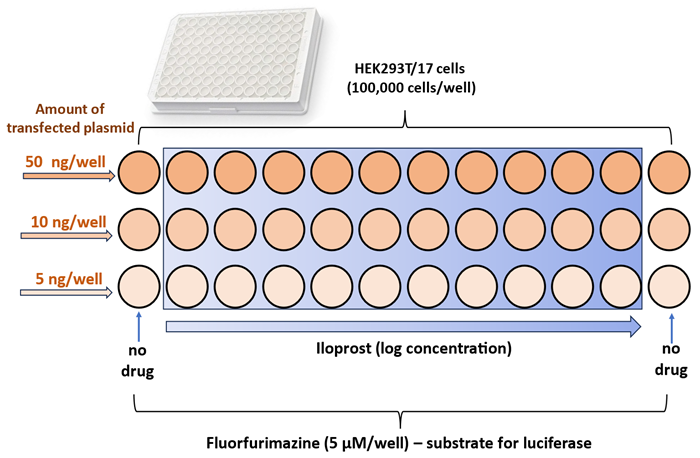
Image Credit: Image courtesy of Ravinder K. Bhardwaj et al., in partnership with ELRIG (UK) Ltd.
miniGs-recruitment (BRET Assay)
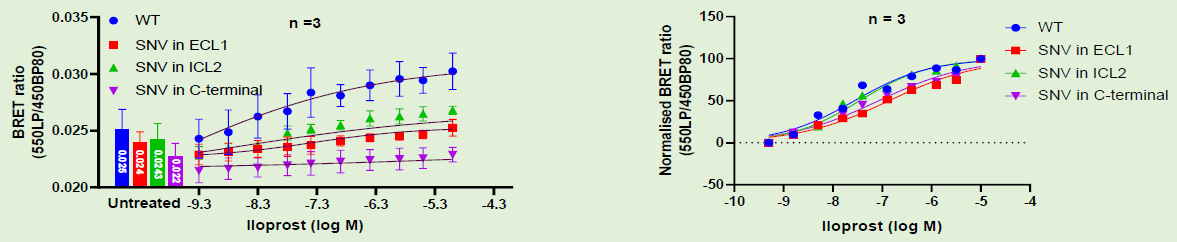
Graphs 1 and 2. SNV in the C-terminal region of the IP receptor seems to be significantly impacting the miniGs recruitment. SNVs in the ELC1 and ICL2 of IP receptor also show reduced recuitment. Image Credit: Image courtesy of Ravinder K. Bhardwaj et al., in partnership with ELRIG (UK) Ltd.
Conclusion
- The IP receptor is functional and is capable of binding to ligand Iloprost
- Receptor is intracellularly capable of forming a complex with miniGsprotein
- Receptor signalling is plasmid transfection amount and Iloprost dose-dependent (n = 3) – data not shown
Future experiments
- Transfect HEK293 cell lines with engineered plasmid and conduct further functional analysis
- Evaluate mutant stability with ThermoBRET or ThermoFRET GPCR assays
- Measure GPCR trafficking to the cell surface (confocal microscopy and AI-driven analysis
- Evaluate ligand binding and signalling properties with TR-FRET and NanoBRET assays
Acknowledgement
- Dr Natalie Poulter
- Dr Steve Thomas
- Natasha Pavey
References
- Watson, S.P. and Harrison, P. (2010). The Vascular Function of Platelets. pp.772–792. https://doi.org/10.1002/9781444323160.ch40.
- Kaye, A.D., et al. (2020). Platelet Dysfunction Diseases and Conditions: Clinical Implications and Considerations. Advances in Therapy, 37(9), pp.3707–3722. https://doi.org/10.1007/s12325-020-01453-4.
- Saboor, M., et al. (2013). Platelet receptors: An instrumental of platelet physiology. Pakistan Journal of Medical Sciences, 29(3). https://doi.org/10.12669/pjms.293.3497.
- Smith, J.B. (2009). PROSTAGLANDINS AND PLATELET AGGREGATION. Acta Medica Scandinavica, 210(S651), pp.91–98. https://doi.org/10.1111/j.0954-6820.1981.tb03638.x.
About the University of Birmingham
For more than a century, the University of Birmingham has pursued and shared knowledge through exceptional teaching and world-leading research.
As the original ‘redbrick’ university and a member of the prestigious Russell Group, the University offers a vibrant academic community, an extensive range of courses, and state-of-the-art campus and research facilities.
About ELRIG (UK) Ltd.
The European Laboratory Research & Innovation Group (ELRIG) is a leading European not-for-profit organization that exists to provide outstanding scientific content to the life science community. The foundation of the organization is based on the use and application of automation, robotics and instrumentation in life science laboratories, but over time, we have evolved to respond to the needs of biopharma by developing scientific programmes that focus on cutting-edge research areas that have the potential to revolutionize drug discovery.
Comprised of a global community of over 12,000 life science professionals, participating in our events, whether it be at one of our scientific conferences or one of our networking meetings, will enable any of our community to exchange information, within disciplines and across academic and biopharmaceutical organizations, on an open access basis, as all our events are free to attend!
Our values
Our values are to always ensure the highest quality of content, that content will be made readily accessible to all, and that we will always be an inclusive organization, serving a diverse scientific network. In addition, ELRIG will always be a volunteer-led organization, run by and for the life sciences community, on a not-for-profit basis.
Our purpose
ELRIG is a company whose purpose is to bring the life science and drug discovery communities together to learn, share, connect, innovate and collaborate, on an open access basis. We achieve this through the provision of world-class conferences, networking events, webinars, and digital content.
Sponsored Content Policy: News-Medical.net publishes articles and related content that may be derived from sources where we have existing commercial relationships, provided such content adds value to the core editorial ethos of News-Medical.Net which is to educate and inform site visitors interested in medical research, science, medical devices and treatments.
Last Updated: Dec 8, 2025