This article is based on a poster originally authored by Loss Omar, Bestwick Michael, Ladduwahetty Tammy, Andrews Mark, Wang Ju, He Jiangchuan, Ding Linli, Pang Tan, Yuan Rui, Sham Hing, and Lin Kui.
DNA polymerase theta (Polθ) is a polymerase A enzyme that repairs DNA through microhomology-mediated end joining (MMEJ). It has both a helicase-like and a polymerase domain. Polθ is a promising therapeutic target for BRCA-deficient tumors with defective DNA repair mechanisms.
Although various Polθ inhibitors have been developed, there has yet to be a direct comparison of the biological effects of drugs targeting different Polθ domains.
Pharmaron and NewBay Pharma collaborated to develop two new Polθ inhibitors, one targeting the DNA polymerase (POL) domain and the other targeting the helicase-like (HEL) domain. This article compares their biological characteristics in vitro and in vivo.
Methods
- HEL and POL were tested in biochemical tests (ATPase activity and PicoGreen polymerase assays) and a cellular colony formation assay (CFA) using a BRCA2-deficient cell line (DLD1), which is sensitive to DNA repair disruptions.
- Compounds HEL and POL were tested for their functional effects with MMEJ and DNA damage tests.
- A CellTiter-Glo luminous cell viability assay was used to assess the synergistic effect of HEL and POL drugs in conjunction with a PARP inhibitor.
- Compound HEL was studied for selectivity, pharmacokinetics, and in vivo effectiveness.
1. HEL and POL compounds exhibit similar biochemical but different cellular potencies
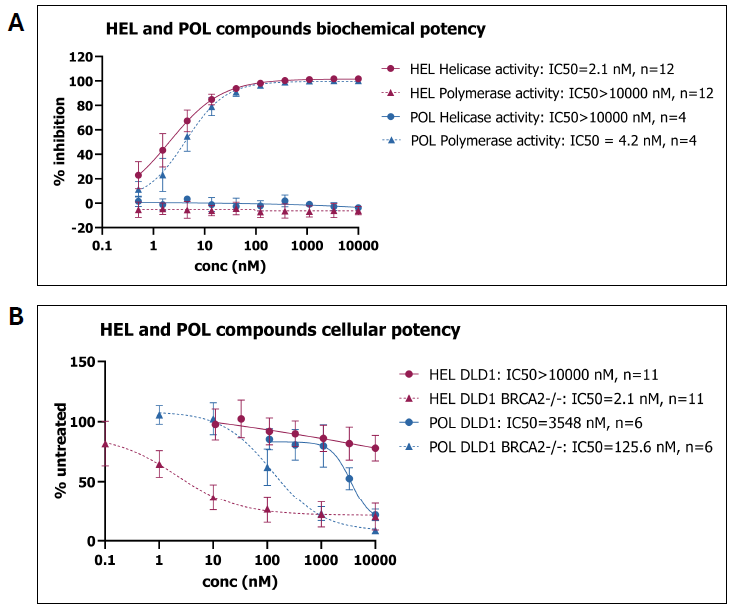
Assessment of the potency of HEL and POL compounds. Image Credit: Pharmaron
(A) HEL and POL compounds had low nanomolar efficacy in ATPase and PicoGreen polymerase activity assays, respectively.
(B) Despite similar physicochemical features, the HEL inhibitor is approximately 60-fold more powerful than the POL inhibitor in a cellular CFA assay in DLD1 BRCA2-/- cells.
2. HEL inhibitor is more potent in functional assays
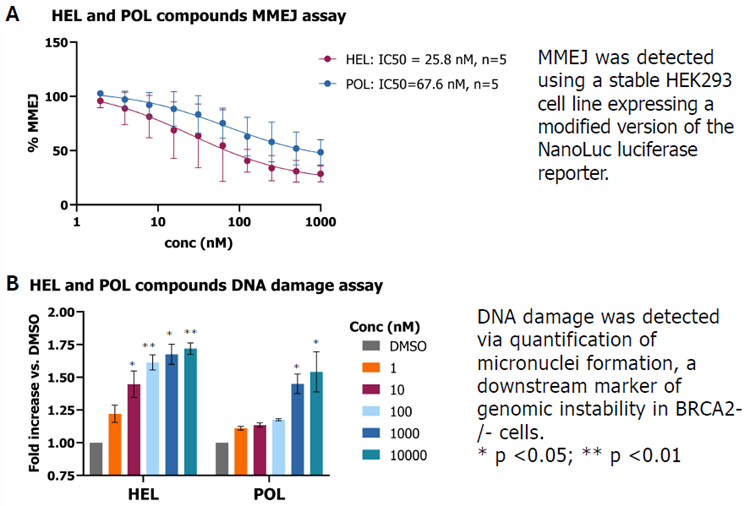
Assessment of MMEJ and DNA damage. Image Credit: Pharmaron
(A) HEL is three-fold more effective than POL in lowering the frequency of MMEJ events.
(B) HEL is 200 times more potent than POL at causing micronuclei production.
3. HEL compound shows stronger synergy with PARP inhibition
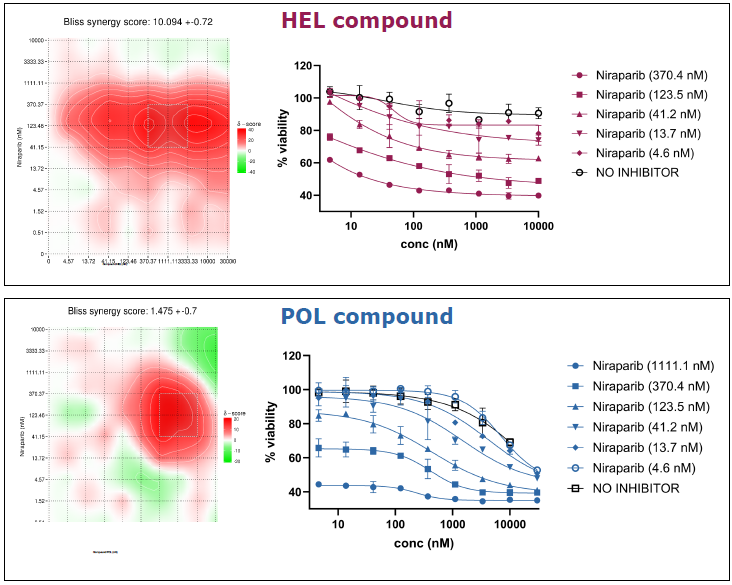
Evaluation of synergistic effects in BRCA2-/- cells. Image Credit: Pharmaron
Cell viability experiments in BRCA2-/- cells show that HEL has a significantly stronger synergy with Niraparib than POL. Similar synergy was detected in BRCA1-deficient MDA-MB-436 cells (data not shown).
4. HEL compound has favorable PK profile
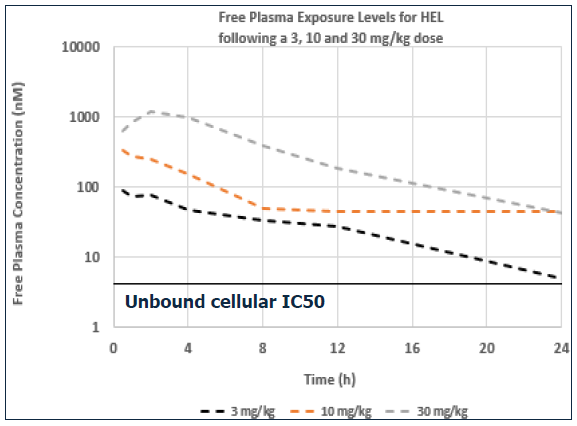
Image Credit: Pharmaron
Source: Pharmaron
| Species |
Clearance
(mL/min/kg) |
Volume
(L/kg) |
Half-life
(hrs) |
Bioavailability
(F%) |
| Mouse |
11.8
(9% liver blood flow) |
2.4 |
2.4 |
100 |
| Rat |
6.7
(9% liver blood flow) |
1.0 |
3.6 |
52 |
| Dog |
1.8
(3% liver blood flow) |
0.7 |
5.3 |
100 |
PK profile of the HEL compound
- Low clearance rates in mice, rats, and dogs
- High oral bioavailability (52–100%)
- With a moderate half-life, free plasma concentrations can remain above the cellular IC50 for 24 hours at dosages above 3 mg/kg
5. HEL compound drives tumor regression in BRCA-deficient xenograft models
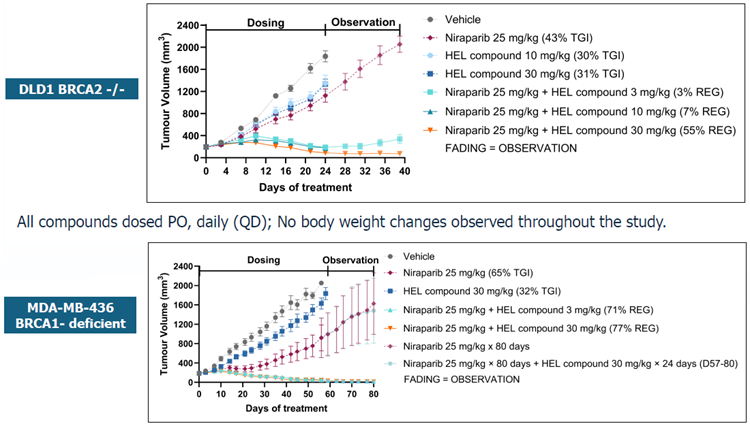
In vivo characterization of compound HEL in DLD1 BRCA2-/- and BRCA1-deficient MDA-MB-436 mouse xenograft models. Image Credit: Pharmaron
When coupled with Niraparib, DLD1 BRCA2-/- xenografts showed 55% tumor reduction at 30 mg/kg, while MDA-MB-436 BRCA1-deficient xenografts showed 70% tumor regression at 3 mg/kg.
6. HEL + PARP inhibition increases DNA damage in tumors
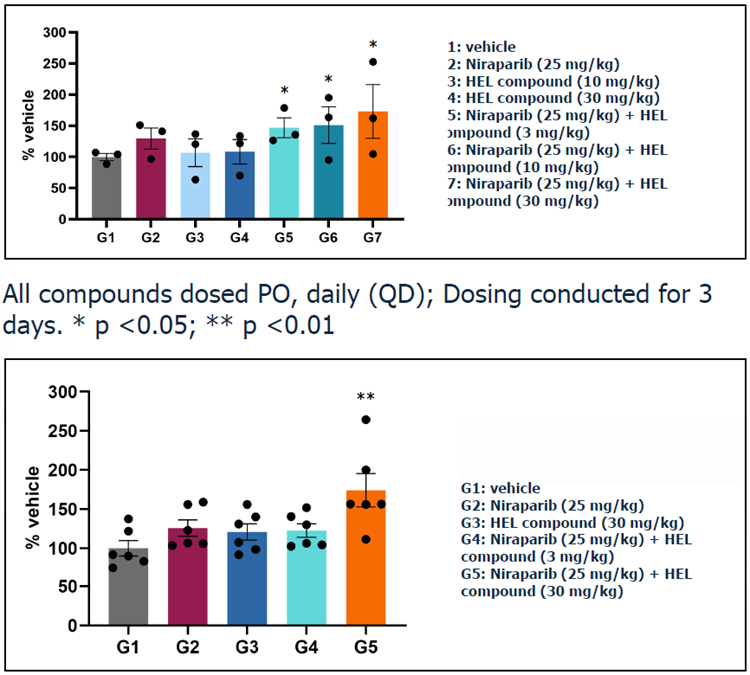
Levels of phosphorylated γH2AX, a biomarker for dsDNA breaks in tumor tissues. Image Credit: Pharmaron
Combination therapy with HEL and Niraparib dramatically increases phosphorylated γH2AX levels in tumor tissue (compared to G1).
Conclusion
- Both HEL and POL inhibitors have considerable biochemical efficacy, indicating domain selectivity
- The HEL inhibitor outperforms all cellular and functional testing for homologous recombination deficit (HRD), causing more DNA damage and exhibiting stronger synergy with PARP inhibition
- HEL demonstrates promising PK, selectivity, and effectiveness in BRCA-deficient xenografts
- These findings suggest future targeting of the Polθ helicase-like domain for synthetic-lethal treatment methods
Acknowledgments
Produced using materials originally authored by Loss Omar, Bestwick Michael, Ladduwahetty Tammy, Andrews Mark, Wang Ju, He Jiangchuan, Ding Linli, Pang Tan, Yuan Rui, Sham Hing, and Lin Kui from Integrated Drug Discovery, Pharmaron UK, In vitro Biology, Pharmaron Inc., Pharmacology, Pharmaron Inc., and NewBay Pharma.
About Pharmaron
Pharmaron is a premier R&D service provider for the life sciences industry. Founded in 2004, Pharmaron has invested in its people and facilities, and established a broad spectrum of research, development and manufacturing service capabilities throughout the entire drug discovery, preclinical and clinical development process across multiple therapeutic modalities, including small molecules, biologics and CGT products. With over 17,000 employees and operations in China, the U.S., and the U.K., Pharmaron has an excellent track record in the delivery of R&D solutions to its partners in North America, Europe, Japan and China.
Sponsored Content Policy: News-Medical.net publishes articles and related content that may be derived from sources where we have existing commercial relationships, provided such content adds value to the core editorial ethos of News-Medical.net, which is to educate and inform site visitors interested in medical research, science, medical devices and treatments.
Last Updated: Oct 27, 2026