This article and associated images are based on a poster originally authored by Dixon C., Haussmann I. and Maryniak L. and presented at ELRIG Drug Discovery 2025 in affiliation with Birmingham City University.
This poster is being hosted on this website in its raw form, without modifications. It has not undergone peer review but has been reviewed to meet AZoNetwork's editorial quality standards. The information contained is for informational purposes only and should not be considered validated by independent peer assessment.

Endometrial cancer (EC) is the most common gynecological cancer the second most common female cancer, after breast cancer, in the developed world (1). In the UK EC is the 4th most common cancer and accounts for around 5 % of all new cancer cases in women. In the UK Mortality rates for EC are projected to rise by 12 % between 2025 and 2040 (2)(3). This increasing burden of EC, combined with the limitations of current treatments highlights the need for research into new treatment options that address issues with current treatment for women of all age groups such as fertility-preservation, drug resistance and recurrent/advanced cases (4)(5)(6) RSV, a polyphenol found in grape skin and seeds with properties including anti-cancer activity has demonstrated its effectiveness in enhancing the efficacy of anticancer drugs such as chloroquine (7)(8). Artesunate, is a semi-synthetic, monomeric compound derived from artemisinin a natural product (9). ART is an anti-malarial drug that has promising anti-cancer effects and has shown therapeutic synergy with anti-cancer agents such as paclitaxel and navitoclax in breast cancer cells and 2D and 3D ovarian cancer cell models (10). Despite both drugs being well known for their anti-cancer properties, to our knowledge, no previous studies have investigated the effects of ART and RSV in combination on Ishikawa EC cells. Given ART and RSVs individual anti-cancer effects we hypothesised that the combination of ART and RSV will significantly reduce cell viability and enhance apoptosis in Ishikawa EC cells compared the effects of each drug alone.
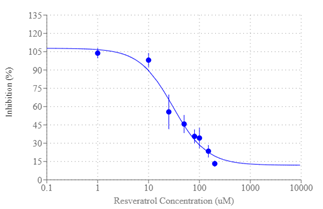
Figure 1. Dose–response curve of resveratrol (0–200 μM) Ishikawa cells seeded at a density of 1 × 10⁴ cells per well in 96-well plates. Cells were treated for 72 hours, after which cell viability was assessed using the MTT assay. Each concentration was tested in triplicate across three independent experiments (n = 9 /concentration). Data are presented as mean ± SEM. Statistical significance determined by Student’s t-test: RSV vs ART (p = 0.002), RSV vs Combo (p = 0.002), ART vs Combo (p < 0.001). Image Credit: Image courtesy of Dixon C. et al., in partnership with ELRIG (UK) Ltd.
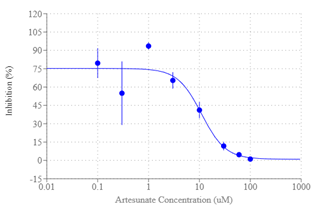
Figure 2. Dose–response curve of artesunate (0–100 μM) Ishikawa cells seeded at a density of 1 × 10⁴ cells per well in 96-well plates Cell viability was determined using the MTT assay after 72 hours of treatment. Each concentration was tested in triplicate across three independent experiments (n = 9/concentration). Data represent the mean ± SEM of three independent experiments, each performed in triplicate. Statistical significance determined by Student’s t-test: RSV vs ART (p = 0.002), RSV vs Combo (p = 0.002), ART vs Combo (p < 0.001). Image Credit: Image courtesy of Dixon C. et al., in partnership with ELRIG (UK) Ltd.
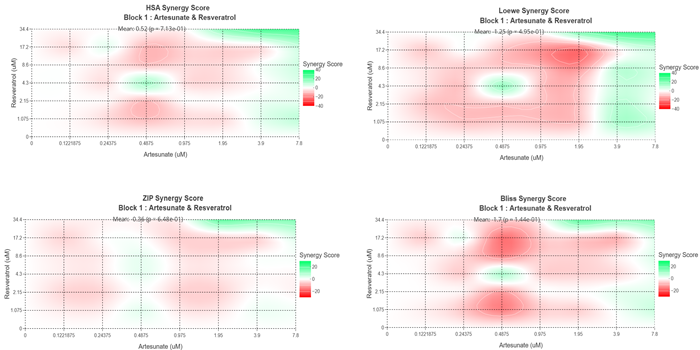
Figure 3. HSA, Loewe, ZIP, and Bliss synergy maps for artesunate (ART) and resveratrol (RSV) combinations (0–34.4 μM). Synergy was determined from MTT assay results in Ishikawa cells after 72 h of treatment. Data represent three independent experiments. Green areas indicate concentrations where ART and RSV show synergy. SynergyFinder identified specific regions of high synergy at lower, untested concentrations. Image Credit: Image courtesy of Dixon C. et al., in partnership with ELRIG (UK) Ltd.
We established our baseline the MTT assay showed that both drugs are effective. ART is significantly more potent on its own, with an IC50 value of 7.8 μM (p=0.002), compared to RSV's IC50 of 34.4 μM. We used the IC50 values as the concentrations to conduct another MTT assay to determine whether there was a synergistic interaction between the drugs To investigate synergy, we utilised the SynergyFinder platform to analyse the interaction across four established mathematical models: Bliss, Loewe, HSA, and ZIP. The synergistic relationship between ART and RSV was consistent across all four models: the large green area in each plot confirms that ART and RSV are synergistic across a range of concentrations.
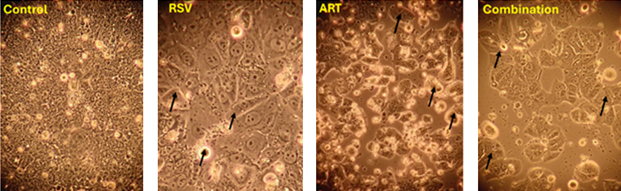
Figure 4. Changes in cell morphology following treatment with ART 7.8 μM, RSV 34.4 μM, and both drugs in combination compared with the effects of no treatment. All treatments exhibit an antiproliferative effect on Ishikawa EC cells. The combination treatment appears to inhibit proliferation the most effectively after treatment for 72 hours. Image Credit: Image courtesy of Dixon C. et al., in partnership with ELRIG (UK) Ltd.
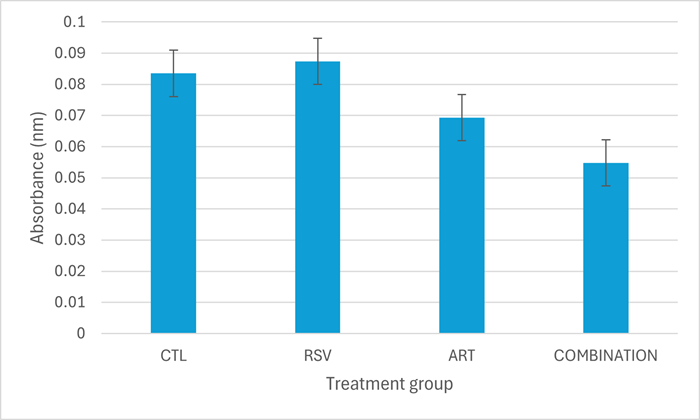
Figure 5. Human TNF-α levels measured by ELISA at 450 nm. All samples were below the detection limit. Data represent three independent experiments; each performed in triplicate. Image Credit: Image courtesy of Dixon C. et al., in partnership with ELRIG (UK) Ltd.
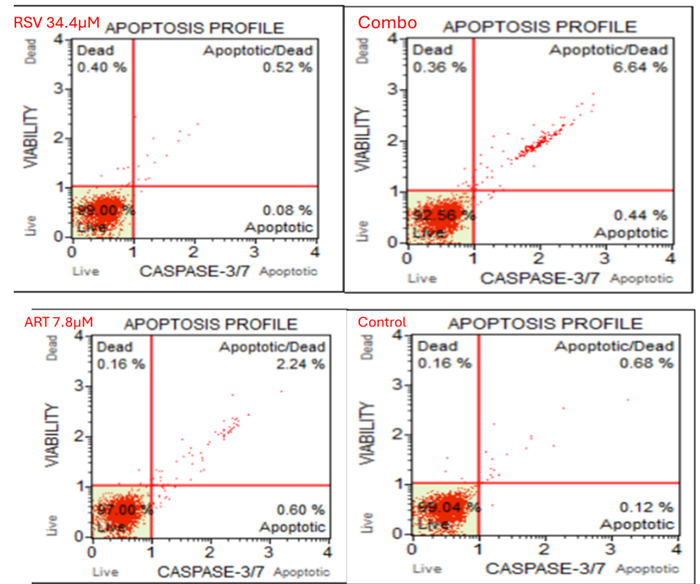
Figure 6. Flow cytometry analysis of Ishikawa cells treated with artesunate (7.8 μM), resveratrol (34.4 μM), and their combination. Plots show cell size vs caspase-3/7 activity, distinguishing live, apoptotic, and dead populations. The combination treatment induced higher apoptosis than single treatments. Data: 3 independent experiments (RSV, Combo, Control) and 2 experiments (ART), each with triplicate samples. Image Credit: Image courtesy of Dixon C. et al., in partnership with ELRIG (UK) Ltd.
We visually validated this synergy with microscopy. Here, we see the cell morphology after 72 hours. While individual treatments showed some effect, the combination treatment resulted in the most pronounced morphological changes including cell detachment.
We hypothesised the combination works by inducing apoptosis, we assessed using flow cytometry to investigate Caspase 3/7 activity. This confirmed that all treatments induced some level of apoptosis. The combination and RSV treatment achieved similar total apoptotic rates at 4.035 % and 4.025 %. We also assessed if the combination had any anti-inflammatory effect by measuring TNF-α levels using an ELISA assay. Here, all samples fell below the assay's level of detection.
KEY FINDINGS
- THE COMBINATION INDUCES CELL DEATH
- ART DEMONSTRATED A MORE POTENT ANTIPROLIFERATIVE EFFECT
- THE COMBINATION DEMONSTRATES A SYNERGISTIC EFFECT VALIDATED ACROSS FOUR MATHEMATICAL MODELS
References
- Raglan, O., et al. (2019). Risk factors for endometrial cancer: An umbrella review of the literature. International Journal of Cancer, 145(7), pp.1719–1730. https://doi.org/10.1002/ijc.31961.
- Cancer Research UK (2015). Uterine cancer incidence statistics. (online) Cancer Research UK. Available at: https://www.cancerresearchuk.org/health-professional/cancer-statistics/statistics-by-cancer-type/uterine-cancer/incidence.
- Cancer Research UK. (2015). Uterine cancer mortality statistics. (online) Available at: https://www.cancerresearchuk.org/health-professional/cancer-statistics/statistics-by-cancer-type/uterine-cancer/mortality.
- Ji, J., et al. (2024). Advances in research on autophagy mechanisms in resistance to endometrial cancer treatment. Frontiers in oncology, 14. https://doi.org/10.3389/fonc.2024.1364070.
- Mutlu, L., et al. (2022). Endometrial Cancer in Reproductive Age: Fertility-Sparing Approach and Reproductive Outcomes. Cancers, (online) 14(21), pp.5187–5187. https://doi.org/10.3390/cancers14215187.
- Rütten, H., et al. (2021). Recurrent Endometrial Cancer: Local and Systemic Treatment Options. Cancers, (online) 13(24), p.6275. https://doi.org/10.3390/cancers13246275.
- Kursvietiene, L., et al. (2023). Anti-Cancer Properties of Resveratrol: A Focus on Its Impact on Mitochondrial Functions. Antioxidants, (online) 12(12), pp.2056–2056. https://doi.org/10.3390/antiox12122056.
- Fukuda, T., et al. (2016). Autophagy inhibition augments resveratrol-induced apoptosis in Ishikawa endometrial cancer cells. Oncology Letters, 12(4), pp.2560–2566. https://doi.org/10.3892/ol.2016.4978.
- Yang, X., et al. (2021). Progress on the study of the anticancer effects of artesunate (Review). Oncology Letters, 22(5). https://doi.org/10.3892/ol.2021.13011.
- McCorkle, J.R., et al. (2024). Antineoplastic Drug Synergy of Artesunate with Navitoclax in Models of High-Grade Serous Ovarian Cancer. Cancers, 16(7), pp.1321–1321. https://doi.org/10.3390/cancers16071321.
About Birmingham City University
Birmingham City University (BCU) is a public university in Birmingham, England, with roots going back to 1843.
BCU serves more than 31,000 students from over 100 countries
The university is known for its practical, industry-focused education, offering a broad range of undergraduate, postgraduate and professional courses across art and design, engineering, business, health, media and the built environment.
About ELRIG (UK) Ltd.
The European Laboratory Research & Innovation Group (ELRIG) is a leading European not-for-profit organization that exists to provide outstanding scientific content to the life science community. The foundation of the organization is based on the use and application of automation, robotics and instrumentation in life science laboratories, but over time, we have evolved to respond to the needs of biopharma by developing scientific programmes that focus on cutting-edge research areas that have the potential to revolutionize drug discovery.
Comprised of a global community of over 12,000 life science professionals, participating in our events, whether it be at one of our scientific conferences or one of our networking meetings, will enable any of our community to exchange information, within disciplines and across academic and biopharmaceutical organizations, on an open access basis, as all our events are free-of-charge to attend!
Our values
Our values are to always ensure the highest quality of content and that content will be made readily accessible to all, and that we will always be an inclusive organization, serving a diverse scientific network. In addition, ELRIG will always be a volunteer led organization, run by and for the life sciences community, on a not-for-profit basis.
Our purpose
ELRIG is a company whose purpose is to bring the life science and drug discovery communities together to learn, share, connect, innovate and collaborate, on an open access basis. We achieve this through the provision of world class conferences, networking events, webinars and digital content.
Sponsored Content Policy: News-Medical.net publishes articles and related content that may be derived from sources where we have existing commercial relationships, provided such content adds value to the core editorial ethos of News-Medical.Net which is to educate and inform site visitors interested in medical research, science, medical devices and treatments.
Last Updated: Nov 27, 2025