From MerckReviewed by Olivia Frost
This article and associated images are based on a poster originally authored by Vincenza Dragone, Alessia Gambardella, Julien Lefranc, Nina Berges, Sebastian Fuchs, Paul Gehrtz, Kai Schiemann and Simon Wöhrle and presented at ELRIG Drug Discovery 2026 in affiliation with Merck Healthcare KGaA.
This poster is being hosted on this website in its raw form, without modifications. It has not undergone peer review but has been reviewed to meet AZoNetwork's editorial quality standards. The information contained is for informational purposes only and should not be considered validated by independent peer assessment.

Introduction and objectives
Direct-to-Biology (D2B) is a cutting-edge approach to expedite drug discovery by combining plate-based chemistry with high-throughput biological screenings of crude reaction mixtures (without purification). Crude mixtures are characterized by measuring protein levels and viability. This enables the facile SAR profiling of PROTAC candidates in a streamlined fashion. Proteolysis-targeting chimeras (PROTACs) are well-suited for D2B workflows that enable high-throughput optimization of linker structure-activity relationships (SAR), E3 ligase selection, and rapid degrader discovery because of their catalytic mode of action.
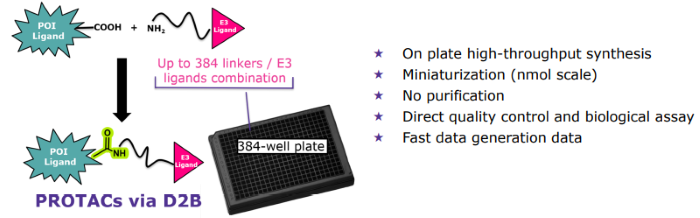
Image Credit: Vincenza Dragone et al., in partnership with ELRIG (UK) Ltd.
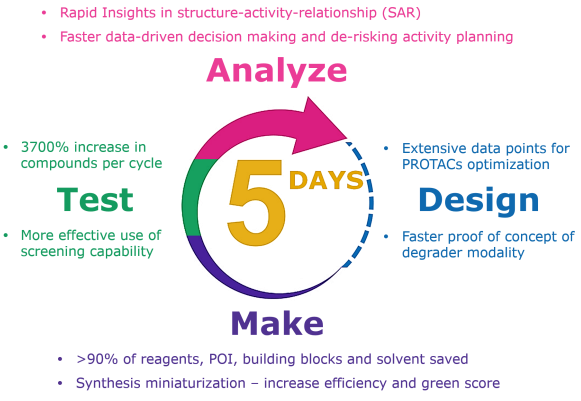
Image Credit: Vincenza Dragone et al., in partnership with ELRIG (UK) Ltd.
To accelerate the Design-Make-Test-Analyze (DMTA) cycle of PROTAC projects, we have developed a D2B process that allows us to make, test and analyze up to 1500 PROTACs within five days.
D2B process

Image Credit: Vincenza Dragone et al., in partnership with ELRIG (UK) Ltd.
The D2B process starts with a library plate containing the building blocks (BB). The Mantis® dispenser adds the POI ligands. After an overnight reaction, the plate is processed, and quality control assesses product conversion by LC-MS.
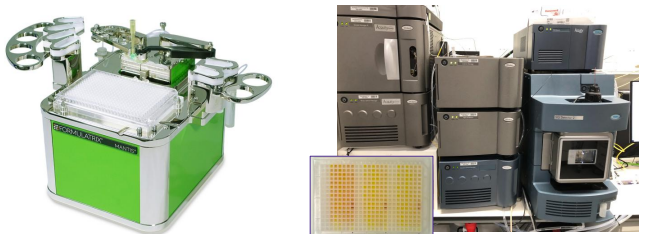
Image Credit: Vincenza Dragone et al., in partnership with ELRIG (UK) Ltd.
Crude mixtures are serially diluted using a Biomek i5 liquid handler. Crude mixtures also need to be registered, and the original BB plate layouts updated.
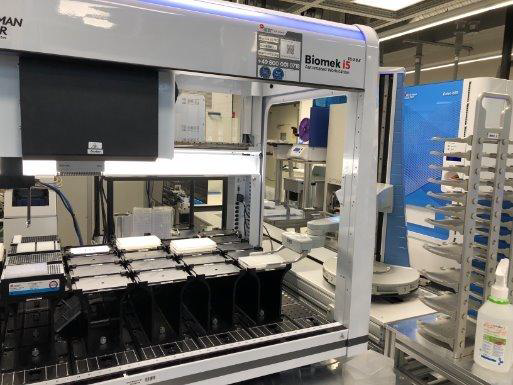
Image Credit: Vincenza Dragone et al., in partnership with ELRIG (UK) Ltd.
Crude mixtures are tested in functional high-throughput assays. For PROTACs, it is usually a degradation assay, such as a HiBiT. Dose-response curves allow reporting of DC50 values.
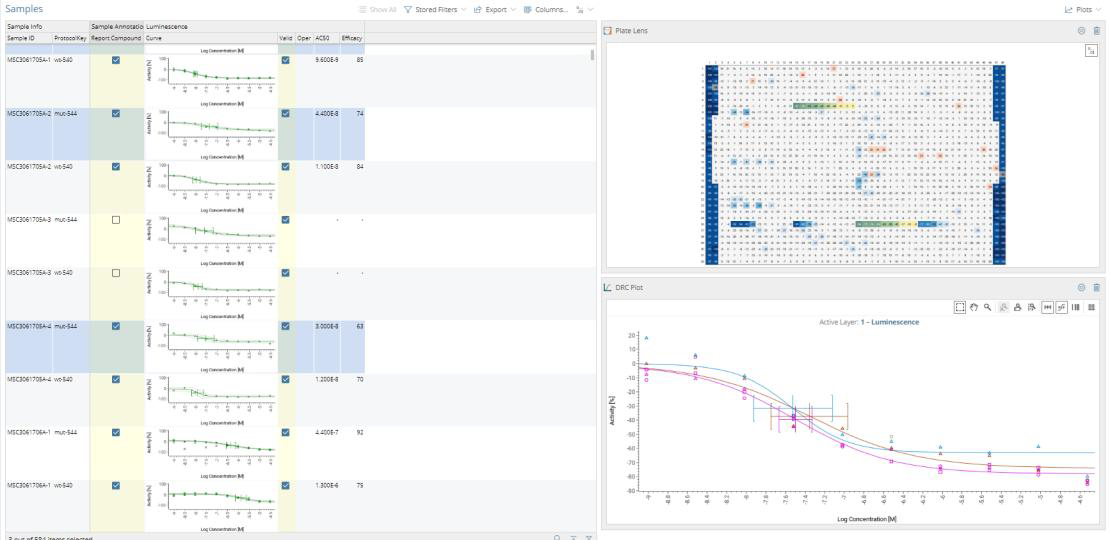
Image Credit: Vincenza Dragone et al., in partnership with ELRIG (UK) Ltd.
D2B data and results allow a preliminary SAR interpretation. Similarly to other screening campaigns, interesting compounds should be confirmed. Therefore, sufficient BB availability is ensured to enable a quick resynthesis.
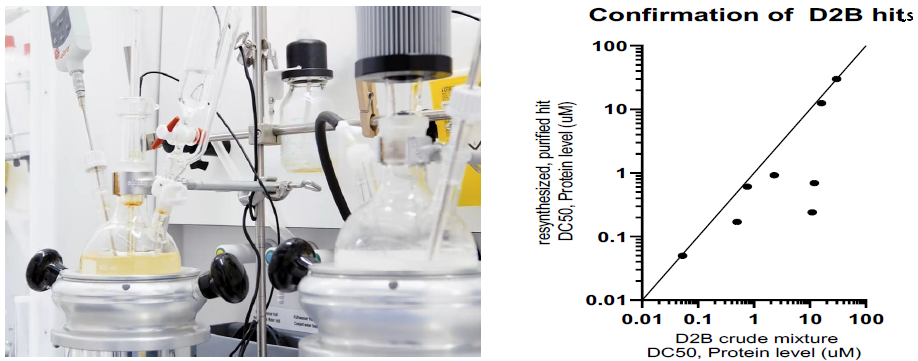
Image Credit: Vincenza Dragone et al., in partnership with ELRIG (UK) Ltd.
Project's impact – Case study
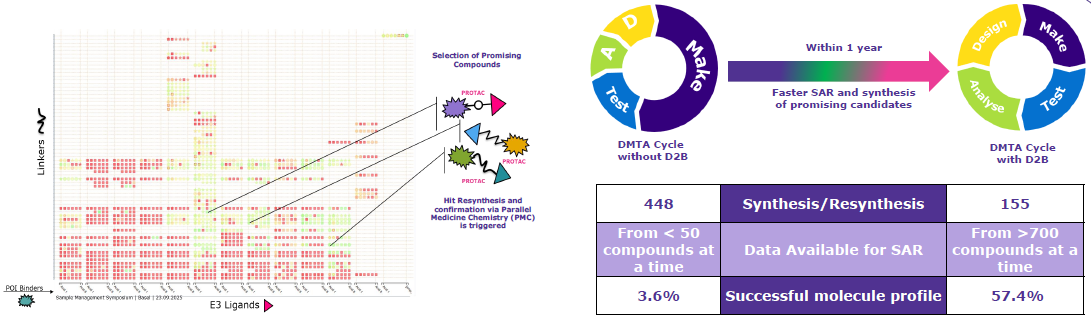
Image Credit: Vincenza Dragone et al., in partnership with ELRIG (UK) Ltd.
Conclusions
- > 17000 D2B compounds yielding > 500 compounds with promising profiles – hit rate 3%
- Hit confirmation achieved in 3 weeks starting with D2B screening followed by hit selection, resynthesis via PMC (Parallel Medicinal Chemistry) and purification, and 90% confirmation active compounds after resynthesis
- Applied successfully to 10 projects across different modalities – PROTACs, ADC payload-linker optimization and Glues
- D2B screenings can be initiated via a requesting tool, that connects to LIMS and ELN systems to trace the screening from the D2B reaction mixture generation to their final serial dilutions data points
- D2B screenings compound syntheses have been miniaturized on 384-microtiterplates and using 3 different reaction types. The conversion rate of the reaction mixtures is assessed via LC-MS and the D2B compounds can be tested in 9 different functional assays (PD, PK and biophysics assays)
Acknowledgments
Birgitta Leuthner, Alessandro Prestipino, Julian Schmid, Fiona Sorrel, Angela Staffa, Alhaji Kamba, Martina Plaschke, Timo Dietz, Paolo Piacentini, Johannes Krieger, Fouzia Machrouhi-Porcher, Christine Maurer, Christian Herhaus, Michael Hoffmann
Sponsors
Arvind Rajpal, Elisabetta Chiarparin, Emanuela Cuomo, Ingo Hartung, Andreas Blum, Thomas Fuerst, Carsten Pieck
About Merck
Merck, a leading science and technology company, operates across life science, healthcare and electronics. More than 62,000 employees work to make a positive difference to millions of people’s lives every day by creating more joyful and sustainable ways to live. From providing products and services that accelerate drug development and manufacturing as well as discovering unique ways to treat the most challenging diseases to enabling the intelligence of devices – the company is everywhere.
About ELRIG (UK) Ltd.
The European Laboratory Research & Innovation Group (ELRIG) is a leading European not-for-profit organization that exists to provide outstanding scientific content to the life science community. The foundation of the organization is based on the use and application of automation, robotics, and instrumentation in life science laboratories, but over time, we have evolved to respond to the needs of biopharma by developing scientific programs that focus on cutting-edge research areas that have the potential to revolutionize drug discovery.
Comprised of a global community of over 12,000 life science professionals, participating in our events, whether it be at one of our scientific conferences or one of our networking meetings, will enable any of our community to exchange information, within disciplines and across academic and biopharmaceutical organizations, on an open access basis, as all our events are free of charge to attend!
Our values
Our values are to always ensure the highest quality of content, that content will be made readily accessible to all, and that we will always be an inclusive organization, serving a diverse scientific network. In addition, ELRIG will always be a volunteer-led organization, run by and for the life sciences community, on a not-for-profit basis.
Our purpose
ELRIG is a company whose purpose is to bring the life science and drug discovery communities together to learn, share, connect, innovate, and collaborate on an open-access basis. We achieve this through the provision of world-class conferences, networking events, webinars, and digital content.
Sponsored Content Policy: News-Medical.net publishes articles and related content that may be derived from sources where we have existing commercial relationships, provided such content adds value to the core editorial ethos of News-Medical.net, which is to educate and inform site visitors interested in medical research, science, medical devices, and treatments.
Last Updated: Oct 29, 2026
 MilliporeSigma’s Milli-Q Connect enables remote, secure monitoring of lab performance