From NovalixReviewed by Olivia Frost
This article and associated images are based on a poster originally authored by Christina Starck, Johann Stojko, Albane Marck, Elise Del Nero, Rémi Longuespee, Emmanuel Klein, Rosine Fellmann, Anna Bonhoure, François Debaene, and Renaud Morales and presented at ELRIG Drug Discovery 2026 in affiliation with Novalix.
This poster is being hosted on this website in its raw form, without modifications. It has not undergone peer review but has been reviewed to meet AZoNetwork's editorial quality standards. The information contained is for informational purposes only and should not be considered validated by independent peer assessment.

Abstract
At Novalix, covalent fragment hits are identified using denaturing liquid chromatography and mass spectrometry-based screening, enabling direct detection and quantification of covalent adducts. Non-covalent lead-like hits are unveiled through affinity selection–mass spectrometry (AS-MS) and DNA-encoded library (DEL) screening, allowing rapid exploration of large chemical spaces and supporting high-throughput campaigns.
Progression from hit identification to validation is achieved through orthogonal approaches providing insights into molecular mechanisms of action, binding affinity, specificity, selectivity, and SAR. Biophysical techniques such as native MS, SPR, and biochemical assays, including cellular studies and structural approaches like HDX-MS, are especially powerful for complex targets such as membrane proteins or multi-domain assemblies.
This integrated workflow enables powerful hit discovery, validation, and mechanistic characterization across diverse and challenging biological systems. These approaches support hit finding across a wide range of target classes, which will be illustrated in this poster through several representative discovery projects.
Methods and results
Hit finding
MS covalent screening
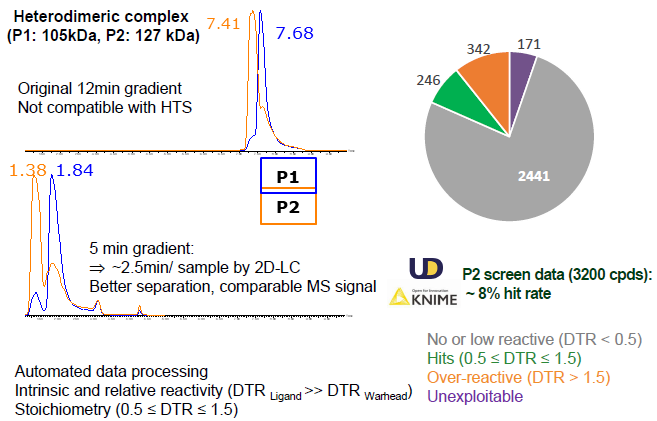
Image Credit: Image courtesy of Christina Starck et al., in partnership with ELRIG (UK) Ltd.
ASMS non-covalent screening
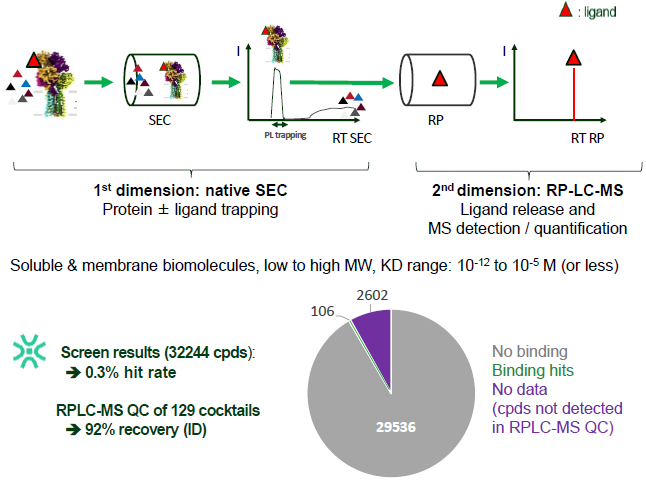
Image Credit: Image courtesy of Christina Starck et al., in partnership with ELRIG (UK) Ltd.
DEL screening and design of PROTAC degraders
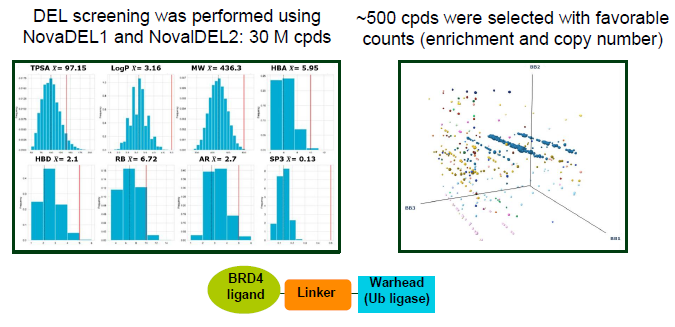
Image Credit: Image courtesy of Christina Starck et al., in partnership with ELRIG (UK) Ltd.
Hit 1 binder to BRD4-D1 (SPR KD ∼ 1.4 μM) was selected for conversion into a PROTAC degrader without any further optimization due to its favorable ADME parameters and physicochemical properties: PROTAC 1
Four additional PROTAC degraders were synthesized, using the same BRD4 ligand (Hit 1) and CRBN warhead and varying the atom chain linker: PROTACs 2, 3, 4, and 5.
Hit validation and SAR
MS-driven mechanistic characterization
Hit binding on Pβ (specificity)
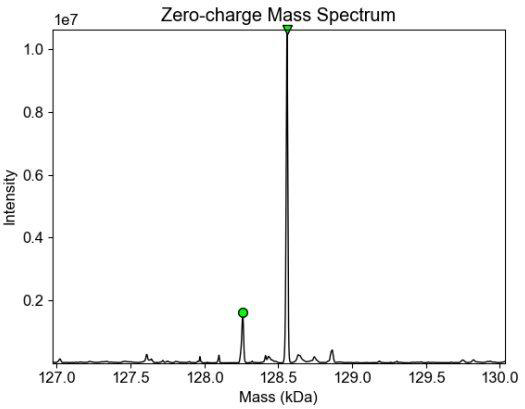
Image Credit: Image courtesy of Christina Starck et al., in partnership with ELRIG (UK) Ltd.
Hit binding on Pα (selectivity)
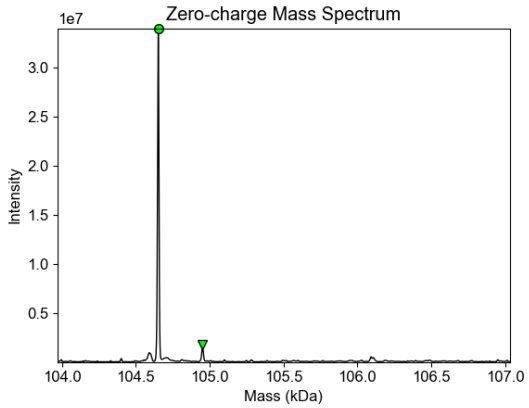
Image Credit: Image courtesy of Christina Starck et al., in partnership with ELRIG (UK) Ltd.
Multiplexed validation and counterscreen
Source: Novalix
| Cpd 4 |
PL1 % |
PLn % |
DTR |
| Pepmap scale-up |
Pβ |
86.9 |
86.9 |
0.9 |
| Pα |
4.8 |
4.8 |
0.1 |
| Retest |
Pβ |
85.6 |
90.5 |
1 |
| Pα |
6.4 |
6.4 |
0.1 |
| Pβ* (DBD) |
0 |
0 |
0 |
| Full screen |
Pβ |
74 |
74 |
0.7 |
| Pα |
0 |
0 |
0 |
Pβ specificity (PL1, PLn ∼ 100%, DTR ∼ 1)
Pβ selectivity (no/little reactivity on P1)
Pβ allosteric binding (no reactivity on P2*)
Binding site mapping and occupancy
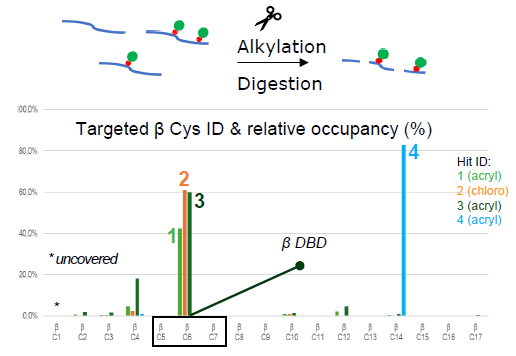
Image Credit: Image courtesy of Christina Starck et al., in partnership with ELRIG (UK) Ltd.
Bottom-up proteomics (ID, occupancy rate)
% Cpd 4 bound to targeted Cys 14 better than other Cys
kinact and KI study
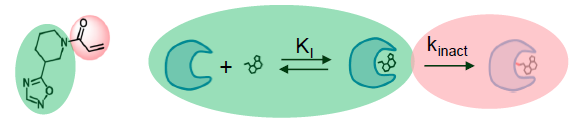
Image Credit: Image courtesy of Christina Starck et al., in partnership with ELRIG (UK) Ltd.
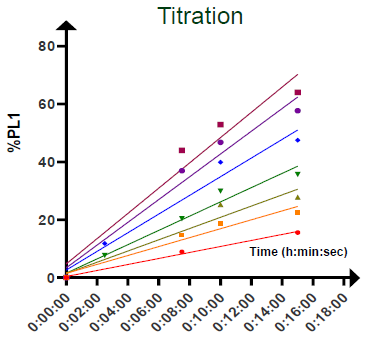
Covalent binding potency study. Image Credit: Image courtesy of Christina Starck et al., in partnership with ELRIG (UK) Ltd.
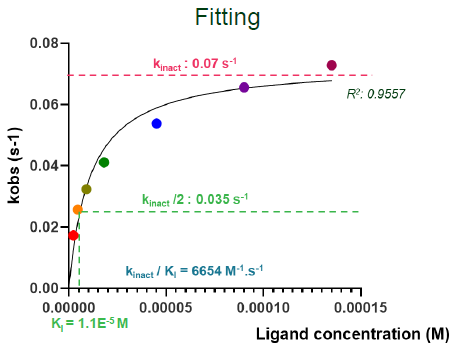
MedChem support. Image Credit: Image courtesy of Christina Starck et al., in partnership with ELRIG (UK) Ltd.
ASMS-based validation of ligand binding and specificity
Binding validation
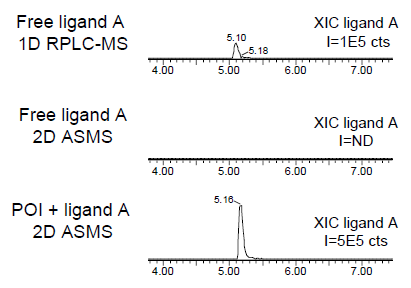
Image Credit: Image courtesy of Christina Starck et al., in partnership with ELRIG (UK) Ltd.
Counterscreen
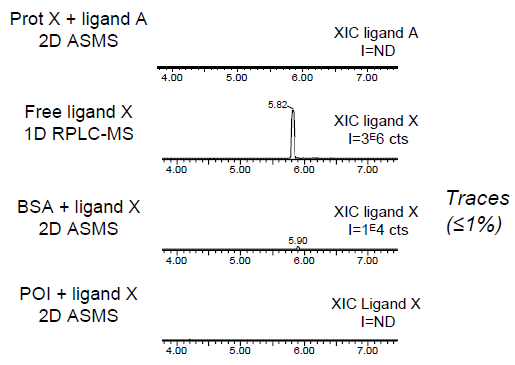
Image Credit: Image courtesy of Christina Starck et al., in partnership with ELRIG (UK) Ltd.
Affinity ranking: Pooled compounds on membrane protein
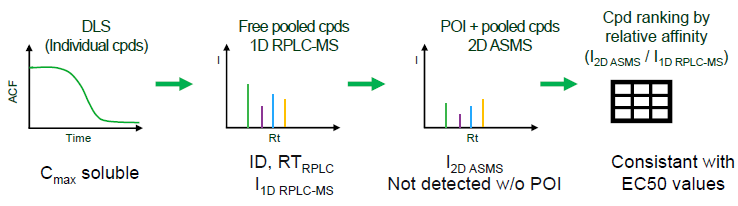
Image Credit: Image courtesy of Christina Starck et al., in partnership with ELRIG (UK) Ltd.
KD measurement: SPR and ASMS DR data comparison on membrane protein
Source: Novalix
| Cpd ID |
Customer data |
Novalix ASMS
(DR study of individual cpds) |
Comment |
IC50
(nM) |
SPR KD
(nM) |
KD
(nM) |
95 CI KD
(nM) |
| XX01 |
4 |
94 |
128 |
76–204 |
KD < 100 nM
not accessible
Limited by [POI] to
1 μM in SEC |
| XX02 |
3 |
72 |
149 |
94–227 |
| XX03 |
9 |
693 |
154 |
106–218 |
| XX04 |
9 |
260 |
232 |
157–338 |
|
| XX05 |
7 |
155 |
271 |
192–375 |
| XX06 |
992 |
729 |
654 |
486–870 |
| XX07 |
18 |
ND |
719 |
590–874 |
| XX08 |
204 |
1503 |
865 |
656–1138 |
| XX09 |
288 |
2513 |
998 |
793–1255 |
| XX10 |
566 |
4520 |
2976 |
2123–4183 |
KD >> IC50 binding
plateau not reached |
KD measurement by ASMS DR on complex target successfully achieved.
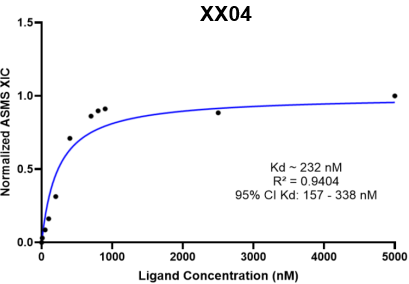
Image Credit: Image courtesy of Christina Starck et al., in partnership with ELRIG (UK) Ltd.
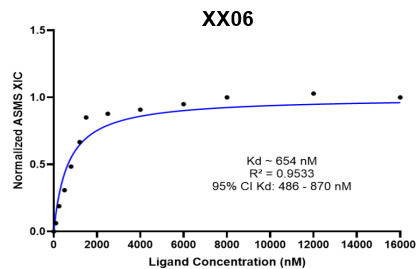
Image Credit: Image courtesy of Christina Starck et al., in partnership with ELRIG (UK) Ltd.
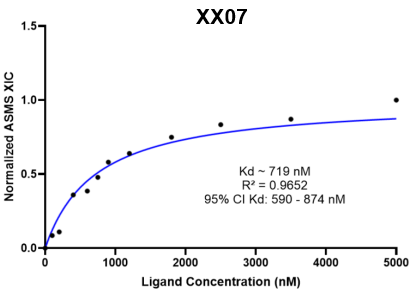
Image Credit: Image courtesy of Christina Starck et al., in partnership with ELRIG (UK) Ltd.
Ternary complex: Characterization by SEC-UV-nMS
UV readout
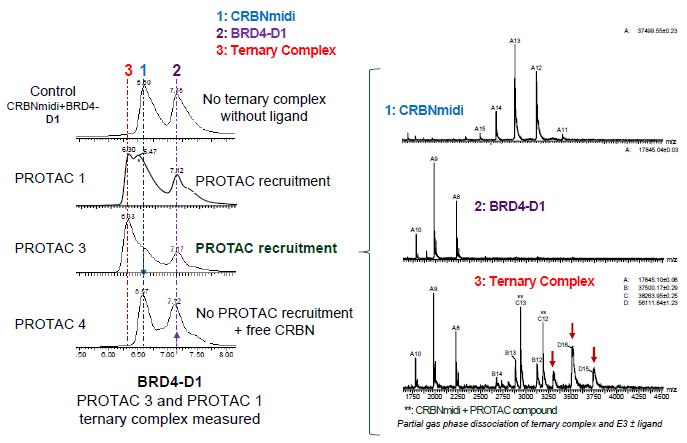
Image Credit: Image courtesy of Christina Starck et al., in partnership with ELRIG (UK) Ltd.
PROTAC 1 and PROTAC 3: Ternary complexes formed with BRD4-D1 and BRD4-D1-D2 (not shown) but not with BRD4-D2, confirming D1 selectivity.
PROTAC 4: No ternary complex formation was detected.
Binary interactions: SPR characterization using Triceratops SPR #64
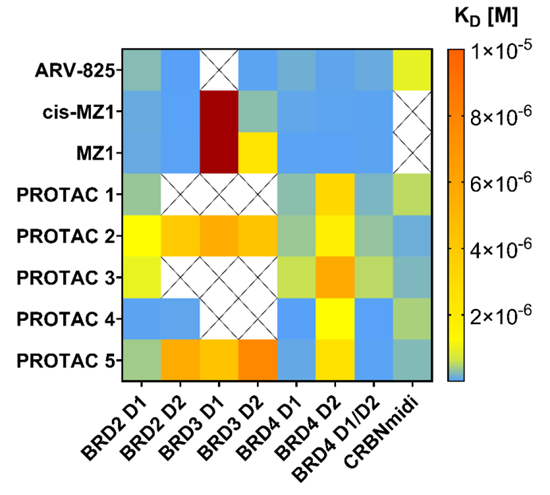
Image Credit: Image courtesy of Christina Starck et al., in partnership with ELRIG (UK) Ltd.
The results showed high selectivity of PROTACs for BRD4 D1 (10–1000×) over other bromodomains.
Significant binding was only observed for BRD2 D1 among the additional domains tested.
PROTAC 4 shows a 10× faster off-rate when binding to CRBN_midi compared with the other PROTACs.
Ternary complex: Characterization using switchSENSE technology
Proximity binding assay using the DNA Y-structure
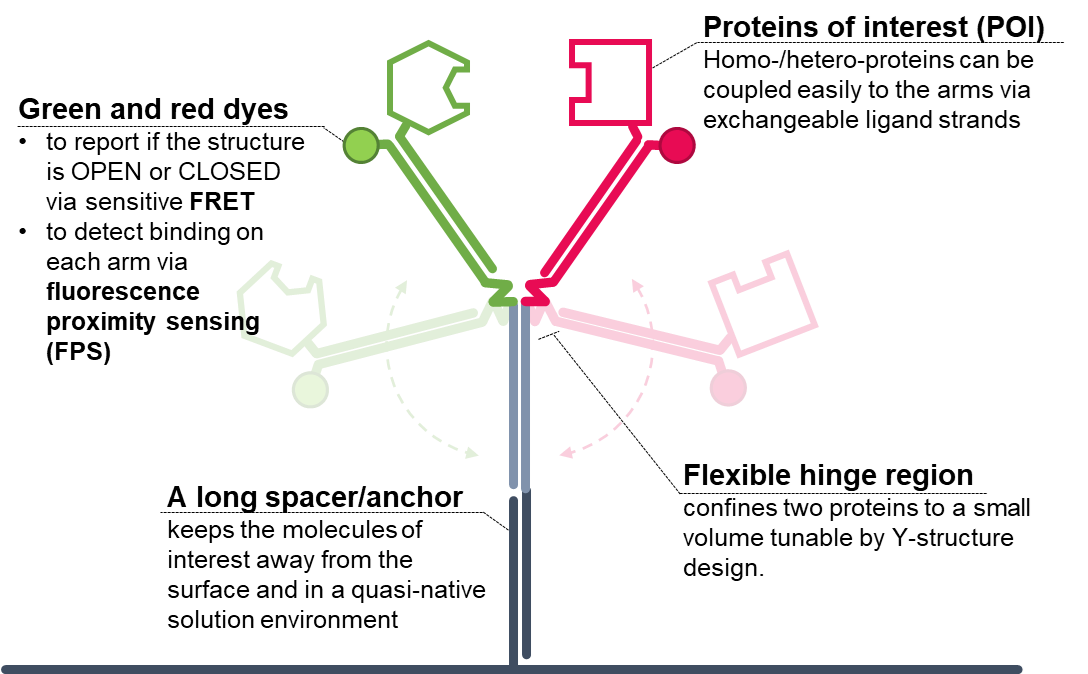
Image Credit: Image courtesy of Christina Starck et al., in partnership with ELRIG (UK) Ltd.
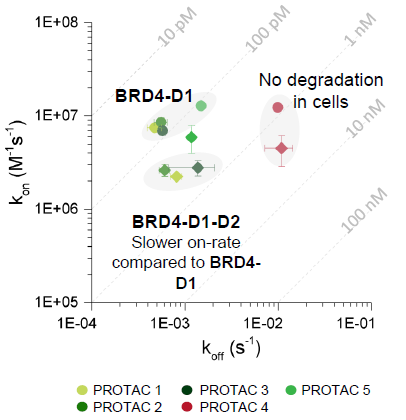
Image Credit: Image courtesy of Christina Starck et al., in partnership with ELRIG (UK) Ltd.
PROTACs 1–3: Strong, similar ternary complexes with BRD4-D1 and BRD4-D1-D2
PROTAC 5: Same pattern, with a slightly faster off-rate
PROTAC 4: Weak ternary complex formation, likely due to an altered binding mode
None form ternary complexes with BRD4-D2
HDX-MS study for non-covalent binding mapping
HDX labeling (PROTAC):
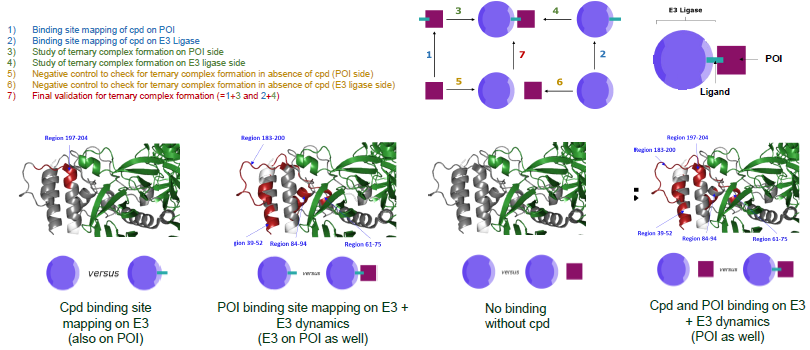
Image Credit: Image courtesy of Christina Starck et al., in partnership with ELRIG (UK) Ltd.
Recruitment conditions/optimization:
SEC-UV-nMS
HDX feasibility:
Best seq.cov./redundancy on four proteins ± ligand ∼90% seq.cov., 320 peptides to follow
HDX applications:
- Protein complexes
- Membrane proteins
- Ligand binding site + induced confo. change (NCE)
- Epitope/paratope mapping (NBE)
- Structural dynamics
Conclusion
By integrating complementary screening and characterization technologies (from denaturing RPLC-MS and ASMS/DEL approaches to biophysical, biochemical, and structural analyses), Novalix has established a robust workflow for the identification and validation of covalent and non-covalent hits, even on highly complex targets.
This multiparametric strategy not only accelerates hit discovery but also provides deep insight into mechanisms of action, selectivity, and SAR. The case studies presented in this article illustrate the power of this approach to deliver high-quality hits and to support discovery programs across a broad range of target classes.
About Novalix 
Novalix is a premier contract research organization, dedicated to improving the critical early stages of drug discovery, combining exceptional scientific talent and exclusive technology with a comprehensive portfolio of world-class chemistry, biophysics and pharmacology capabilities. Novalix has pioneered the concept and practice of insourcing in Europe, has engaged in risk-sharing collaborations with biotechnology investors, and has also formed an alliance with a major pharmaceutical company to co-develop DNA-encoded library technology.
About ELRIG (UK) Ltd.
The European Laboratory Research & Innovation Group (ELRIG) is a leading European not-for-profit organization that exists to provide outstanding scientific content to the life science community. The foundation of the organization is based on the use and application of automation, robotics, and instrumentation in life science laboratories, but over time, we have evolved to respond to the needs of biopharma by developing scientific programs that focus on cutting-edge research areas that have the potential to revolutionize drug discovery.
Comprised of a global community of over 12,000 life science professionals, participating in our events, whether it be at one of our scientific conferences or one of our networking meetings, will enable any of our community to exchange information, within disciplines and across academic and biopharmaceutical organizations, on an open access basis, as all our events are free-of-charge to attend!
Our values
Our values are to ensure the highest quality of content and make it readily accessible to all. We will also strive to be an inclusive organization, serving a diverse scientific network. In addition, ELRIG will always be a volunteer-led organization, run by and for the life sciences community, on a not-for-profit basis.
Our purpose
ELRIG is a company whose purpose is to bring the life science and drug discovery communities together to learn, share, connect, innovate, and collaborate on an open-access basis. We achieve this through the provision of world-class conferences, networking events, webinars, and digital content.
Sponsored Content Policy: News-Medical.net publishes articles and related content that may be derived from sources where we have existing commercial relationships, provided such content adds value to the core editorial ethos of News-Medical.net, which is to educate and inform site visitors interested in medical research, science, medical devices and treatments.
Last Updated: Oct 12, 2026