This article and associated images are based on a poster originally authored by Laurine Achimo, Dr. Leon F. Willis, and Dr. David J. Brockwell and presented at ELRIG Drug Discovery 2026 in affiliation with the University of Leeds.
This poster is being hosted on this website in its raw form, without modifications. It has not undergone peer review but has been reviewed to meet AZoNetwork's editorial quality standards. The information contained is for informational purposes only and should not be considered validated by independent peer assessment.

Polyethylene glycol (PEG) precipitation has been used for decades as a protein solubility assay. Understanding protein solubility is fundamentally important and has applications in antibody formulation1. The slope of the precipitation curve (β) (Figure 1a, left) is indicative of cooperativity, and a link has been proposed between β and protein hydrodynamic radius (rh) (Figure 1b, right).
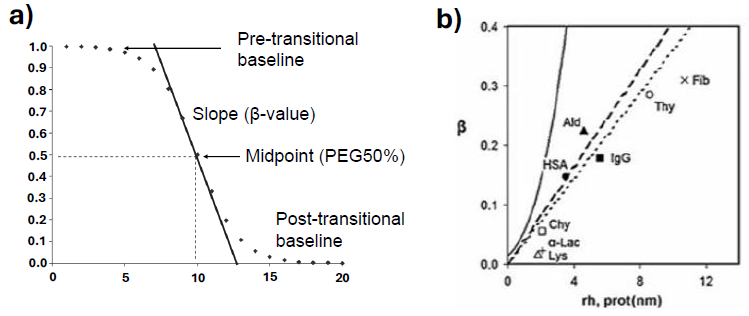
Figure 1. (a) Representative precipitation curve fitted with the Boltzmann sigmoidal model and (b) proposed relationship between rh and β. Image Credit: Gibson, T.J., et al. (2011); Atha, D.H. and Ingham, K.C. (1981); Pons Royo, M.D.C. and Jungbauer, A. (2025)2-4
- Research gap: Most studies report that protein rh and molecular weight (Mw) are the primary factors dictating protein precipitation behavior while ignoring the dynamic behavior of proteins.
- Study aim: Optimize and validate the PEG precipitation assay and screen a panel of model proteins (with known dynamic properties) to assess whether the slope and midpoints are correlated with the rh or molecular weight of proteins. Panel included: IgGs (Adalimumab, Fulranumab) and corresponding scFv-Fc fusions, Glucose oxidase, MBP WT and MBP 4A.
Methods
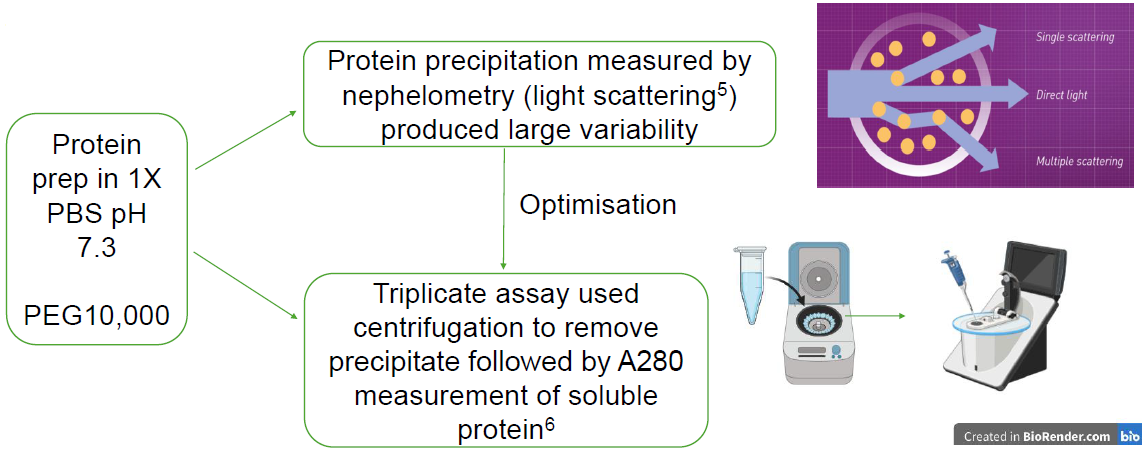
Image Credit: Image courtesy of Laurine Achimo et al., in partnership with ELRIG (UK) Ltd.
- The optimized assay was then used to determine the β values and midpoint values of different proteins. Proteins were purchased or expressed in E.coli (MBP WT and 4A) or in CHO cells (IgGs from AstraZeneca). Preparation involved SEC or AKTA purification. Protein rh was determined by FIDA neo.
Key findings
- The PEG precipitation assay was successfully optimized over the range 0–20% PEG (w/v). The significant negative correlation between β and protein hydrodynamic radius (Log rh) was in sharp contrast to the previously reported positive association3,4,7.
- The data suggests that more dynamic proteins have higher β values and thus exhibit higher cooperativity. No significant association was observed between Mw and either β or PEG50%.
Results
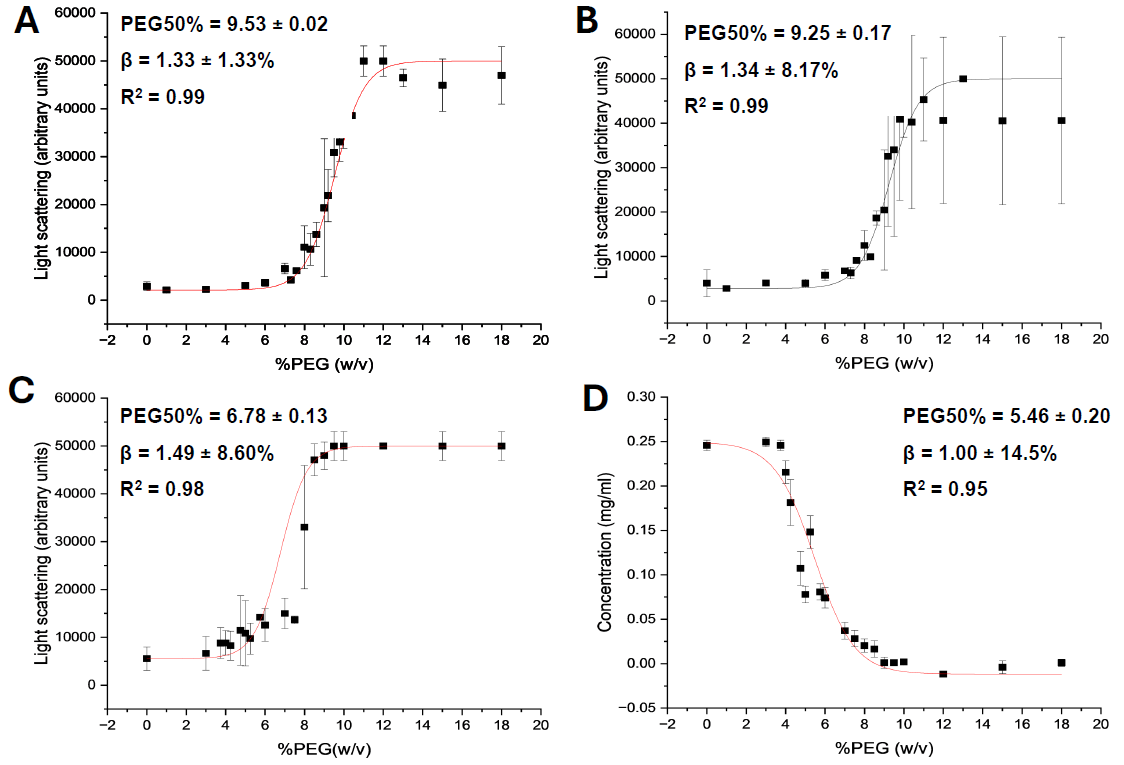
Figure 2. Progressive optimization of the PEG-precipitation assay reduced variability within the transition region. Light scattering is plotted against PEG concentration (% w/v) for nephelometry measurements (A–C) and for the optimized assay soluble protein concentration (D) determined by absorbance (NanoDrop) following centrifugation and plotted against PEG concentration (% w/v).
The optimized assay reduced normalized mean absolute error from 7.4% to 3.6% and improved estimates of PEG50% and cooperativity (β). MEDI IgG was used throughout assay optimization. Image Credit: Image courtesy of Laurine Achimo et al., in partnership with ELRIG (UK) Ltd.
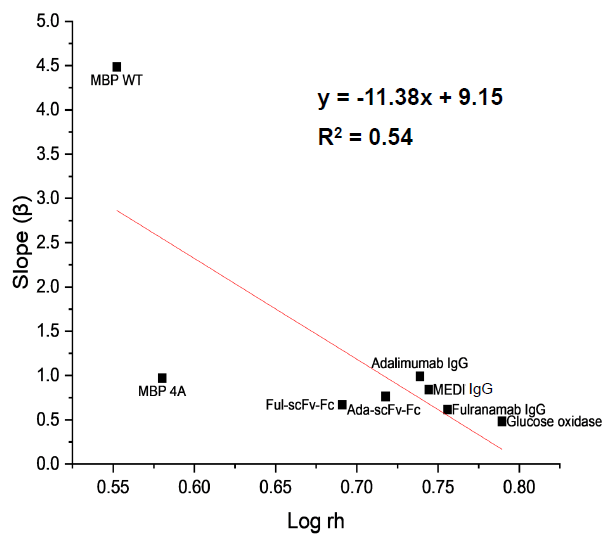
Figure 3. Correlation analysis between protein hydrodynamic radius (Log rh) measured using FIDA neo and cooperativity (β). β showed a significant negative association with rh (Spearman’s ρ = -0.714, p = 0.047). Image Credit: Image courtesy of Laurine Achimo et al., in partnership with ELRIG (UK) Ltd.
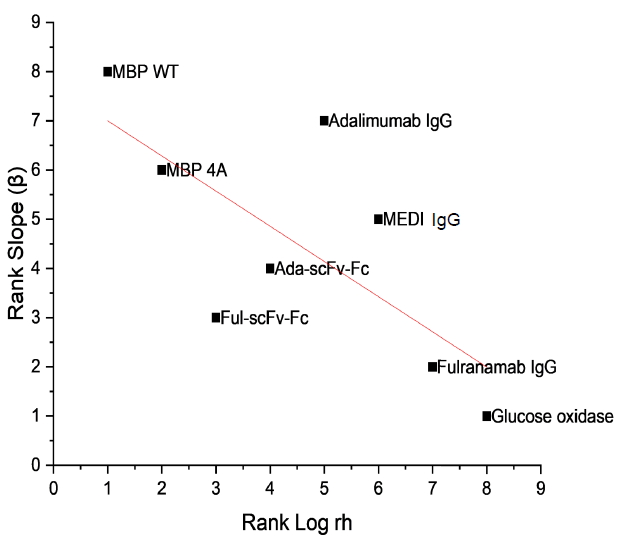
Figure 4. Spearman’s rank-rank correlation graphs for Log rh and β values. This helps to visualize the strong negative monotonic association observed between the Rank β and Rank Log rh (Spearman’s ρ = -0.714, p = 0.047). Image Credit: Image courtesy of Laurine Achimo et al., in partnership with ELRIG (UK) Ltd.
Conclusion
- These findings suggest that protein size alone may not adequately describe PEG-induced precipitation behavior, highlighting the potential contribution of protein dynamics to precipitation cooperativity. However, limited protein availability limited the dataset's size and diversity, and protein dynamics were inferred rather than measured directly.
- A larger protein panel combined with direct measurements of conformational dynamics will be required to test this hypothesis.
References and further reading
- Willis, L.F., et al. (2024). Biophysical analysis of therapeutic antibodies in the early development pipeline. Biologics : targets & therapy, 18, pp.413–432. DOI:10.2147/BTT.S486345. https://www.dovepress.com/biophysical-analysis-of-therapeutic-antibodies-in-the-early-developmen-peer-reviewed-fulltext-article-BTT.
- Gibson, T.J., et al. (2011). Application of a high-throughput screening procedure with PEG-Induced precipitation to compare relative protein solubility during formulation development with IgG1 monoclonal antibodies. Journal of Pharmaceutical Sciences, 100(3), pp.1009–1021. DOI:10.1002/jps.22350. https://jpharmsci.org/article/S0022-3549(15)32264-4/abstract.
- Atha, D.H. and Ingham, K.C. (1981). Mechanism of precipitation of proteins by polyethylene glycols. Analysis in terms of excluded volume. Journal of Biological Chemistry, 256(23), pp.12108–12117. DOI:10.1016/s0021-9258(18)43240-1. https://www.sciencedirect.com/science/article/pii/S0021925818432401.
- Pons Royo, M.D.C. and Jungbauer, A. (2025). Polyethylene glycol precipitation: Fundamentals and recent advances. Preparative biochemistry & biotechnology, 55(8), pp.935–954. DOI:10.1080/10826068.2025.2470220. https://www.tandfonline.com/doi/full/10.1080/10826068.2025.2470220.
- BMG Labtech (2026). Nephelometry measurements on plate readers | BMG labtech. Available at: https://www.bmglabtech.com/en/nephelometry/.
- Toprani, V.M., et al. (2016). A micro–polyethylene glycol precipitation assay as a relative solubility screening tool for monoclonal antibody design and formulation development. Journal of Pharmaceutical Sciences, 105(8), pp.2319–2327. DOI:10.1016/j.xphs.2016.05.021. https://www.sciencedirect.com/science/article/abs/pii/S0022354916414577.
- Odijk, T. (2009). Depletion theory and the precipitation of protein by polymer. The Journal of Physical Chemistry B, 113(12), pp.3941–3946. DOI:10.1021/jp806722j. https://pubs.acs.org/jpcbfk/article-abstract/113/12/3941/1423492/Depletion-Theory-and-the-Precipitation-of-Protein?redirectedFrom=fulltext.
About University of Leeds

Established in 1904, the University of Leeds is one of the largest universities in the UK. We’re part of the Russell Group of research-intensive universities and are renowned globally for the quality of our research and teaching.
Leeds is among the top ten universities for research power in the UK. Our academic breadth, commitment to quality and determination to make a genuine impact on the world around us enables us to achieve extraordinary results in:
- Creating knowledge through research and innovation.
- Disseminating it through excellent student education.
- Applying it to make a difference to society, culture and the economy.
We have over 34,000 students, over 7,000 members of staff and a global network of more than 240,000 alumni. Integrating research and learning and teaching is at the heart of our strategy. Our courses are taught by staff who are engaged in world-class research and cutting-edge professional practice. We have strong ties with industry, and work with organisations of all sizes. Our outstanding entrepreneurial record of commercialising our research has seen us launch more spin-out companies on the AIM stock market than any other UK university.
About ELRIG (UK) Ltd.
The European Laboratory Research & Innovation Group (ELRIG) is a leading European not-for-profit organization that exists to provide outstanding scientific content to the life science community. The foundation of the organization is based on the use and application of automation, robotics and instrumentation in life science laboratories, but over time, we have evolved to respond to the needs of biopharma by developing scientific programs that focus on cutting-edge research areas that have the potential to revolutionize drug discovery.
Comprised of a global community of over 12,000 life science professionals, participating in our events, whether it be at one of our scientific conferences or one of our networking meetings, will enable any of our community to exchange information, within disciplines and across academic and biopharmaceutical organizations, on an open access basis, as all our events are free-of-charge to attend!
Our values
Our values are to always ensure the highest quality of content and that content will be made readily accessible to all, and that we will always be an inclusive organization, serving a diverse scientific network. In addition, ELRIG will always be a volunteer led organization, run by and for the life sciences community, on a not-for-profit basis.
Our purpose
ELRIG is a company whose purpose is to bring the life science and drug discovery communities together to learn, share, connect, innovate and collaborate, on an open access basis. We achieve this through the provision of world class conferences, networking events, webinars and digital content.
Sponsored Content Policy: News-Medical.net publishes articles and related content that may be derived from sources where we have existing commercial relationships, provided such content adds value to the core editorial ethos of News-Medical.net, which is to educate and inform site visitors interested in medical research, science, medical devices and treatments.
Last Updated: Nov 6, 2026