This article and associated images are based on a poster originally authored by Yuka Ryomoto, Mari Tsutsumi, Masato Kanemaki, and Shuji Ozawa and presented at ELRIG Drug Discovery 2026 in affiliation with the National Institute of Genetics.
This poster is being hosted on this website in its raw form, without modifications. It has not undergone peer review but has been reviewed to meet AZoNetwork's editorial quality standards. The information contained is for informational purposes only and should not be considered validated by independent peer assessment.

What can we learn by depleting a protein of interest within minutes?
1. Why acute protein depletion?
Does permanent gene knockout tell the whole story?
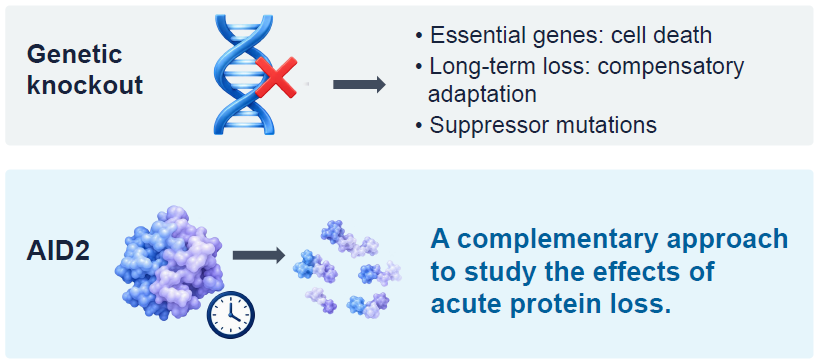
Image Credit: Image courtesy of Yuka Ryomoto et al., in partnership with ELRIG (UK) Ltd.
2. Control protein depletion in time
AID2 enables rapid, inducible, and reversible protein depletion.
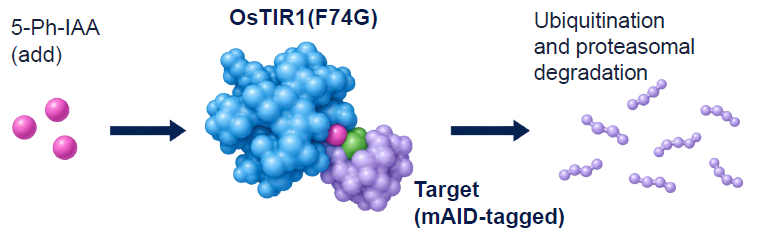
Image Credit: Image courtesy of Yuka Ryomoto et al., in partnership with ELRIG (UK) Ltd.
- Rapid: Protein depletion within minutes
- Inducible: Temporal control with 5-Ph-IAA
- Reversible: Protein levels recover after removal
3. Rapid depletion of RAD21 in human cells
RAD21-mAID-Clover was rapidly depleted after 5-Ph-IAA addition in HCT116 cells.
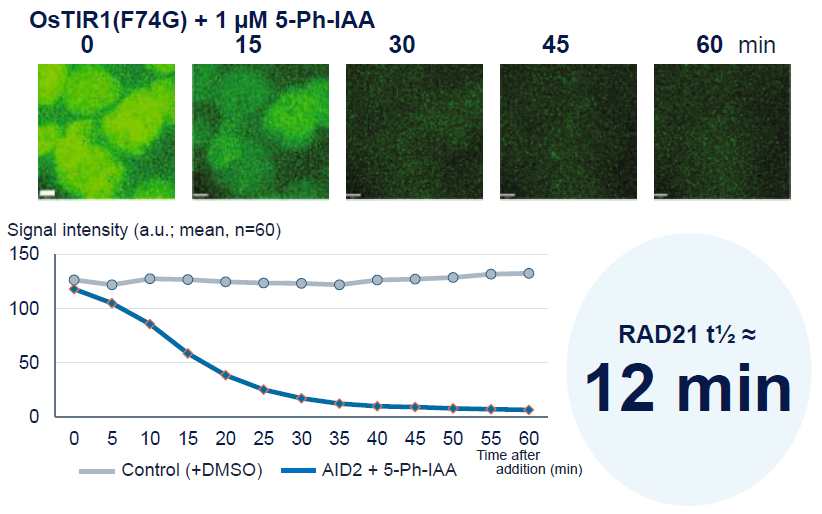
Image Credit: Yesbolatova et al., Nat. Commun. 11, 5701 (2020), Fig. 3; source data
4. What can acute protein depletion reveal about the target?
Examine the phenotypic consequences of acute protein depletion.
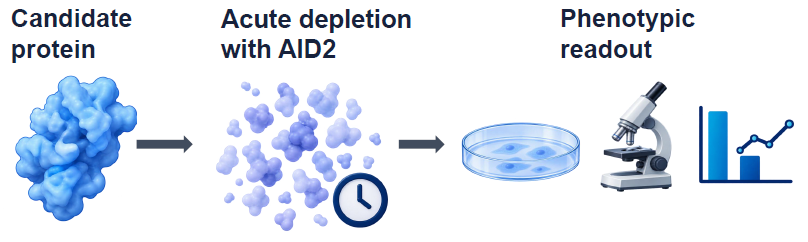
A complementary approach to functional studies of candidate drug targets. Image Credit: Image courtesy of Yuka Ryomoto et al., in partnership with ELRIG (UK) Ltd.
Potential application: Functional evaluation of candidate drug targets
5. AID2-mediated protein depletion in vivo
AID2 also functions in mice.
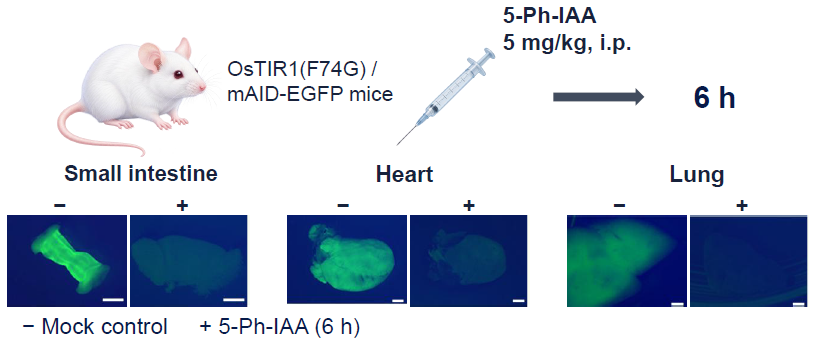
Reporter depletion was observed in multiple tissues. Image Credit: Yesbolatova et al., Nat. Commun. (2020), Fig. 6b
6. Where could AID2 fit into drug discovery?
Potential applications
- Functional target studies: Phenotypic consequences of acute protein depletion
- Disease-related proteins: Functional studies in cells and mice
- Disease models: Conditional cellular and mouse models
- Essential protein: Timed Depletion and functional analysis
About National Institute of Genetics
The National Institute of Genetics (NIG), located in Mishima, Shizuoka, is a premier Japanese research institute specializing in life science research with genetic approaches. Established in 1949, NIG plays a central role in advancing basic and applied research in life sciences, particularly in the fields of molecular biology, evolutionary genetics, and bioinformatics. It operates several national research programs and databases, including the DNA Data Bank of Japan (DDBJ), and is a core facility for the National Bioresource Project (NBRP). NIG also promotes international collaboration and provides advanced education through its affiliation with the Graduate University for Advanced Studies (SOKENDAI).
About ELRIG (UK) Ltd.
The European Laboratory Research & Innovation Group (ELRIG) is a leading European not-for-profit organization that exists to provide outstanding scientific content to the life science community. The foundation of the organization is based on the use and application of automation, robotics and instrumentation in life science laboratories, but over time, we have evolved to respond to the needs of biopharma by developing scientific programmes that focus on cutting-edge research areas that have the potential to revolutionize drug discovery.
Comprised of a global community of over 12,000 life science professionals, participating in our events, whether it be at one of our scientific conferences or one of our networking meetings, will enable any of our community to exchange information, within disciplines and across academic and biopharmaceutical organizations, on an open access basis, as all our events are free-of-charge to attend!
Our values
Our values are to always ensure the highest quality of content and that content will be made readily accessible to all, and that we will always be an inclusive organization, serving a diverse scientific network. In addition, ELRIG will always be a volunteer led organization, run by and for the life sciences community, on a not-for-profit basis.
Our purpose
ELRIG is a company whose purpose is to bring the life science and drug discovery communities together to learn, share, connect, innovate and collaborate, on an open access basis. We achieve this through the provision of world class conferences, networking events, webinars and digital content.
Sponsored Content Policy: News-Medical.net publishes articles and related content that may be derived from sources where we have existing commercial relationships, provided such content adds value to the core editorial ethos of News-Medical.net, which is to educate and inform site visitors interested in medical research, science, medical devices and treatments.
Last Updated: Oct 28, 2026