This poster is being hosted on this website in its raw form, without modifications. It has not undergone peer review but has been reviewed to meet AZoNetwork's editorial quality standards. The information contained is for informational purposes only and should not be considered validated by independent peer assessment.

Study objective
This study examined CellShip® across increasingly complex mammalian cell models, with the aim of understanding whether cells survive short-term preservation, recover after storage and retain characteristics relevant to downstream use.
Rethinking short-term cell transport
Transport of viable mammalian cells between laboratories is increasingly important for assay development and cell-based drug discovery. Conventional transport commonly relies on cryopreservation, requiring cryoprotective agents, controlled freezing, and shipment under frozen conditions. This can introduce additional handling steps and may influence cell recovery following transport.
CellShip® is a xeno-free preservation medium developed to enable short-term storage and transport of mammalian cells without cryopreservation. Previous work has demonstrated that multiple mammalian cell types can be maintained during ambient-temperature transport, providing an opportunity to investigate whether this approach can be extended beyond conventional cell lines.
1. Introduction
- Cryopreservation is the conventional approach for the transport and long-term storage of cells and tissues.
- However, freeze–thaw-induced cellular stress can compromise viability, membrane integrity, and functional recovery, potentially affecting the reliability of downstream experimental outcomes.
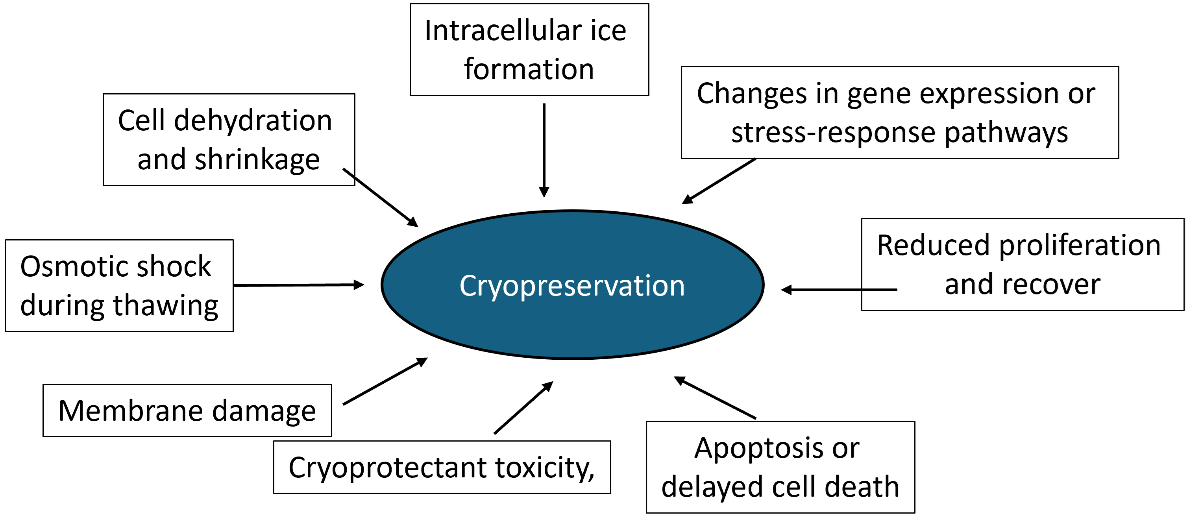
Are there any alternatives?. Image Credit: Image courtesy of Life Science Group Ltd. in partnership with ELRIG (UK) Ltd.
2. Does it work?
- CellShip® is a promising ambient-temperature medium for the short-term transport and storage of mammalian cell cultures.
- Buick et al. evaluated HEK293, CHO, HepG2, K562, and Jurkat cells after 72 hours ambient transport/storage in CellShip®.
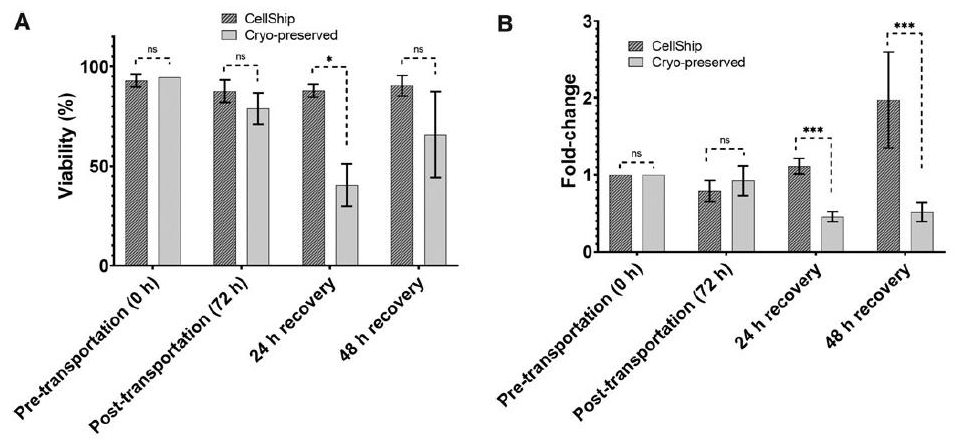
Comparison study showing higher Jurkat cell viability in CellShip compared to cryopreservation, Buick et al. 2023. Image Credit: Image courtesy of Life Science Group Ltd. in partnership with ELRIG (UK) Ltd.
3. Recovery is more than a viability number
AlamarBlue reduction (%) serves as an indicator of cellular metabolic activity and proliferation, demonstrating significantly higher activity (a) in Jurkat, HEK, and HepG2 following 72 hours of transport/storage in CellShip at ambient temperature compared with cryopreserved cells.
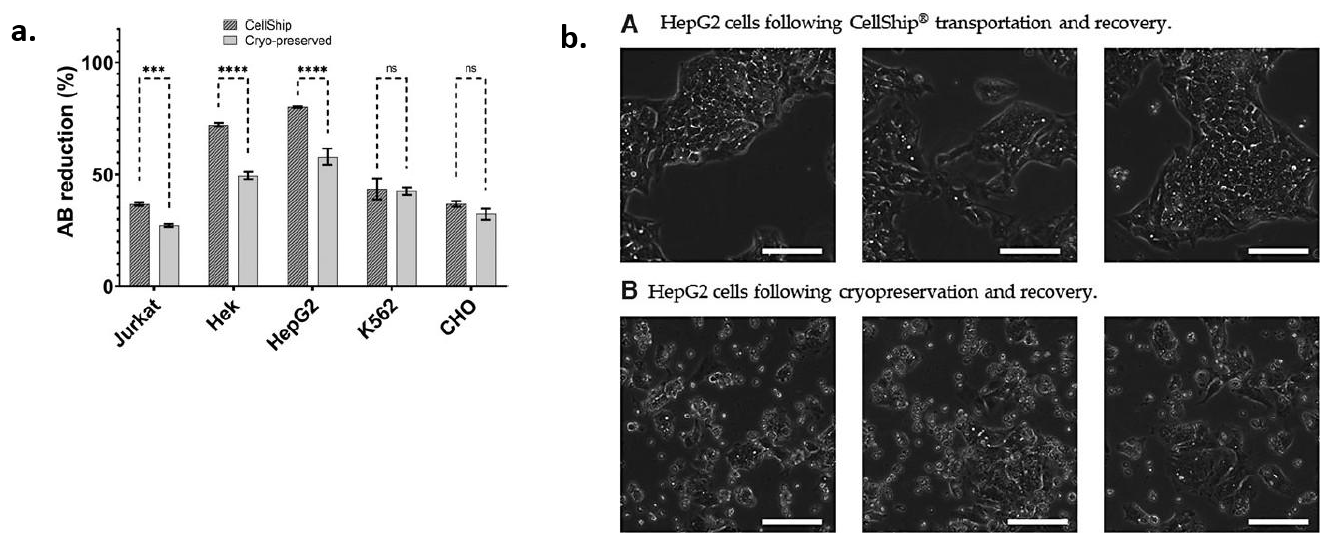
Image Credit: Image courtesy of Life Science Group Ltd. in partnership with ELRIG (UK) Ltd.
- HepG2 cell morphology (b) after 72 hours of CellShip transport/storage and 48 hours of standard culture recovery.
4. Can we transport immune cells as well?
- CD19-CAR Jurkat cells, stored in CellShip® for 72 hours at ambient temperature or 4 °C, then returned to complete medium for a further 72 hours at 37 °C
- Viability and cell counts were measured by Trypan Blue exclusion.
- CAR expression was measured by flow cytometry using PE-conjugated FMC63 idiotype antibody.
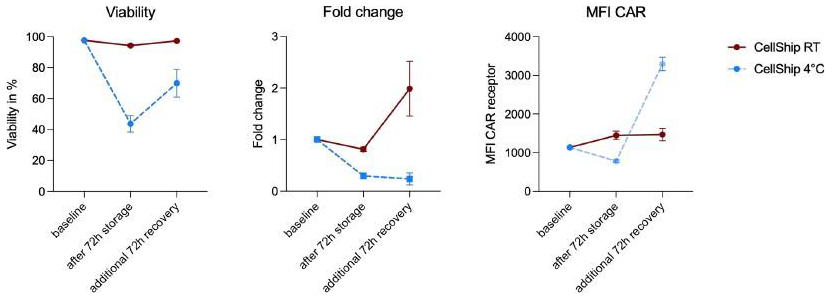
CAR expression and cell viability are maintained after cell storage at 4 °C or at 37 °C. Image Credit: Image courtesy of Life Science Group Ltd. in partnership with ELRIG (UK) Ltd.
5. Cell viability and proliferation analysis in NPCs, neural progenitor cells derived from hiPSCs
- The study also compared CRYO, WOCS, and WCS over time to assess growth/confluence among the three storage conditions. (CRYO: frozen with DMSO; WOCS: CellShip then washed before seeding; WCS: CellShip, no wash before seeding).
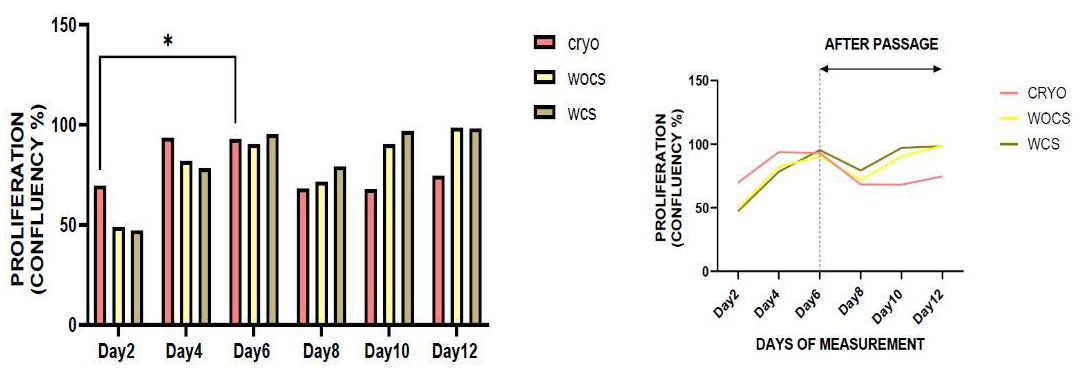
The study confirmed that NPCs stored in CellShip at 4 °C recovered and proliferated similarly to conventionally cryopreserved cells. Image Credit: Image courtesy of Life Science Group Ltd. in partnership with ELRIG (UK) Ltd.
6. Future objectives
- Extend preservation duration beyond the current short-term time points to define the maximum practical transport window.
- Optimize CellShip® conditions for sensitive and advanced cell models.
- Expand assessment beyond viability to include proliferation, phenotype, differentiation capacity, and functional activity.
- Evaluate performance across additional temperatures, transport conditions, and real-world shipping scenarios.
CellShip® offers a potential alternative to cryopreservation by enabling short-term preservation and transport of multiple mammalian cell types without the need for freezing.
7. Acknowledgments
- Coventry University, Coventry
- Julius-Maximilians-Universität Würzburg
- University Hospital, LMU Munich
About Life Science Group Ltd.

Life Science Group (LSG) is an independent UK manufacturer of cell culture media, buffers, sera and transport media. From our site in Sandy, Bedfordshire, we supply research, diagnostic and bioprocessing customers, and manufacture custom liquids from trial batches up to 2,000 liters.
Life Science Group is a partner to the industry with a simple aim: to further science. As a proudly independent, UK-based company, we offer industry-leading customer care, because every customer matters to us.
We make ready-to-use reagents, including cell culture media, buffers, animal and human sera, and our CellShip and T-Store transport media. Our contract manufacturing team also produces custom formulations, backed by an ISO 13485 and ISO 9001 quality system and ISIA traceability certification.
We work from The Science Centre in Sandy, Bedfordshire, which houses our manufacturing, laboratory and warehouse space and our Grade C/D cleanrooms.
About ELRIG (UK) Ltd.
The European Laboratory Research & Innovation Group (ELRIG) is a leading European not-for-profit organization that exists to provide outstanding scientific content to the life science community. The foundation of the organization is based on the use and application of automation, robotics and instrumentation in life science laboratories, but over time, we have evolved to respond to the needs of biopharma by developing scientific programs that focus on cutting-edge research areas that have the potential to revolutionize drug discovery.
Comprised of a global community of over 12,000 life science professionals, participating in our events, whether it be at one of our scientific conferences or one of our networking meetings, will enable any of our community to exchange information, within disciplines and across academic and biopharmaceutical organizations, on an open access basis, as all our events are free-of-charge to attend!
Our values
Our values are to always ensure the highest quality of content and that content will be made readily accessible to all, and that we will always be an inclusive organization, serving a diverse scientific network. In addition, ELRIG will always be a volunteer led organization, run by and for the life sciences community, on a not-for-profit basis.
Our purpose
ELRIG is a company whose purpose is to bring the life science and drug discovery communities together to learn, share, connect, innovate and collaborate, on an open access basis. We achieve this through the provision of world class conferences, networking events, webinars and digital content.
Sponsored Content Policy: News-Medical.net publishes articles and related content that may be derived from sources where we have existing commercial relationships, provided such content adds value to the core editorial ethos of News-Medical.net, which is to educate and inform site visitors interested in medical research, science, medical devices and treatments.
Last Updated: Nov 19, 2026