This article and associated images are based on a poster originally authored by Steven R. Brown, Nuno Leitão, Adam Winnifrith, Thomas Lanyon-Hogg, Caroline Wickramasinghe, Philip E. Kay, and Markus Gershater and presented at ELRIG Drug Discovery 2026 in affiliation with Synthace, University of Oxford, SPT Labtech and SAS Institute.
This poster is being hosted on this website in its raw form, without modifications. It has not undergone peer review but has been reviewed to meet AZoNetwork's editorial quality standards. The information contained is for informational purposes only and should not be considered validated by independent peer assessment.

Adam's assay development challenge
Adam is a Master's student in the Department of Pharmacology at the University of Oxford investigating antimicrobial resistance. His research focuses on developing and optimizing a novel biochemical assay for RecBCD, a DNA damage-repair enzyme central to the evolution of antibiotic resistance.
Starting with theoretical knowledge of RecBCD's mechanism of action and a limited timeframe, he sought to acquire the experimental tools needed to advance his project.
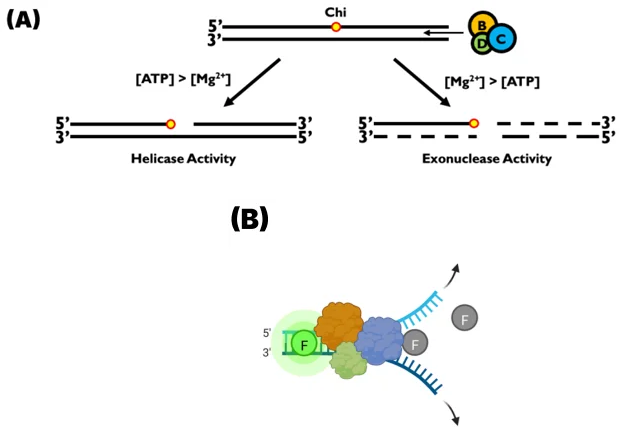
The RecBCD assay principle. (A) RecBCD activity is modulated by the ATP:Mg2+ ratio. (B) QuantiFluor dsDNA dye (F) fluoresces when bound to dsDNA; RecBCD (orange, blue, and green complex) exonuclease processing of dsDNA is detected as a decrease in fluorescence. Image Credit: Image courtesy of Steven R. Brown et al., in partnership with ELRIG (UK) Ltd.
Bringing together a research toolbox: Methodology, planning, execution, and analysis
Experiment methodology
Adam recognized that optimizing this complex assay required evaluating interactions among 10 variables.
Design of experiments (DOE)
- Systematic and simultaneous evaluation of variables (multivariate), enabling quantitative identification of interactions
- Efficient use of resources
- Improved reproducibility and robustness of experimental outcomes
Experiment planning
A multivariate design, in which all variable setpoints change for each observation, adds complexity to experiment planning.
Synthace software
- Integration of DOE designs and experimental methods
- In silico experiment simulation and labware planning
- Instruction generation for automated liquid handling systems
- Automatic structuring of experiment design, metadata, and results
Experiment execution
Using the generated experiment instructions, the research required an automated liquid handler to perform accurate, reproducible, and rapid low-volume transfers.
SPT Labtech dragonfly® discovery
- Ten independent non-contact dispensing channels for ultimate flexibility
- Accurate and repeatable low-volume dispensing
- Supports all liquid viscosities
- Rapid programming and high speed plate setup
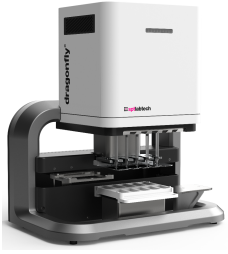
Image Credit: Image courtesy of Steven R. Brown et al., in partnership with ELRIG (UK) Ltd.
Data analysis
Instead of curve descriptors, Adam wanted to model full reaction time courses to link experimental variables to changes in curve shape.
JMP Statistical Discovery functional data explorer
- Models entire data structure, keeping the context and nuance that summarisation loses
- Includes smoothing and functional principal component analysis (FPCA), making key features stand out
- Model assay reaction curves as a function of experimental variables
Results of Adam's research using the toolbox
✓ Ten variables investigated
✓ Three weeks (two experiment iterations and assay validation)
✓ 0.59 Z' value of assay
Experiment iteration one
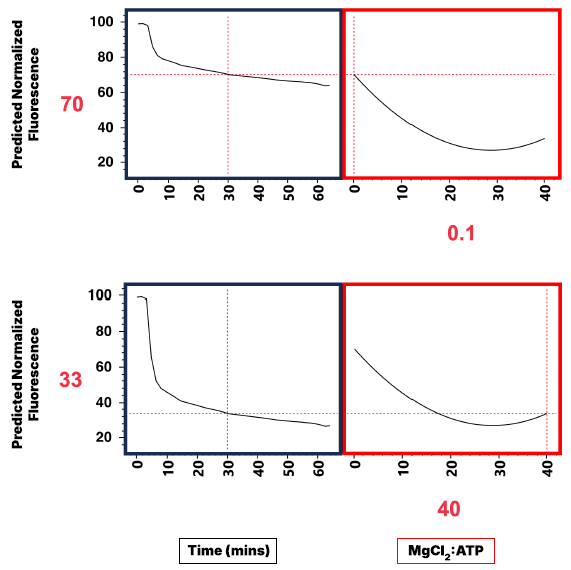
Image Credit: Image courtesy of Steven R. Brown et al., in partnership with ELRIG (UK) Ltd.
Consistent with existing literature, a four-factor DOE identified optimal MgCl2:ATP ratios that enhance nuclease activity.
Experiment iteration two
A 10-factor space-filling DOE highlighted key and non-impactful factors using Z'. A significant three-way interaction between pH, [BSA], and [RecBCD] was discovered.
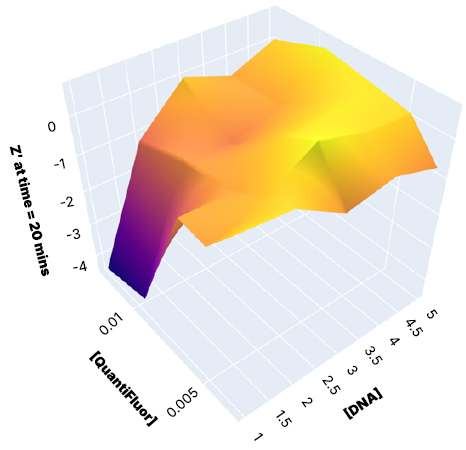
Image Credit: Image courtesy of Steven R. Brown et al., in partnership with ELRIG (UK) Ltd.
Assay validation
To check the robustness of the assay, the best assay conditions were repeated 128 times, yielding a Z' of 0.59 (measured after 10 minutes).
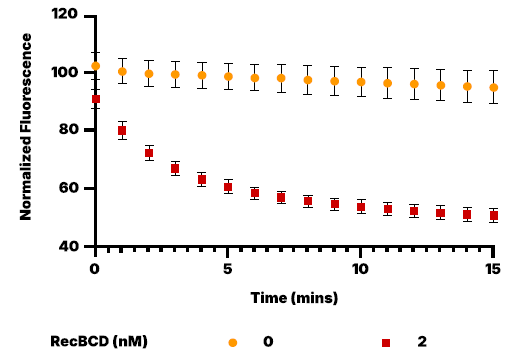
Image Credit: Image courtesy of Steven R. Brown et al., in partnership with ELRIG (UK) Ltd.
Summary
DOE, Synthace, the dragonfly® discovery, and JMP enabled rapid development of a robust RecBCD assay, offering a versatile toolbox for novel assay optimization.

About Synthace
Synthace is a digital experiment platform built for life science R&D teams to help them run more powerful experiments. It digitizes experiments from end to end: with minimal training, scientists can design and plan reproducible experiments, simulate them ahead of time, run them on their automation equipment, and automatically structure all of their experimental data and metadata in a single place. Controlled from a browser window and needing no code to operate, it makes experiments easier to run in the lab, increases the scientific value of experiments, and also makes it possible to run experiments that were previously thought impossible.
About ELRIG (UK) Ltd.
The European Laboratory Research & Innovation Group (ELRIG) is a leading European not-for-profit organization that exists to provide outstanding scientific content to the life science community. The foundation of the organization is based on the use and application of automation, robotics, and instrumentation in life science laboratories, but over time, we have evolved to respond to the needs of biopharma by developing scientific programs that focus on cutting-edge research areas that have the potential to revolutionize drug discovery.
Comprised of a global community of over 12,000 life science professionals, participating in our events, whether it be at one of our scientific conferences or one of our networking meetings, will enable any of our community to exchange information, within disciplines and across academic and biopharmaceutical organizations, on an open access basis, as all our events are free of charge to attend!
Our values
Our values are to always ensure the highest quality of content, that content will be made readily accessible to all, and that we will always be an inclusive organization, serving a diverse scientific network. In addition, ELRIG will always be a volunteer-led organization, run by and for the life sciences community, on a not-for-profit basis.
Our purpose
ELRIG is a company whose purpose is to bring the life science and drug discovery communities together to learn, share, connect, innovate, and collaborate on an open-access basis. We achieve this through the provision of world-class conferences, networking events, webinars, and digital content.
Sponsored Content Policy: News-Medical.net publishes articles and related content that may be derived from sources where we have existing commercial relationships, provided such content adds value to the core editorial ethos of News-Medical.net, which is to educate and inform site visitors interested in medical research, science, medical devices, and treatments.
Last Updated: Nov 2, 2026