This article and associated images are based on a poster originally authored by Irma O’Meara, Caitlin Shaw, Ana-Maria Nastase, Lauren Toms, Grace Haydon, Robert Pedley, Mohamed Naeem Khan, Talat Nahid Khan, Michael Eyres, Philip Auckland, Bruno Bellina, Gayle Marshall, and Bridgeen Callan and presented at ELRIG Drug Discovery 2025 in affiliation with Medicines Discovery Catapult (MDC) and KLAS Therapeutics.
This poster is being hosted on this website in its raw form, without modifications. It has not undergone peer review but has been reviewed to meet AZoNetwork's editorial quality standards. The information contained is for informational purposes only and should not be considered validated by independent peer assessment.

KLAS-PDT assessment
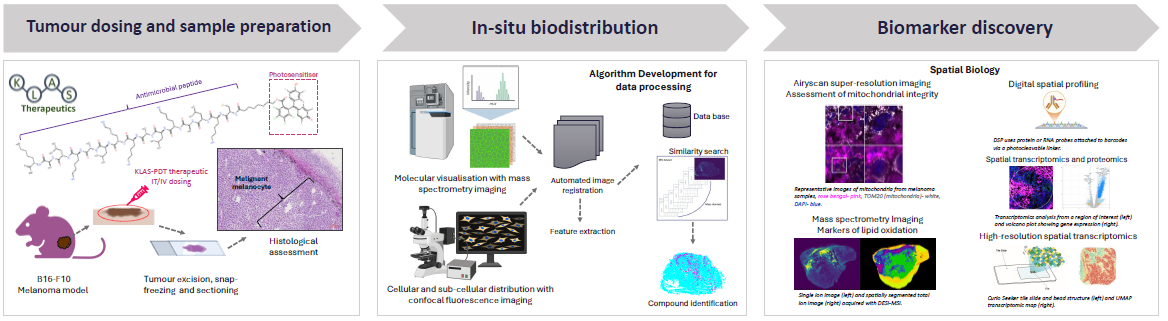
Image Credit: Image courtesy of Irma O’Meara et al., in partnership with ELRIG (UK) Ltd.
KLAS-PDT biodistribution
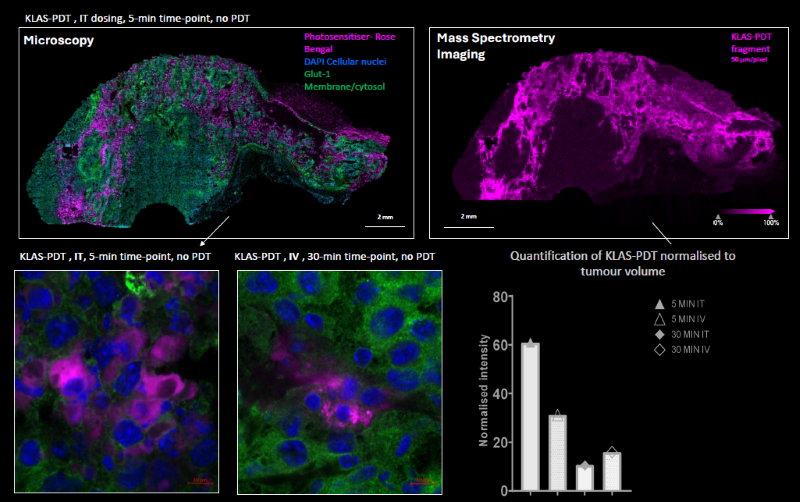
Image Credit: Image courtesy of Irma O’Meara et al., in partnership with ELRIG (UK) Ltd.
To assess the in situ biodistribution of KLAS-PDT, MDC developed a workflow that integrated MSI and fluorescence microscopy for the identification of KLAS-PDT in preclinical models of melanoma. An algorithm developed during the data processing step enabled data integration, identification, and quantification of the KLAS-PDT therapeutic. Accumulation of KT-001 was observed from the five-minute time point using both IT and IV route.
KLAS-PDT activation- Lipid oxidation
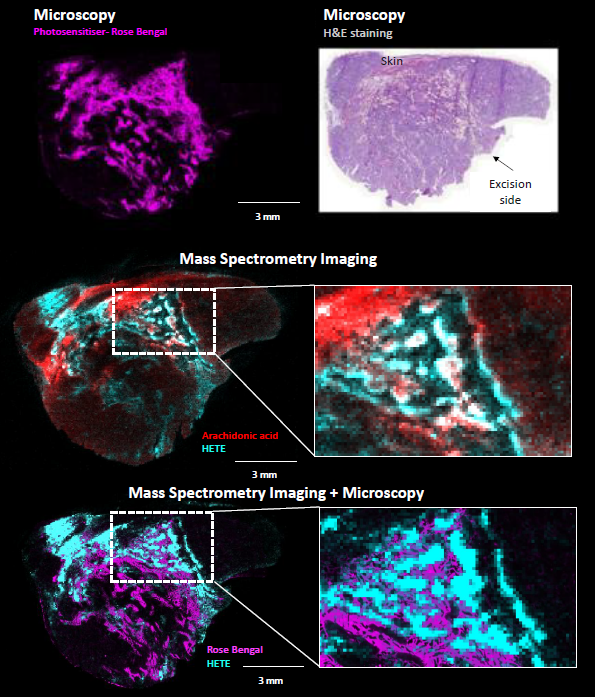
Image Credit: Image courtesy of Irma O’Meara et al., in partnership with ELRIG (UK) Ltd.
Source: ELRIG (UK) Ltd.
| Position of unsaturation |
Fatty acid chain |
MW |
[M-H] |
| C20:4n6 |
Arachidonic acid |
304.2402 |
303.2330 |
| C20:4;O |
Hydroxy Arachidonic Acid (20-HETE) |
320.2351 |
319.2279 |
| C20:4;O2 |
Arachidonic acid 5-hydroperoxide (5-HpETE) |
336.2300 |
335.2228 |
| C18:2n6 |
Linoleic acid |
280.2402 |
279.2330 |
| C18:2;O |
Hydroxy linoleic acid (9-HODE) |
296.2351 |
295.2279 |
| C18:2;O2 |
Dihydroxy linoleic acid (9S-HpODE) |
312.2300 |
311.2228 |
| C22:6n3 |
Docosahexaenoic acid (DHA) |
328.2402 |
327.2330 |
| C20:5n3 |
Eicosapentaenoic acid (EPA) |
302.2245 |
301.2173 |
| C20:5;O |
Hydroxy-EPA (20-HEPE) |
318.2194 |
317.2122 |
| C20:5;O2 |
Dihydroxy-EPA (5S-HpEPE) |
334.2144 |
333.2071 |
| C22:5n3 |
Docosapentaenoi c acid (DPA) |
330.2558 |
329.2486 |
Spatial distribution of arachidonic acid (AA) and its oxidized product hydroxy arachidonic acid (HETE). The distribution or AA matches the areas with remaining skin structure whereas HETE is localized in close proximity to regions with Rose Bengal. Similarly, other oxidized fatty acid species (shown in the table above), such as hydroxyl linoleic acid, hydroxy EPA, and dihydroxy EPA, were also detected with a similar distribution as HETE.
The detection of these species could be explained by the peroxidation of the fatty acid species pathway, where hydroxy fatty acid species are produced from the presence of reactive oxygen species (ROS), possibly derived from the activation of KLAS-PDT. All ions were putatively assigned according to their exact masses.
KLAS-PDT activation- Mitochondria imaging
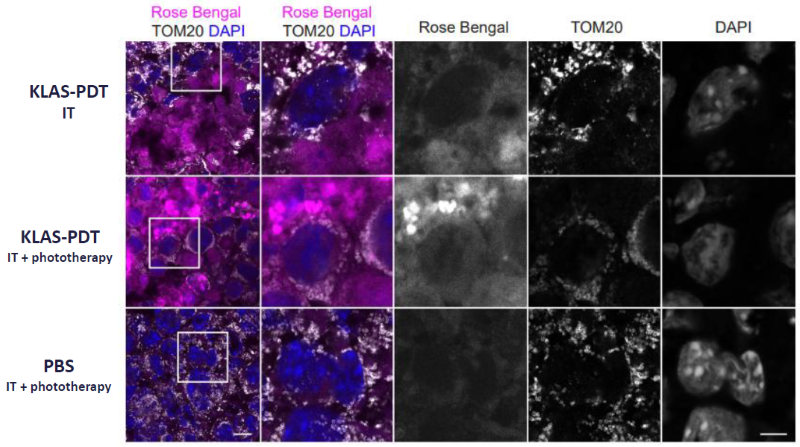
Image Credit: Image courtesy of Irma O’Meara et al., in partnership with ELRIG (UK) Ltd.
*Rose Bengal- Photosensitiser, TOM20- mitochondria, DAPI- nucleus
Representative airyscan images of mitochondria in malignant melanoma tissue sections following KLAS-PDT dosing with and without phototherapy, as well as a samples dosed with PBS used as a control + phototherapy. The signal intensity from the mitochondria seems to decrease in areas where rose bengal from the KLAS-PDT compound was present.
KLAS-PDT activation- Transcriptomic changes
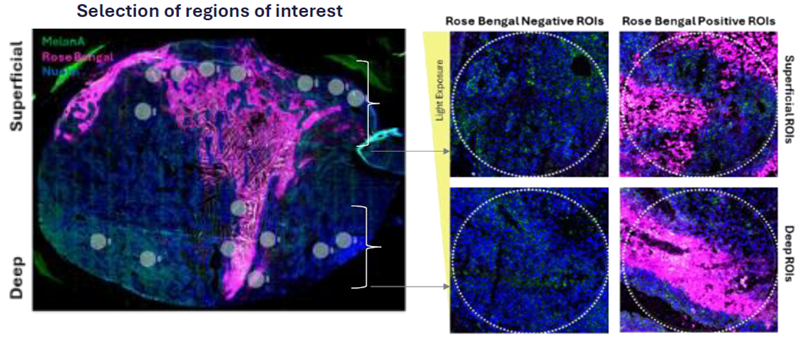
Image Credit: Image courtesy of Irma O’Meara et al., in partnership with ELRIG (UK) Ltd.
Selection of regions of interest (ROIs) based on the presence of the rose bengal (RB+, RB-) and the region of tumor (surface or excision side).
Whole transcriptome analysis
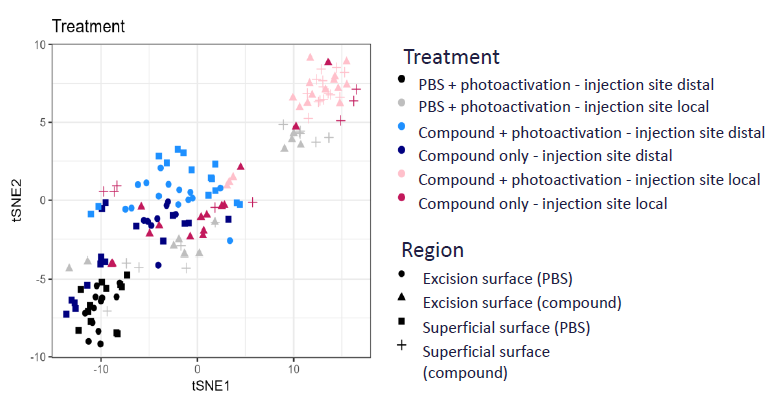
Image Credit: Image courtesy of Irma O’Meara et al., in partnership with ELRIG (UK) Ltd.
Plot showing the t-SNE dimensional reduction of transcriptomic profiles from samples treated with KLASPDT with and without photoactivation or with PBS and photoactivation (controls).
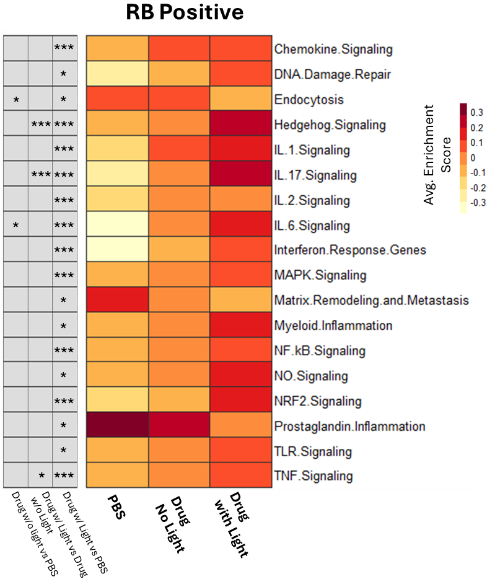
Image Credit: Image courtesy of Irma O’Meara et al., in partnership with ELRIG (UK) Ltd.
Possible enriched pathways identified with DSP-protein analysis. The heatmap shows the average enrichment score for each treatment group. This analysis highlighted interleukin, TNF, and inflammation-associated pathways that were upregulated with treatment, as well as increased DNA damage repair, NO signaling, a decrease in matrix remodeling, and metastasis pathways in RB+ regions.
Single-cell spatial transcriptomics by Curio Seeker
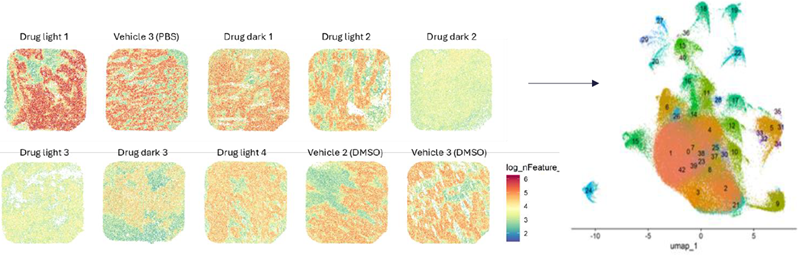
Image Credit: Image courtesy of Irma O’Meara et al., in partnership with ELRIG (UK) Ltd.
Curio Seeker tiles comprise a monolayer of barcoded microparticles (beads) that contain poly(dT) sequences, allowing mRNA molecules from the tissue to hybridize. Gene expression is reconstructed spatially by using the bead barcode to map individual sequencing reads back to their original XY coordinate. This approach enables unbiased, spatial, whole-transcriptome profiling at single-cell resolution.
Conclusion
- MDC applied Spatial Biology to the analysis of preclinical melanoma models dosed with KLAS-PDT (non-activated and photoactivated).
- Accumulation of KLAS-PDT was observed from the five-minute time point using both IT and IV routes.
- High-resolution microscopy revealed the colocalization of KLAS-PDT with malignant melanocytes. The intensity from the mitochondrial staining seems to decrease where rose bengal was present.
- Molecular imaging revealed the possible presence of oxidized fatty acid species localized in close proximity to regions with photoactivated KLAS-PDT compound. These species could be derived from lipid peroxidation initiated by ROS.
- Spatial transcriptomics and proteomics analysis suggested that rose bengal-positive areas showed enriched immune and inflammation-associated pathways, including possible upregulation of immune activation markers.
- All together, these results underscore the transformative power of spatial biology in oncology drug development and set the stage for the advancement of KLAS-PDT towards clinical application.
About Medicines Discovery Catapult
Medicines Discovery Catapult (MDC) is a national UK life-sciences organisation dedicated to accelerating drug discovery and translating bold scientific ideas into real-world therapeutics.
MDC’s team of scientists, technologists, and strategists apply their expertise across in-vitro biology, in-vivo biology, translational medicine, and a range of modalities (small molecules, large molecules, new modalities, radiopharmaceuticals) to support target identification, lead generation, lead optimisation, candidate selection and clinical translation.
About ELRIG (UK) Ltd.
The European Laboratory Research & Innovation Group (ELRIG) is a leading European not-for-profit organization that exists to provide outstanding scientific content to the life science community. The foundation of the organization is based on the use and application of automation, robotics and instrumentation in life science laboratories, but over time, we have evolved to respond to the needs of biopharma by developing scientific programs that focus on cutting-edge research areas that have the potential to revolutionize drug discovery.
Comprised of a global community of over 12,000 life science professionals, participating in our events, whether it be at one of our scientific conferences or one of our networking meetings, will enable any of our community to exchange information, within disciplines and across academic and biopharmaceutical organizations, on an open access basis, as all our events are free-of-charge to attend!
Our values
Our values are to always ensure the highest quality of content and that content will be made readily accessible to all, and that we will always be an inclusive organization, serving a diverse scientific network. In addition, ELRIG will always be a volunteer led organization, run by and for the life sciences community, on a not-for-profit basis.
Our purpose
ELRIG is a company whose purpose is to bring the life science and drug discovery communities together to learn, share, connect, innovate and collaborate, on an open access basis. We achieve this through the provision of world class conferences, networking events, webinars and digital content.
Sponsored Content Policy: News-Medical.net publishes articles and related content that may be derived from sources where we have existing commercial relationships, provided such content adds value to the core editorial ethos of News-Medical.Net which is to educate and inform site visitors interested in medical research, science, medical devices and treatments.
Last Updated: Nov 26, 2025