Discover how Oi View delivers real-time insights, revolutionizes lab management, and enhances productivity for Oxford Instruments users.
Could you explain the main features of Oi View and how they benefit the users?
Ed Jackson:
Oi View is intended to be a comprehensive but user-friendly tool that tackles important challenges in lab administration, a one-stop shop for information to help you get the most out of your equipment.
One of the key advantages is real-time system monitoring, which enables customers to rapidly check the health of their equipment. This is advantageous since it allows you to handle problems before they worsen, reducing downtime.
Another feature is the centralized consultation portal, which allows users to view and exchange papers, contact Oxford Instruments specialists, and monitor the status of their consultations. This improves communication and ensures everyone is on the same page.
The system is dynamic - it adapts to how you engage with it, bringing the most relevant information to the front so you can concentrate on what is essential.
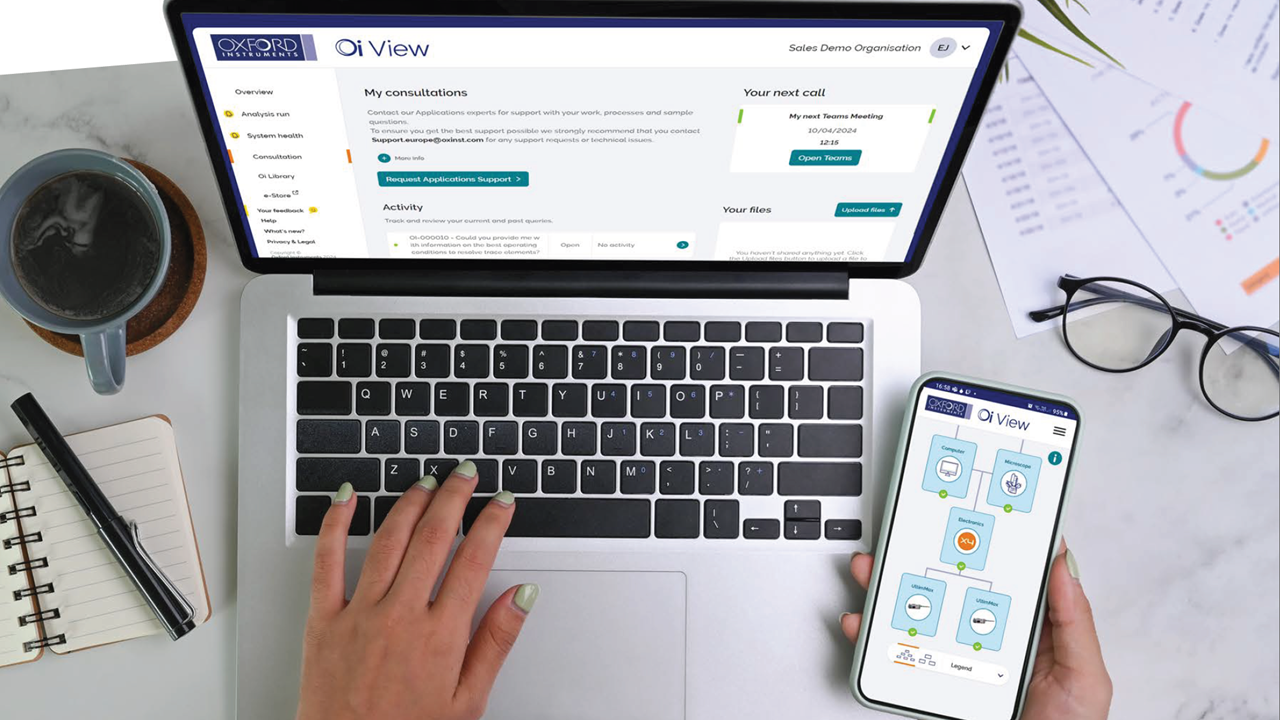
Image Credit: Oxford Instruments
What are the advantages of Oi View providing real-time data, and how does it improve the utilization of Oxford Instruments equipment?
Ed Jackson:
Real-time data is a game changer in laboratories. By delivering up-to-date information on the state of your equipment, Oi View enables you to make educated choices fast. For example, if a piece of equipment malfunctions, you will be notified right away, allowing you to take corrective action before the problem disrupts your operation.
This proactive approach shirnks downtime and extends the life of your equipment whilst ensuring it is constantly functioning at peak performance.
In addition, having real-time data accessible across different devices allows you to monitor your lab's activities from the workplace, at home, or while traveling. It is all about ensuring that your laboratory works as smoothly as possible, even when you are not there.
How does the system health monitoring feature work, and why is it crucial for facility managers?
Ed Jackson:
The system health monitoring tool intends to provide facility managers and technicians with peace of mind and an early warning. It operates by continually monitoring the condition of all linked systems for any indications of problems, such as a drop in performance, an error message, or anything else. If it detects anything out of the norm, it delivers a notification via email or a push notification on a device, allowing for a quick response.
This is critical because it enables issues to be handled before they escalate, lowering the chance of expensive downtime.
Since this monitoring occurs in real time, managers do not have to examine each system manually; instead, they can depend on Oi View to monitor things for them. It is like having an additional pair of eyes constantly watch over your lab.
How did customer feedback influence the development of Oi View? Can you provide some specific examples?
Ed Jackson:
Customer input was very important in designing Oi View. We began by engaging with our users to better understand their needs and issues. For example, we discovered that lab managers want a more simplified approach to monitoring their systems and accessing essential data without jumping through many hoops.
This prompted the development of the dynamic overview feature in Oi View, which reprioritizes systems depending on real-time alerts and updates. Another example is our focus on data security, which sprang from consumer concerns.
We did not only want to satisfy industry norms; we wanted to surpass them. So we spent substantially in third-party security audits and penetration testing to guarantee that our consumers' data is safeguarded at all stages.
Can you elaborate on the consultation services provided through Oi View and how users can benefit from them?
Ed Jackson:
The consultation services in Oi View are intended to make professional advice more accessible. Users may seek consultations directly via the platform, whether they need assistance resolving a problem, enhancing system performance, or organizing future tests.
The beauty of this function is that it provides more than advice; it also creates a recorded history of consultations you may return to at any time.
This is especially important for laboratories that must maintain a high level of compliance or routinely work on complicated projects where previous insights might guide future choices.
This is incorporated into Oi View, so users do not need to leave the platform to obtain the required assistance - it is all right there.
Security is a critical aspect of any digital platform. What measures have you taken to ensure data security within Oi View?
Ed Jackson:
Oxford Instruments takes security extremely seriously, and Oi View is no exception. We have taken a multi-layered strategy to protect our consumers' data. First, all data communicated over Oi View is encrypted, both in transit and at rest. This means that even if someone intercepts the data, they cannot read it.
We have also replaced conventional passwords with Magic Links provided to users' emails. This lowers the danger of password-related security breaches. We have also worked with third-party security organizations to undertake regular penetration testing and uncover vulnerabilities. We understand that our consumers must believe that their data is secure, and we are dedicated to preserving that confidence via continuing security advancements.
How does Oi View enhance user experience, especially regarding ease of access and usability across different devices?
Ed Jackson:
One of our primary goals with Oi View was to make it as accessible and user-friendly as possible. Whether on a PC, tablet, or smartphone, the experience is uniform and straightforward. This is especially important in a lab setting, where you may need to verify something fast while on the road.
We have also ensured that the platform is simple to use, with a clear layout highlighting the information that matters most to users. Since Oi View is a progressive web app, it works just like a native app on your phone, but found in your browser, allowing you to access all your data and features intuitively.
This ease of use across numerous devices is ensures that technology works for the user rather than the other way around.
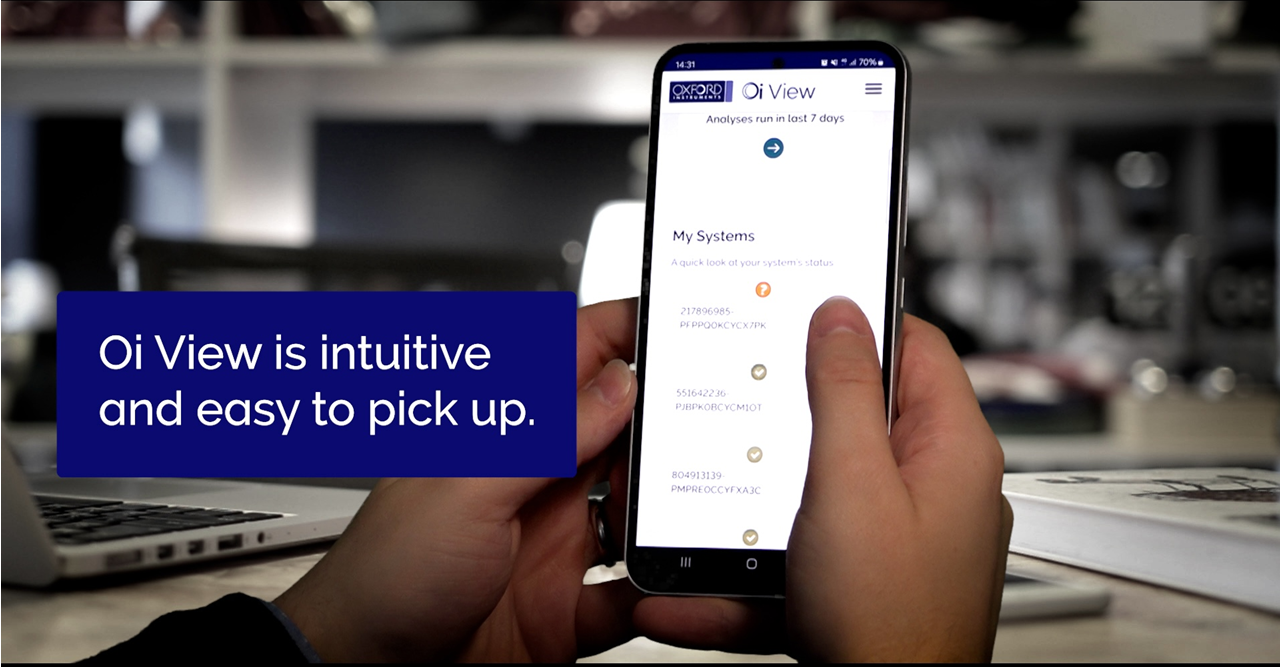
Image Credit: Oxford Instruments
What are the benefits of Oi View being a progressive web app, and how does it impact the delivery of new features and updates?
Ed Jackson:
The choice to build Oi View as a progressive web app was deliberate. Progressive web apps combine the finest features of online and mobile applications, allowing users to access them via a browser while providing the functionality and experience of native apps. One significant advantage is that updates are seamless.
Users are not required to download new versions or install anything manually; when we release a new feature or patch, it is accessible to everyone immediately. This enables us to be more nimble in our development process and react more quickly and effectively to customer input.
PWAs have lightweight data requirements and require minimal space on your device. It is all about offering a robust and responsive experience that adapts to our consumers' demands.

Image Credit: Oxford Instruments
You mentioned that customer feedback will continue to shape future updates. Can you give us a sneak peek into some of the features or improvements planned for Oi View?
Ed Jackson:
We always listen to our users and have some interesting upgrades in the works. One area we are working on is growing the number of connectors with different lab management solutions. We understand that laboratories employ a variety of applications to handle various elements of their operations, therefore we are aiming to make Oi View more compatible with these systems.
Another feature we are looking at is better data visualization, enabling users to build more thorough reports and dashboards inside the platform. Of course, we will continue strengthening our security measures to ensure the platform stays safe and trustworthy as it develops.
These are only a few examples, but the objective is to make Oi View more useful and customized to our consumers' requirements, making it the first place to go for insights and information.
About Dr Ed Jackson
Dr Ed Jackson graduated with an MPhys in Physics from the University of York and later a PhD in electron microscopy from the same institute. He joined the company in 2019 as part of the Technical Support and Training team, applying his knowledge to directly educate and support customers. His current focus is to develop new ways we can provide support to the customer, to ensure that everyone gets the best out of Oxford Instruments equipment and software.
About Oxford Instruments
Oxford Instruments is a leading provider of high-technology tools and systems for research and industry, dedicated to accelerating breakthroughs that create a brighter future for our world. With a global presence, we are committed to innovation and excellence, offering cutting-edge solutions that enable researchers and industry professionals to achieve breakthroughs in their fields. Our advanced technologies deliver numerous benefits through unparalleled precision and reliability, allowing users to obtain accurate and reproducible results. By utilising Oxford Instruments' innovative solutions, research is accelerated, productivity is enhanced, and innovation is achieved in various fields, including materials analysis, life sciences, semiconductors, physics, chemistry, and food sciences. We take pride in being a trusted partner for those aiming to push the boundaries of scientific and industrial advancements, providing the tools and support necessary to realise their visions.
Atomic force microscopy: These advanced instruments are utilised for high-resolution imaging and precise measurement of surface properties at the nanoscale level. They offer detailed topographical information and enable accurate measurements of features such as height, roughness, and mechanical properties.
Light microscopy: Our solutions encompass a comprehensive range of advanced imaging systems that utilise visible light for examining samples at the microscale. Equipped with high-quality lenses, cameras, and illumination systems, these optical microscopes deliver detailed images with exceptional clarity and resolution. They find applications in fields such as biology, materials science, and forensics.
Deposition and etching: Our advanced tools are specifically designed for the precise fabrication and modification of materials at the nanoscale. They include a variety of deposition techniques like physical vapor deposition (PVD), chemical vapour deposition (CVD), and atomic layer deposition (ALD), as well as etching processes, such as plasma etching and reactive ion etching (RIE). These tools empower users to create customised materials and devices with exceptional control and precision.
Electron microscopy analysis: Our high-performance tools are tailored for materials characterisation, particle analysis, and sample manipulation at the nanometre scale. Techniques such as Backscatter Electron and X-ray (BEX), Energy Dispersive Spectroscopy (EDS), and Electron Backscatter Diffraction (EBSD) enable imaging, chemical analysis, and crystallographic characterisation of materials at atomic and nanoscale levels.
Optical imaging and spectroscopy: Our optical imaging solutions comprise a range of advanced technologies and systems for capturing and analysing images using light. From state-of-the-art optical microscopes to spectroscopy systems and imaging software, these solutions provide high-quality images and data for applications such as materials characterisation, biological research, and semiconductor analysis.
Nanoindentation: Our high-resolution, MEMS-based nanoindenters are designed to measure the mechanical properties of materials, including hardness, elastic modulus, stiffness, and creep behaviour. These instruments offer superior fabrication tolerances, enhancing sensitivity, resolution, and repeatability beyond conventional technology limits.
Nuclear magnetic resonance: We offer a variety of benchtop Nuclear Magnetic Resonance (NMR) instruments for research, industrial quality assurance/control, and rock core analysis. These instruments provide advanced capabilities for chemical analysis, materials characterisation, and more.
Raman microscopy: Our advanced imaging systems are tailored for high-resolution microscopy and analysis, offering cutting-edge technology and precision optics for detailed insights into samples at the micro- and nanoscales. Trusted by researchers and scientists in fields such as materials science, life sciences, and nanotechnology, these systems are available in various models to suit different applications.
X-ray technologies: Our technologies encompass a range of advanced systems and solutions for materials analysis and characterisation. With cutting-edge capabilities and high sensitivity, Oxford Instruments X-ray technologies are widely used in various industries and research academic institutions for applications such as material identification, quality control, and research in fields like geology, metallurgy, and semiconductor manufacturing.