In this interview, News Medical speaks with Brian Keith, Applications Engineer at TMC Vibration Control about the critical role of vibration isolation in drug discovery research. The discussion explores how nanometer-scale stability supports advanced microscopy, why even minimal environmental vibrations can affect image quality and data accuracy, and how collaborative facility planning can help researchers achieve reliable, high-resolution results in complex biomedical and cancer research environments.
Could you please describe your role at TMC?
I am an Applications Engineer at TMC, where I support life science and biomedical research customers by providing vibration isolation solutions for sensitive imaging and measurement instruments. My role involves collaborating with researchers, microscope manufacturers, and facility design teams to evaluate vibration environments and ensure that advanced microscopy systems perform at their highest possible resolution, particularly in drug discovery and cancer research applications.
What is the importance of stability at the nanometer scale?
Stability is critical at the nanometer scale because modern biomedical imaging techniques measure structures that are the same size, or smaller, than many environmental vibrations. Any mechanical motion at this level directly limits image resolution and data accuracy, making sub-nanometer stability essential for reliable results.

Image Credit: TMC Vibration Control
How can vibrations, even those that are extremely small, impact image acquisition?
Even extremely small vibrations can cause image blur, drift, or loss of focus in long-term microscopy studies. Over-extended acquisition times, these vibrations accumulate, reducing image clarity and making it difficult to achieve reproducible, high-quality data.
What role does vibration isolation play in cellular research?
Vibration isolation provides a mechanically quiet platform that allows advanced microscopes to operate at their design limits. By reducing floor-borne and structural vibrations, isolation systems enable longer imaging sessions, higher resolution, and more consistent experimental outcomes.
What unique challenges can soft or riverbank soil present?
Buildings located on soft or riverbank soil often experience amplified low-frequency ground motion from environmental sources such as traffic or nearby infrastructure. These low-frequency vibrations are especially challenging for sensitive microscopy equipment because they are difficult to isolate and can significantly degrade instrument performance.
How do soil conditions influence infrastructure, and what is the importance of stable foundations?
Soil conditions determine how vibrations propagate into a building, while the building’s structural design controls how those vibrations reach the instrument. Flexible floors, long-span slabs, and upper-level installations can amplify motion, negatively impacting high-precision instruments.
Stable foundations work hand in hand with vibration isolation systems. A stiff slab or inertial block provides a reliable reference point, allowing the isolation system to effectively attenuate vibrations and minimize resonance peaks.
What approach does TMC take to environmental compensation?
TMC’s vibration isolation technologies are designed to mitigate environmental factors that cannot be engineered out of a building’s location. Through advanced active cancellation systems, we can significantly reduce the impact of traffic, building resonance, and soil-related vibration across a wide frequency range.
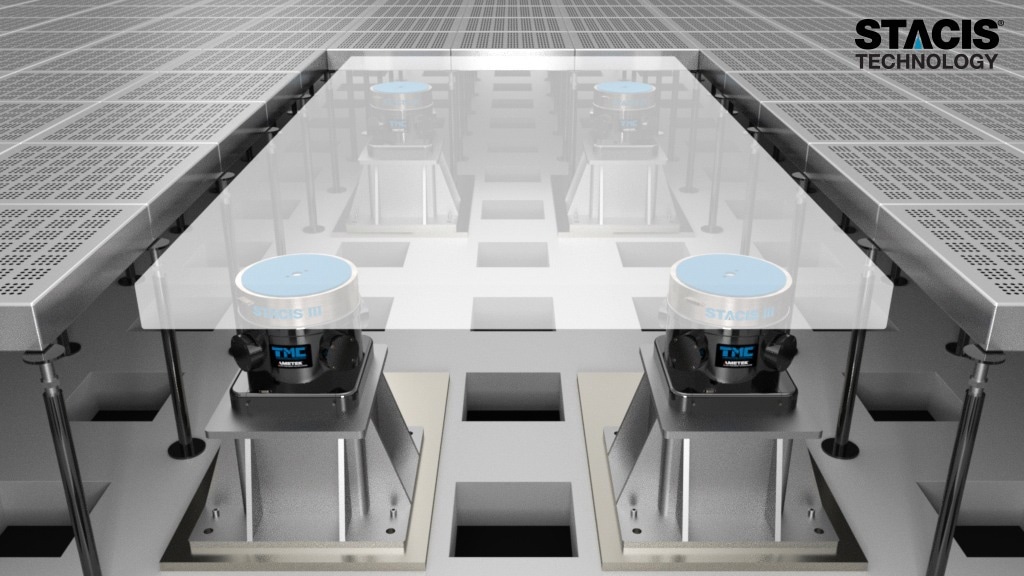
Image Credit:TMC Vibration Control
How important has a collaborative approach proven to be?
Collaboration among equipment manufacturers, facility designers, and vibration-isolation experts is essential for successful research environments. At institutions such as Oregon Health & Science University (OHSU), early coordination between these groups helped address challenging soil and site conditions, enabling high-performance microscopy within a complex urban and hillside environment.
How do you see vibration isolation progressing in biomedical research?
As biomedical and cancer research technologies continue to evolve, vibration isolation will need to support higher resolution, longer acquisition times, and more sensitive instruments. Future solutions will involve deeper integration with instruments and earlier involvement in facility planning, ensuring stability remains a foundational element of next-generation research.

About Brian Keith
Brian Keith is an applications engineer with TMC. He has a Ph.D. in Physics from Clark University. There, he worked with the novel magnetic materials group. After graduate school, he worked in Cryogenics for ten years and has been with TMC for the past two years.
About TMC Vibration Control
TMC is a global leader in precision floor vibration isolation systems with over 50 years of experience.
Major research centers, OEM and end-user semiconductor manufacturers, drug discovery companies, and nanotechnology labs across all seven continents rely on TMC solutions to support ultra-precision measurements, instruments, and manufacturing.
TMC’s precision floor vibration isolation product line ranges from isolated microscope bases and damped optical tables to sophisticated active vibration cancellation systems featuring piezoelectric actuators and digital controllers.
In addition, TMC offers active magnetic field cancellation systems and acoustic noise isolation enclosures that, together with vibration isolation, provide complete environmental noise control. Environmental surveys performed on-site by experienced TMC service engineers and state-of-the-art measurement equipment are also available.
TMC systems are designed and manufactured at the company’s vertically integrated factory and headquarters in Peabody, Massachusetts. The facility is ISO 9001:2015 certified.
TMC is a unit of AMETEK Ultra Precision Technologies, a pioneer in the development of ultraprecision measurement instruments and a global leader in ultraprecise machine tools and manufacturing systems for the semiconductor, photovoltaic, nanotechnology, military, defense, and ophthalmic lens markets.
AMETEK Ultra Precision Technologies is a division of AMETEK, Inc., a leading global manufacturer of electronic instruments and electromechanical devices with annualized sales of approximately $5 billion.