In this interview, industry expert Paul Baker explores data quality in untargeted metabolomics and lipidomics, comparing DDA and DIA approaches for cleaner spectra, confident identification, and quantitative analysis.
To get started, what are some of the main challenges in untargeted metabolomics and lipidomics?
One of the biggest challenges is achieving comprehensive coverage while still generating data that is clean enough to confidently identify compounds.
Metabolomics and lipidomics samples can contain a huge number of molecules across a relatively narrow mass range. Many compounds may also be present at very different abundance levels, so an acquisition strategy needs to capture lower-abundance molecules without compromising the quality of the MS/MS spectra.
Another major issue is reproducibility. Ideally, if you inject the same sample more than once, you want to obtain comparable information each time. At the same time, you need sufficiently selective MS/MS data to distinguish molecules in complex biological samples and accurately match them against reference libraries.
For me, this means the focus should not simply be on the number of features detected. The quality and reliability of those identifications are ultimately much more important.

Image Credit: Anusorn Nakdee/Shutterstock.com
How does data-dependent acquisition work, and where can it fall short?
Data-dependent acquisition (DDA) has traditionally been considered the gold standard for generating spectral databases in metabolomics and lipidomics because it can yield high-quality MS/MS spectra.
The challenge is that precursor selection is stochastic and is generally driven by intensity. Higher-abundance precursor ions are therefore more likely to be selected for MS/MS, while lower-abundance features can be missed.
If you inject the same sample twice, you may obtain very similar datasets, but they will not necessarily be identical because different precursors can be selected each time.
Coverage can still be very good, but you are not guaranteed an MS/MS spectrum for every feature. Another limitation is that quantitative analysis is generally performed at the MS1 level rather than using the more selective fragment-ion information available at MS/MS.
How does data-independent acquisition address those limitations, and what challenges does it introduce?
Data-independent acquisition, or DIA/SWATH, takes a much more comprehensive approach.
Instead of selecting individual precursor ions based on intensity, the full mass range is divided into sequential Q1 isolation windows and everything within each window is fragmented. That removes much of the abundance bias associated with DDA and means that almost every feature can have MS/MS information associated with it.
The trade-off is that multiple precursor ions may be isolated and fragmented together. This creates highly multiplexed or chimeric spectra containing fragments from several different compounds.
Those spectra then have to be deconvoluted before they can be confidently interpreted. Conventional DIA primarily uses retention time to separate signals, which can be particularly challenging in metabolomics and lipidomics because many compounds co-elute or produce similar fragment ions.
Why is spectral quality so important when identifying metabolites and lipids?
I think those working with metabolomics and lipidomics need to place much more emphasis on data quality than simply maximizing identification numbers; you are better off identifying 100 molecules with high confidence than reporting 1000 features when you are uncertain what they actually represent.
Co-isolation and chimeric MS/MS spectra can obscure structural information and reduce the reliability of library matching. Poor-quality spectra can lead to false positives or misannotations, which can weaken downstream pathway analysis, biomarker studies, and biological conclusions.
It is also important to remember that identification numbers can sometimes be increased simply by changing processing parameters in the software. More identifications do not automatically mean better data. What we really want are selective, clean spectra that give us confidence in the molecules we are assigning.
How can precursor isolation and deconvolution help improve MS/MS data quality?
Reducing the number of precursor ions entering an MS/MS spectrum can significantly impact spectral quality.
A narrower Q1 isolation window reduces overlap between neighboring precursor ions. This is particularly useful in metabolomics and lipidomics because many analytes can occupy the same low-molecular-weight space. It will not necessarily separate isomers, but it can help exclude isobaric interference and reduce contributions from adjacent precursor ions.
Deconvolution provides another level of selectivity. Rather than relying solely on retention time, additional information linking fragment-ion formation to the precursor ion can help determine which fragments belong to which molecule.
The cleaner that relationship becomes, the better the resulting MS/MS spectrum and the greater the likelihood of achieving a reliable reference-library match.
How does ZT Scan DIA apply these principles to untargeted analysis?
ZT Scan DIA is designed to bridge some of the gaps between DDA and conventional DIA.
Rather than stepping through discrete Q1 isolation windows, it continuously scans across the precursor mass range. That sliding Q1 window can produce sub-Dalton precursor isolation, which reduces the number of interfering ions being fragmented together.
As a precursor enters and leaves the moving window, the appearance of its fragment ions can be linked to that precursor in the Q1 dimension. That information can then be used post-acquisition for deconvolution.
With MS-DIAL 5.6, for example, we can combine Q1 deconvolution with retention-time deconvolution. In the datasets we evaluated, combining those strategies produced substantially cleaner spectra than the raw data.
The overall goal is to retain the comprehensive coverage associated with DIA while improving the quality of the MS/MS spectra used for identification.
What did your comparisons show for untargeted metabolomics?
We performed a direct comparison using SRM 1950 plasma, keeping the sample, column, LC conditions, and mass spectrometer the same and changing only the acquisition mode.
After processing the data in MS-DIAL and applying our quality criteria, we curated the metabolomics results to remove duplicates, lipids, plasticizers, and other unwanted features.
Using the narrower ZT Scan DIA conditions, we observed close to a doubling in the number of confidently reference-matched compounds compared with DDA.
Normally, I would be cautious about comparing metabolomics workflows purely on identification numbers, but this was a controlled comparison. In this case, I think the increase reflects the improvement in spectral quality and the ability to obtain cleaner, more confidently matched MS/MS spectra.
Manual verification is still essential, however. Regardless of the acquisition strategy or software score, potential metabolite identifications should always be reviewed.
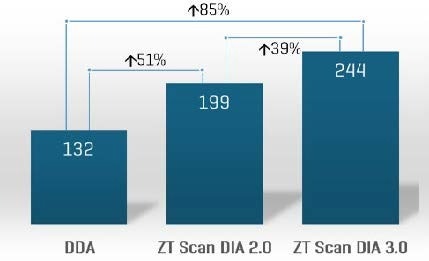
Curated numbers of polar metabolites identified using data acquired with multiple acquisition scans. Results from MS-DIAL 5.6 analysis of DDA, ZT Scan DIA 2.0, and ZT Scan DIA 3.0 data acquired using the ZenoTOF 8600 system were curated to remove duplicates, lipids, and plasticizers. The number of compounds positively identified is shown on each bar. The percentages increase between the different experimental workflows are indicated on the graph. Image Credit: SCIEX
What did the lipidomics experiments reveal about throughput and data quality?
We also used this approach to analyze untargeted lipids in human plasma.
We ran experiments using both five- and 15-minute chromatographic gradients in positive- and negative-ion modes. It was particularly interesting to see that the shorter five-minute method still produced reference-matched lipid numbers that were relatively close to those obtained with the 15-minute gradient.
After curation to remove polar metabolites, plasticizers, and other unwanted features, we were still seeing roughly 1100 to 1300 matched lipids across the different samples and conditions.
For me, the important point was not just the number of identified lipids, but seeing that we could maintain strong reference matching while significantly shortening the chromatographic run. That suggests there may be an opportunity to combine high-quality untargeted lipidomics with higher-throughput analysis.
How can the same dataset be used for quantitative analysis?
One interesting aspect of this data is that it can also support quantitative analysis at the MS/MS level.
MS/MS-based quantitation is inherently more selective than relying on precursor-ion information alone, and it can provide improved signal-to-noise data because you are extracting a specific fragment ion associated with the compound.
For example, with gamma-glutamyl leucine, quantitation using the TOF-MS signal produced a relatively high baseline with neighboring interferences. Using the narrower ZT Scan DIA data and extracting the MS/MS signal gave a much cleaner baseline and a significantly improved signal-to-noise ratio.
The quantitative data can be processed within SCIEX OS using a targeted list containing information such as the compound name, precursor mass, and fragment mass. The resulting extracted chromatograms look very similar to MRM data.
We also found that processing is relatively quick. In one experiment involving around 2500 lipids, the data file was processed in approximately one minute, so the analysis itself does not need to become a major workflow bottleneck.
Looking ahead, what value does comprehensive data acquisition offer researchers beyond the original experiment?
I think retrospective analysis is one of the most valuable opportunities; if you acquire comprehensive MS/MS data when you run the sample, that dataset can serve as a permanent analytical record to revisit later.
With DDA, this can be difficult because the stochastic acquisition means a compound of interest may never have received an MS/MS spectrum in the original experiment. Comprehensive DIA-based acquisition provides much greater flexibility because the information may already be present even if the compound was not originally targeted.
For example, you might complete one cohort study and then identify a new metabolite of interest during a later study. Instead of rerunning the original cohort, you can return to the existing dataset and perform targeted XIC-based quantitation retrospectively.
That means the same data can support untargeted identification, quantitative analysis, and future questions that may not even have been considered when the samples were first acquired. For long-term metabolomics and lipidomics studies, I think that has significant value.
Interested in learning more? Watch the full webinar here
About Paul Baker 
Paul Baker is a Senior Scientist at SCIEX with extensive experience in mass spectrometry workflow development and advanced acquisition strategies for omics research. His work focuses on improving both qualitative and quantitative performance through innovative technologies that enhance selectivity, identification confidence, and analytical robustness. Paul has played a key role in the development and application of next-generation DIA approaches, helping researchers overcome challenges associated with complex biological samples and enabling more confident, reproducible results across a broad range of omics disciplines.
About SCIEX
SCIEX mission is to deliver solutions for the precision detection and quantitation of molecules, empowering their customers to protect and advance the wellness and safety of all.
SCIEX has led the field of mass spectrometry for 50 years. From the moment we launched the first ever commercially successful triple quad in 1981, they have developed groundbreaking technologies and solutions that influence life-changing research and outcomes.
Today, as part of the Danaher family of global life science and technology innovators, they continue to pioneer robust solutions in mass spectrometry and capillary electrophoresis. But they don’t just develop products. It is what they do together with their customers that sets them apart. That’s why thousands of life science experts around the world choose SCIEX to get the answers they can trust to better inform critical decisions. Decisions that positively impact lives.
They proudly stand behind our tagline: The Power of Precision.
 SCIEX and Mass Analytica collaborate to advance artificial intelligence quantitation software