Sponsored Content by SCIEXReviewed by Olivia FrostNov 24 2026
In this interview, News-Medical speaks with Andrew Pinkham and Ryan Fantasia from Meadowhawk Biolabs about bioanalysis using high-resolution mass spectrometry, from the quantitation of small organic acids to the in vivo analysis of antibody-drug conjugates.
Can you please introduce yourselves and your roles at Meadowhawk Biolabs?
Andrew Pinkham: Hi, I’m Andrew Pinkham. I'm a Principal Scientist II in LC-MS Bioanalysis at Meadowhawk Biolabs, where my work focuses on applying LC-MS methods to bioanalytical challenges.
I’ll be discussing a small-molecule derivatization assay for inorganic acids, specifically the quantitation of succinic acid and alpha-ketoglutarate in biological samples using a high-resolution mass spectrometer. I’ll cover some of the challenges that we typically face, the qualification and extraction method, chromatography, quantitative results, and what we learned from the assay.
Ryan Fantasia: I’m Ryan Fantasia, a Senior Scientist in LCMS Discovery Bioanalysis at Meadowhawk Biolabs. My work focuses on developing LC-MS approaches for complex biologics and antibody-drug conjugates.
I’ll be discussing immunoaffinity LC-MS for the in vivo analysis of antibody-drug conjugates. I’ll also look at some of the capabilities offered by the ZenoTOF 7600+ system in this context and showcase Meadowhawk’s capabilities for in vivo dosing and study design. We’ll tie that together through ADC development and what we can offer client sponsors.
Why are succinic acid and alpha-ketoglutarate important, and what makes their bioanalysis challenging?
Andrew Pinkham: Alpha-ketoglutarate and succinic acid are vital small organic acids in biology. They have various roles and are part of the broader spectrum of energy metabolism as Krebs cycle intermediates.
They participate in the hypoxic response, particularly succinic acid. Alpha-ketoglutarate is an enzyme co-substrate in a number of different pathways, and both feed into amino acid metabolism as well as the cellular stress response overall.
However, there are some challenges associated with these compounds in standard LC-MS workflows. The first is their low hydrophobicity: getting small organic acids to stick in regular reversed-phase chromatography workflows for LC-MS is very difficult. As a result, people usually have to resort to anion exchange, ion-pairing chromatography, or HILIC methods.
They also have reduced ionization efficiencies, and you see very large ion suppression in ESI. Most importantly, if you are targeting these compounds for drug development, there is typically significant endogenous interference in the mass ranges in which they occur. In roughly the 140 to 160 Dalton range, there is a whole slew of organic acids that are naturally present.
How does derivatization with 4-BNMA help overcome these analytical challenges?
Andrew Pinkham: To overcome these challenges, we derivatize the compounds with 4-bromo-N-methylbenzylamine, or 4-BNMA. It is widely commercially available and inexpensive, and it uses fairly standard EDC coupling to the carboxylic acids.
The secondary amine is preferable to a primary amine because the addition of the methyl group prevents cyclization during derivatization. You also have a large organic section that adds much-needed hydrophobicity to these molecules.
The incorporated bromine has a distinct isotopic pattern that is easily identifiable on high-resolution mass spectrometry. If you are performing an MRM-style or MRMHR method, the fragmentation pattern is also very useful. We see fragments at 169 and 171, which makes tuning relatively easy.
We get nice, sharp peaks on a relatively short method. The LC method takes about 1.85 minutes, and you can see the characteristic pattern from the derivatized acid containing bromine.
Putting this together with the ZenoTOF gives us a robust assay.
How did you qualify the method for analyzing endogenous compounds in biological samples?
Andrew Pinkham: Because there is a high endogenous contribution from the background, we had to screen several surrogate matrices. We found that the best for equivalence was 2% bovine serum albumin in water.
We used a wide curve range of 500 to 200,000 ng/mL for alpha-ketoglutarate and succinic acid. The endogenous contribution of succinic acid and AKG in humans is typically in the thousands of nanograms per milliliter, so we settled on this range to effectively back-calculate below the endogenous concentration and go far above it if a client needed to monitor up- or down-expression.
Our acceptance criteria were a ±20% bias for QCs and standards, a 20% CV for the QCs, and ±25% at the LLOQ.
The authentic matrix was K2 EDTA mouse plasma. Most importantly, we demonstrated parallelism between the surrogate and authentic matrices by upspiking authentic-matrix QCs with known concentrations of both organic acids and then back-calculating the upspiked amount against the surrogate-matrix curve.
For both succinic acid and alpha-ketoglutarate, the upspiked endogenous authentic-matrix QCs met our acceptance criteria.
What did comparing the SCIEX ZenoTOF 7600 system with the SCIEX 7500+ system reveal about the importance of selectivity?
Andrew Pinkham: We originally tried to run this method on the SCIEX 7500+ system. While there is a distinct difference in sensitivity between a QTOF and a triple quadrupole, we found that the SCIEX 7500+ system was unable to accurately back-calculate the upspiked endogenous authentic-matrix QCs due to the high levels of interference in the plasma.
We ran a set of QCs on the ZenoTOF 7600 system versus the SCIEX 7500+ system, and these were the exact same wells. All we did was transfer the plate from one instrument to the other. We observed a difference of about 200% between the two back-calculated concentrations.
For alpha-ketoglutarate specifically, we think what is happening is that there is a lot of glutamine, glutamic acid, and hydroxyglutarate. That mass range is pretty heavy with compounds that are within one to three Daltons.
It has been our experience with the SCIEX 7500+ system that you need at least around three Daltons of mass separation between what you are looking at and the interference to get a clean MRM method to work. That is definitely not the case here.
We needed the added selectivity of the SCIEX ZenoTOF 7600 system, as well as a relatively tight XIC window, to separate alpha-ketoglutarate from the endogenous background.
We know the surrogate standards and QCs in the batch all met the acceptance criteria on the SCIEX 7500+ system, meaning that the only difference between the two sets of data was the mass spectrometer. We are therefore pretty confident that this is a selectivity issue inherent to the SCIEX 7500+ system compared with the high-resolution mass spectrometer.
Ryan, what factors need to be considered when developing bioanalytical methods for antibody-drug conjugates?
Ryan Fantasia: There are a few things to consider when you are developing an ADC that feed into the analytical method development we do here at Meadowhawk.
The first is what you intend to do with it. What kind of expressed proteins and cell types are you targeting? Then you have to consider what type of antibody you would like. We have full antibodies, but there are also forms like VHH antibodies, Fcs, and Fabs, which can offer different immunogenic profiles or alter pharmacokinetics.
Then you have the class of drugs being conjugated to the antibody. They could be cytotoxic, or you could see corticosteroid or anti-inflammatory-type drugs. You also have the linker itself, which affects the system's performance.
This all ties into the types of analytical methods that need to be developed and run, especially in the early phases of drug discovery.
You are going to be quantitating total antibody and free drug, and sometimes you need to look at cleavage of the linker. We are finding that this is very important in affecting the pharmacokinetics and metabolism of the drugs themselves.
How do you use immunoaffinity LC-MS and high-resolution mass spectrometry to investigate ADCs in vivo?
Ryan Fantasia: These types of assays usually require some cleanup. It is very rare that you can just go into plasma, do a crash, and analyze your analytes of interest without some form of enrichment for the target analyte.
Typically, that is done by immunoaffinity using a capture antibody linked to a magnetic bead system.
For this study at Meadowhawk, we dosed four male Sprague-Dawley rats at 5 mg/kg with trastuzumab-MMAE with an enzymatically cleavable linker. We took relatively large sample volumes at each time point from each animal and ran a three-week time series, allowing us to perform multiple complementary sample analyses.
For the high-resolution workflow, we take 50 microliters of serum. We enrich for and capture the ADC from the serum, and wash off everything else that could confound meaningful data from low-concentration samples.
In this case, we reduce our disulfide bonds to break the ADC into light and heavy chains. In other cases, you might take that one step further and perform an enzymatic digest or deglycosylation, but that was not necessary for this experiment.
We then put the samples on a high-resolution mass spectrometry system such as the SCIEX ZenoTOF 7600+ system. The real heavy lifting typically comes with the data processing.
What does drug-to-antibody ratio tell you about how an ADC behaves in vivo?
Ryan Fantasia: We calculate average DAR based on a weighted sum of the different light-chain and heavy-chain species.
There are a couple of different mechanisms through which you could see payload release or a loss of the entire linker-payload itself. You can have enzymatic cleavage of the valine-citrulline linker by endoproteases. That is what you intend to happen in a disease system, where the ADC is taken up into the cell, enters the lysosome, and is chopped up, releasing the free drug product.
The thiol-maleimide linker system is also subject to retro-Michael addition, while ring-opening hydrolysis can lead to greater stability. In this particular system, where we are not expressing the antibody's target, we do not expect to see enzymatic cleavage.
When we looked at the study data, there was excellent agreement between the different subjects, and we saw a change in DAR over time in all animals.
Realistically, in most of these cases, we are looking at the elimination of high-DAR species. You have different pharmacokinetics for the monoclonal antibody itself, and a higher elimination rate for more highly conjugated ADCs.
We did not observe any linker-payload cleavage or any of the enzymatic cleavage products I highlighted earlier. It is difficult to determine from this dataset whether you have lost the linker-payload itself due to those retro-Michael products, but we can perform additional analyses if it appears that this could be happening in a particular system.
How does software help process the complex datasets generated during ADC bioanalysis?
Ryan Fantasia: You can take the deconvoluted spectrum, integrate all of your peaks, bin different species together based on what you expect to see on your linker-payload, and calculate DAR. However, there are better tools available that do not require manually sifting through Excel sheets, identifying peaks, and calculating DAR.
This is where Biologics Explorer comes in. This system allows us to improve visualization and peak processing in these workflows.
There are some key considerations to make when processing the data. Number one, you need an accurate sequence for your antibody. This is something we can help determine early on, making sure that you are actually expressing what you think you are. A small amino acid swap in the sequence can lead to a big difference in mass accuracy, so you are not necessarily going to pick up the correct peaks.
You also want to consider the disulfide-reduction conditions. Sometimes you won't get 100% completion, so you can tell the software to look for partial reductions, which can help with peak identification.
We also have common glycoforms built into a library for the heavy chain. Another way around that is to enzymatically deglycosylate the samples, but in this case we chose to keep the sample processing simple and let some of the software do the heavy lifting.
Finally, you need to know the formula and molecular weight of your conjugate. Some prior knowledge of possible biotransformation products and metabolites is ideal, as it lets you incorporate them into the sample-processing workflow.
You have to know your chemistry, know your biology, and know what you are putting into the samples. When this is the case, this tool makes processing much easier.
Why is it useful to combine high-resolution ADC characterization with quantitative surrogate-peptide analysis?
Ryan Fantasia: As you get further along in your program, you are typically going to want to analyze the total amount of antibody, conjugated or not, within your samples.
You can do some of this quantitative work on the high-resolution system, but when you have a wide distribution of DAR in your samples, you need to monitor multiple deconvoluted peaks. The triple quadrupole really shines in surrogate-peptide analysis.
For these studies, we use an immunoaffinity step to pull the ADC out of the samples. We then run it through a tryptic digest workflow and analyze a surrogate peptide on the SCIEX 7500+ system.
A surrogate peptide is a peptide from the tryptic digest that you use as a proxy for quantification. In this experiment, we chose three peptides from three different domains of the ADC.
We had a peptide from the functional domain that is very specific to trastuzumab and can differentiate it from potentially co-administered ADCs. We had a generic peptide from the heavy chain and an additional peptide from the light chain. The light-chain peptide indicates that the antibody itself is intact, because the light chain may not make it into the final tryptic digest during sample processing.
The data showed great agreement between the peptides, and we were still able to detect the antibody as late as the three-week time point.
How can combining these different analytical workflows provide a more complete picture of ADC performance?
Ryan Fantasia: We have an idea of the total antibody present in the serum over the three-week time course, and that allows us to tie the two datasets together.
A lot of clients want to do this to get an idea of how the decrease in DAR corresponds with elimination of the antibody pharmacokinetically.
We see a decrease in DAR, in this case due to elimination of the higher-DAR species at a faster rate. Early on, we have a high average DAR. Then, as the ADC is eliminated, we eliminate those high-DAR species, and therefore the average DAR decreases.
Typically, we approach this with a high-resolution workflow and the surrogate-peptide workflow. We can then perform a standard protein precipitation or SPE on the entire serum fraction to obtain additional complementary data and provide the full picture of what is happening with the ADC in vivo.
These workflows were developed at Meadowhawk using the SCIEX ZenoTOF 7600+ for quantitative and qualitative analysis of in vivo ADCs. Overall, this package allows us to offer complete quantitative and qualitative analysis of ADCs, which is essential to early discovery and optimization of antibody-drug conjugates.
Whether you have a suite of different antibodies with one linker-payload system or a single antibody that you are using with a suite of different potential linkers and payloads, we can use these workflows to help with the development process.
About Andrew Pinkham 
Andrew Pinkham is a Principal Scientist II in LC-MS Bioanalysis at Meadowhawk Biolabs, where his work focuses on developing and applying LC-MS methods to bioanalytical challenges across diverse molecular modalities.
Pinkham has nearly a decade of experience in CRO bioanalysis. His expertise encompasses the analysis of proteins, antibodies, antibody-drug conjugates, and oligonucleotides, as well as small-molecule applications. His work at Meadowhawk includes the development of high-resolution mass spectrometry approaches for challenging endogenous compounds, where analytical selectivity is critical for accurate quantitation in complex biological matrices.
Pinkham earned a Bachelor of Science in Biochemistry from Rochester Institute of Technology before completing a PhD in Chemistry at The Ohio State University. His doctoral research included a focus on bioinorganic chemistry.
He joined Meadowhawk Biolabs in 2022 as Principal Scientist II. His combination of small- and large-molecule LC-MS experience supports the development of fit-for-purpose bioanalytical strategies for increasingly complex drug discovery and development programs.
About Ryan Fantasia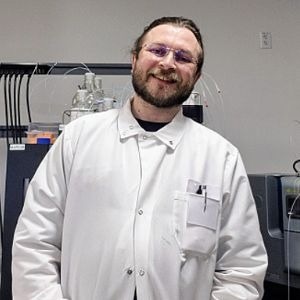
Ryan Fantasia is a Senior Scientist in LCMS Discovery Bioanalysis at Meadowhawk Biolabs, where his work includes LC-MS approaches for complex biologics and antibody-drug conjugates.
Fantasia has approximately nine years of experience in bioanalysis across contract research environments. His work encompasses analytical method development and LC-MS, with recent activities focusing on complex therapeutic modalities. At Meadowhawk, his work includes immunoaffinity LC-MS and high-resolution mass spectrometry workflows to characterize ADCs, including investigations of drug-to-antibody ratio and in vivo changes in ADC species.
Fantasia studied Marine Science at Rutgers University-New Brunswick, with studies incorporating biochemistry and molecular biology and a minor in biochemistry. His early research experience included laboratory and field-based scientific research before his career moved into analytical chemistry and bioanalysis.
He joined Meadowhawk Biolabs in 2023. His current work combines immunoaffinity sample preparation, high-resolution mass spectrometry, and complementary quantitative LC-MS approaches to investigate the behavior of complex therapeutics during discovery and development.
Mastering Bioanalysis from Small Molecules to Biologics with HRMS
Mastering Bioanalysis from Small Molecules to Biologics with HRMS. Video Credit: SCIEX
About SCIEX
SCIEX mission is to deliver solutions for the precision detection and quantitation of molecules, empowering their customers to protect and advance the wellness and safety of all.
SCIEX has led the field of mass spectrometry for 50 years. From the moment it launched the first ever commercially successful triple quad in 1981, it has developed groundbreaking technologies and solutions that influence life-changing research and outcomes.
Today, as part of the Danaher family of global life science and technology innovators, the company continues to pioneer robust solutions in mass spectrometry and capillary electrophoresis. The company does not just develop products. It is what it does together with its customers that sets it apart. That’s why thousands of life science experts around the world choose SCIEX to get the answers they can trust to better inform critical decisions. Decisions that positively impact lives.
The company proudly stands behind its tagline: The Power of Precision.
 SCIEX summit - Highlighting scientific breakthroughs in mass spectrometry that really count