Sponsored Content by SCIEXReviewed by Maria OsipovaAug 5 2026
This paper presents a sensitive, precise, and highly reproducible technique for quantitating a peptide therapeutic via the novus V55 system. The system delivers dependable, uncompromised quantitative performance in a miniaturized design.
A lower limit of quantitation (LLOQ) of 25 pg/mL was obtained for the evaluation of insulin degludec in rat plasma (Figure 1).
Background
Over the past decade, peptide drugs have become increasingly important in pharmaceutical development. Compared with small-molecule therapeutics, peptides offer enhanced efficacy and specificity, making them well-suited for treating critical diseases.1
Given the significant potential of peptide therapeutics, sensitive and selective LC-MS assays are required for precise quantitation in intricate biological matrices. In addition, since peptide quantitation involves a broad range of charge states, versatility is crucial for achieving optimal selectivity and sensitivity.
This article demonstrates the quantitation of a model peptide therapeutic, insulin degludec, in rat plasma, combining exceptional quantitative performance with the sustainable novus V55 system.2
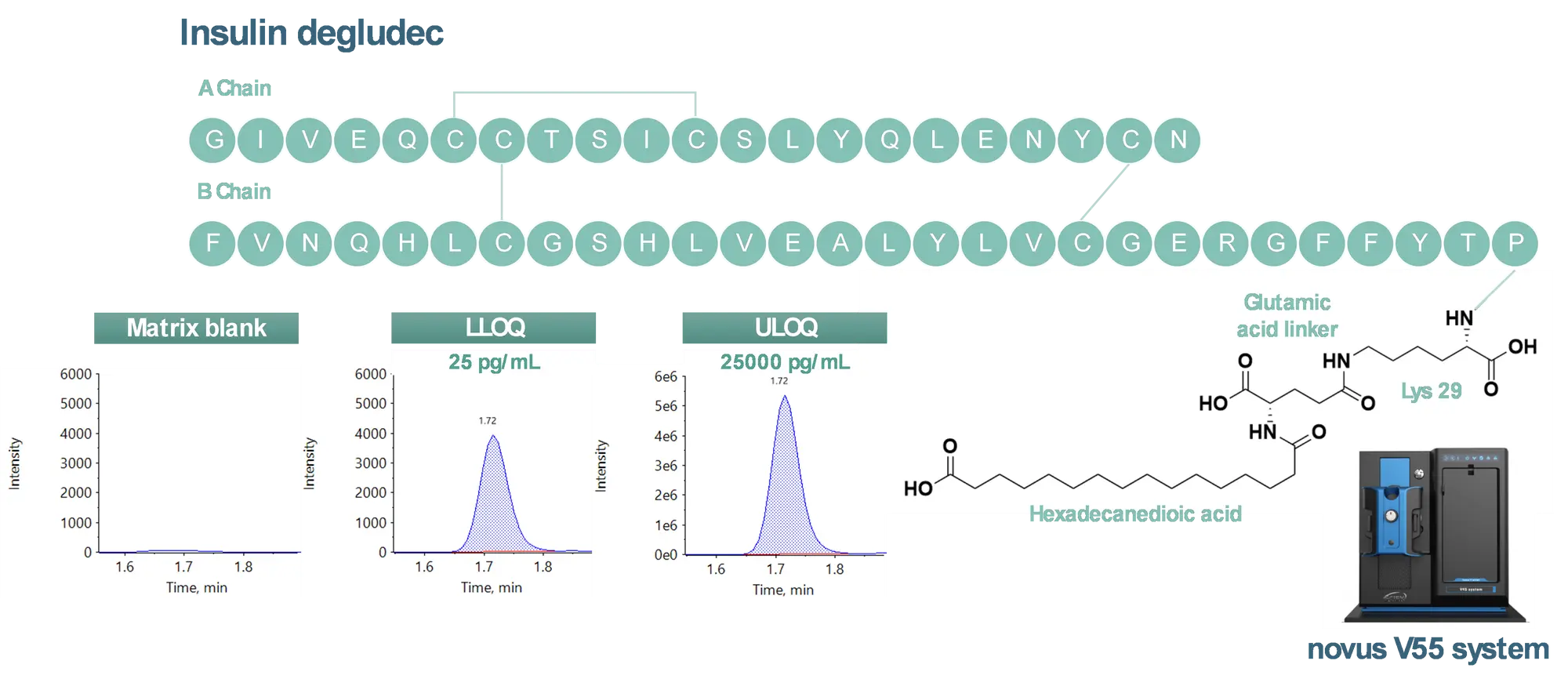
Figure 1. Representative extracted ion chromatograms (XICs) and structure of insulin degludec. An LLOQ of 25 pg/mL was achieved for insulin degludec in rat plasma. No interference was observed at the retention time of the analyte in the matrix blank. An upper limit of quantitation (ULOQ) of 25,000 pg/mL was reached. Image Credit: SCIEX
Advantages of analyzing insulin degludec with the novus V55 system
- Low- pg/mL level of quantitation: Attain an LLOQ of 25 pg/mL for insulin degludec quantitation in rat plasma
- Strong analytical performance: Reach precise quantitative performance with %CV <3 across all concentration levels over a linear dynamic range (LDR) of three orders of magnitude
- Extended mass range: Acquire flexibility for therapeutic peptide quantitation with the broader mass range of the novus V55 system, enabling more options for m/z selection for optimal selectivity and sensitivity
- Reduced footprint without impairing quantitative fidelity: Achieve optimal bioanalytical quantitative performance using the most compact triple quadrupole mass spectrometer in its class
- Streamlined data management: Simplify data acquisition, management, and processing with SCIEX OS software, a 21 CFR Part 11-compliant platform
Introduction
LC-MS has been widely used in bioanalytical research for peptide therapeutic development, primarily due to its selectivity and sensitivity.
When conducting peptide quantitation, bioanalytical laboratories are frequently challenged with selecting the optimal m/z value combination that delivers the best sensitivity and selectivity. In addition to quantitative performance, the question of how to achieve sustainability objectives has become increasingly prominent as bioanalytical laboratories continue to develop and expand.
In this research, insulin degludec was used as a model peptide therapeutic and evaluated in rat plasma. The evaluation was conducted using the novus V55 system, providing a broad quadrupole mass range that enables greater quantitative versatility for optimal sensitivity and selectivity.
In addition, the novus V55 system delivers highly dependable quantitative performance within a miniaturized design, providing bioanalytical labs with improved energy efficiency solutions.
Methods
Sample preparation: The commercially available insulin degludec (Figure 1) was reconstituted in dimethyl sulfoxide and then diluted in dilution solvent containing 1% formic acid in a 75:25 (v/v) acetonitrile/water mixture.
Individual concentrations were spiked into 100 µL of rat plasma at concentrations ranging from 10 to 2500 pg/mL. Proteins were precipitated using 100 µL of 4% phosphoric acid in methanol. Samples underwent vortexing for 30 seconds and centrifugation at 12,000 rcf for 10 minutes at ambient temperature.
The supernatant was transferred to a new Eppendorf tube containing 800 µL of water, after which the samples underwent brief vortexing and centrifugation. Next, 500 µL of each sample was loaded twice onto a Phenomenex Strata -X-A microelution plate operated under positive pressure. The samples were washed sequentially with 5% aqueous ammonia and 20% acetonitrile in water.
Finally, elution was conducted using 50 µL of 1% trifluoroacetic acid in a solution containing 70:20:10 (v/v) acetonitrile/water/acetic acid. An additional 50 µL of water was added to bring the final volume to 100 µL.
Chromatography: Samples were separated via an Agilent 1290 Infinity II LC System at a flow rate of 0.6 mL/minute on a Phenomenex Kinetex XB C18 (2.1 x 50 mm, 1.7 µm, 100 Å) column. A six-minute gradient was operated using 0.1% formic acid in water as mobile phase A and 0.1% formic acid in acetonitrile as mobile phase B (Table 1).
The column temperature was maintained at 55 °C, and a 10 µL injection volume was used for evaluation. A mixture of equal parts by volume of acetonitrile, methanol, and water was used as a needle wash solvent.
Mass spectrometry: Evaluation was carried out using the novus V55 system. Table 2 lists the optimized source and gas parameters, and Table 3 includes the MRM parameters.
Table 1. LC gradient conditions. Source: SCIEX
| Time [Min] |
Mobile phase A [%] |
Mobile phase B [%] |
| 0 |
90 |
10 |
| 0.2 |
90 |
10 |
| 1 |
70 |
30 |
| 3 |
55 |
45 |
| 3.1 |
2 |
98 |
| 4.1 |
2 |
98 |
| 4.2 |
90 |
10 |
| 6 |
90 |
10 |
Table 2. Source and gas parameters. Source: SCIEX
| Parameter |
Value |
| Polarity |
Positive |
| Ionization mode |
ESI |
| Ion source gas 1 |
50 psi |
| Ion source gas 2 |
60 psi |
| Curtain gas |
40 psi |
| Source temperature |
500 °C |
| Spray voltage |
5000 V |
| CAD gas |
9 |
| Dwell time |
100 ms |
Table 3. MRM parameters used for quantitation on the novus V55 system. Source: SCIEX
| ID |
Precursor ion [m/z] |
Fragment ion [m/z] |
CE [V] |
CXP [V] |
DP [V] |
| Insulin degludec_1 |
1527.0 |
641.4 |
70 |
25 |
20 |
| Insulin degludec_2 |
1527.0 |
1183.8 |
70 |
25 |
20 |
Data processing: Data acquisition and evaluation were conducted with SCIEX OS software, version 4.0. Peaks were integrated using the MQ4 algorithm, and a 1/x2 weighting factor was employed to quantitate insulin degludec.
Automated compound optimization for peptide quantitation
The automated compound optimization feature in SCIEX OS software enables MRM optimization, including DP, CE, and CXP voltages, as well as ion source parameters, for unknown targets or known transitions (Figure 2).
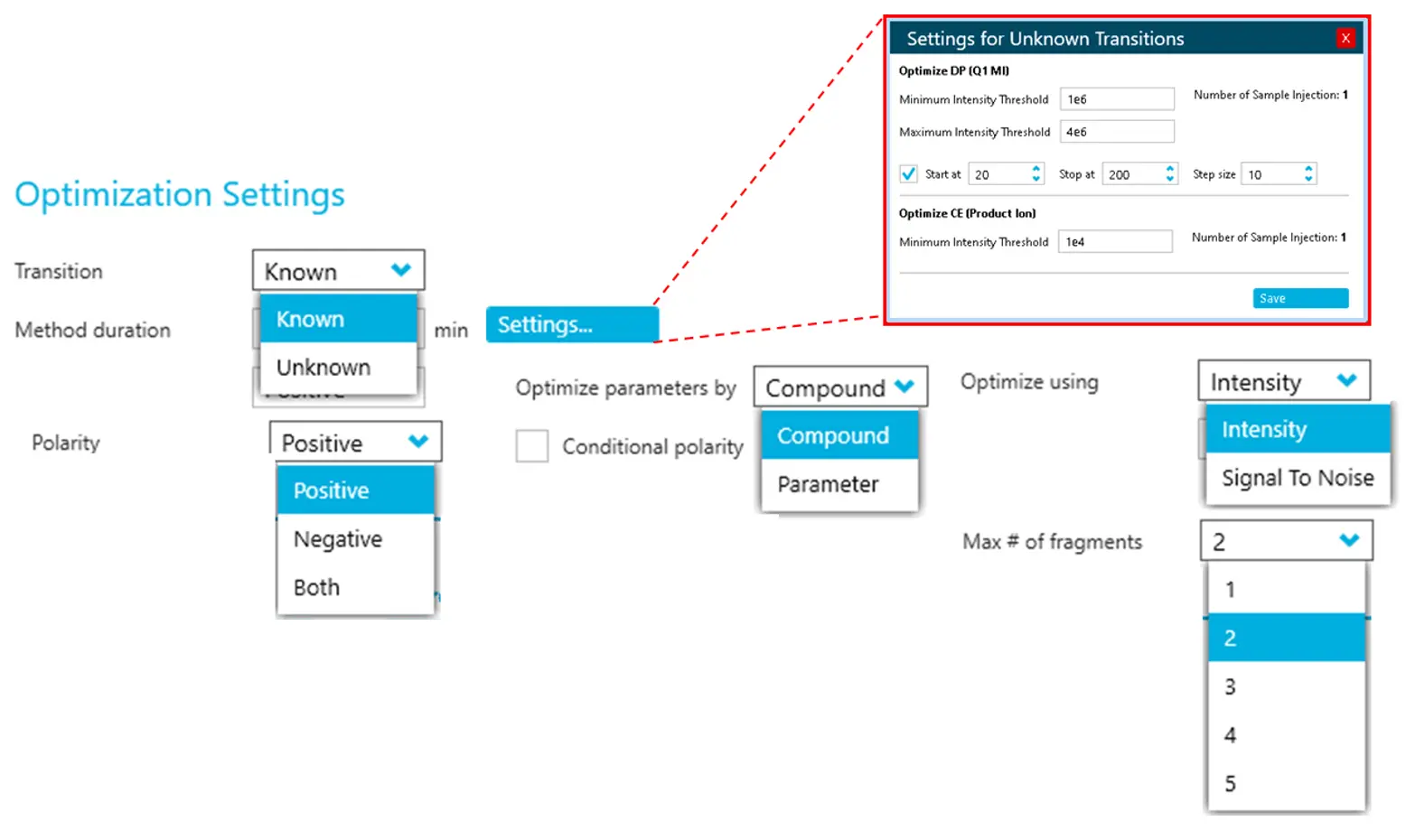
Figure 2. Automated compound optimization feature on SCIEX OS software. Easily optimize source and MRM conditions for optimal quantitation conditions for known and unknown targets. Image Credit: SCIEX
During automated compound optimization, users can select the operating polarity, specify the number of target fragments to optimize, and choose whether MS/MS evaluations should be performed by intensity or signal-to-noise (S/N) ratio.
Outcomes from automated compound optimization can be stored in a compound database within SCIEX OS software, offering additional versatility to readily access optimal settings for future use.
Quantitative performance on the novus V55 system
For insulin degludec quantitation, a precursor ion at m/z 1527.0 (charge state four) and a fragment ion at m/z 641.4 (charge state five) were chosen. The overall MRM transition was selected to prioritize optimal assay selectivity and sensitivity. A 25 pg/mL LLOQ was obtained for insulin degludec (Figure 1). The rat plasma mix showed no observable interferences (Figure 1).
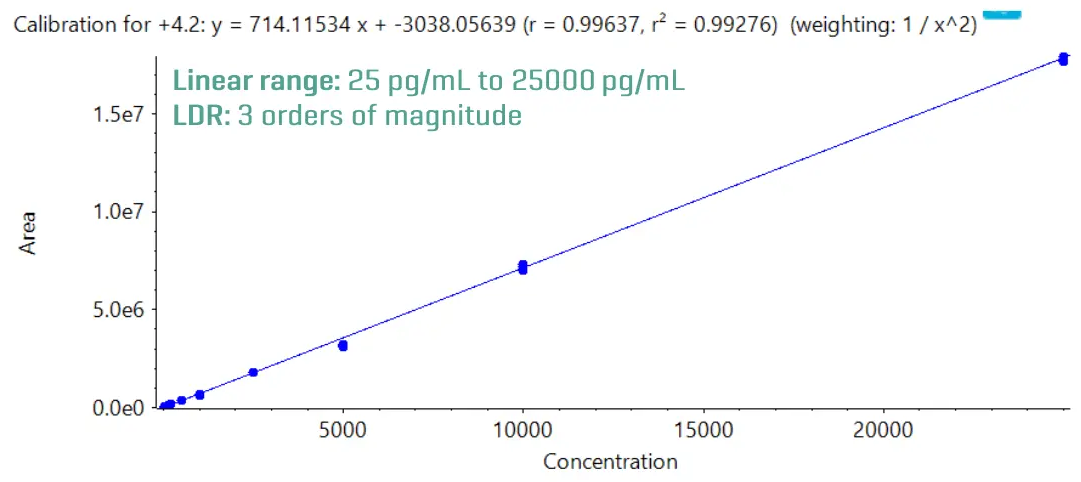
Figure 3. Calibration curve for quantitation of insulin degludec using the quantifier ion (1527.0→641.4). The calibration curve was generated using a weighing factor of 1/x2. Image Credit: SCIEX
| Actual concentration |
Num. values |
Mean |
Standard deviation |
Percent
CV |
Average accuracy across replicates |
| 25.0 |
3 of 3 |
23.4 |
0.374 |
1.60 |
93.6 |
| 50.0 |
3 of 3 |
55.0 |
0.660 |
1.20 |
110. |
| 100. |
3 of 3 |
101. |
1.06 |
1.05 |
101. |
| 150. |
3 of 3 |
146. |
1.63 |
1.11 |
97.6 |
| 200. |
3 of 3 |
226. |
3.79 |
1.67 |
113. |
| 500. |
3 of 3 |
522. |
7.57 |
1.45 |
104. |
| 1000. |
3 of 3 |
909. |
11.2 |
1.23 |
90.9 |
| 2500. |
3 of 3 |
2520. |
22.3 |
0.885 |
101. |
| 5000. |
3 of 3 |
4450. |
95.7 |
2.15 |
89.0 |
| 10000. |
3 of 3 |
10000. |
208. |
2.07 |
100. |
| 25000. |
3 of 3 |
24800. |
220. |
0.887 |
99.4 |
Figure 4. Quantitative performance of insulin degludec. Reproducibility and accuracy results were determined from the calibration curve standards across three replicates at each concentration. Statistical results were summarized using the Analytics module in SCIEX OS software. Image Credit: SCIEX
The calibration curve ranged from 25 to 25,000 pg/mL and was prepared as described in the sample preparation section. Each concentration was run in triplicate.
Linearity was achieved between 25 and 25,000 pg/mL with a coefficient of determination (r2) of 0.993 (Figure 3). An LDR of three orders of magnitude was achieved, enabling measurement over a broad concentration range.
Analytical performance was assessed for precision and accuracy. The accuracy of the computed average was anticipated to be between 80 and 120% at the LLOQ and between 85 and 115% at higher concentrations. The %CV of the computed average for each concentration was anticipated to be <20% at the LLOQ.3
The assay accuracy was within ±1.3 % of the actual concentration, and the %CV was less than 3%. The computed percentage accuracy and %CV values met the acceptance requirements at each concentration level (Figure 4).
Compliance-ready SCIEX OS software
Equivalent SCIEX OS software capabilities for regulated bioanalysis can be performed on the novus V55 system, guaranteeing high fidelity during method transfers while maintaining crucial compliance features.
SCIEX OS software is a closed system and requires electronic record and signature storage, satisfying the requirements described in 21 CFR Part 11. The software can access raw data files from any visible storage location within a closed network through designated processing workstations.
Figure 5 depicts the SCIEX OS software features used for audit trail monitoring, data acquisition and processing, and user access configuration. The audit trail feature allows critical user actions to be audited while also locking in data integrity.
The central administrator console (CAC) feature enables centralized acquisition and processing on a single platform, maximizing efficiency for multi-instrument labs regardless of compliance standards. The configuration module allows users to assign roles and access as the administrator, method developer, analyst, and reviewer.
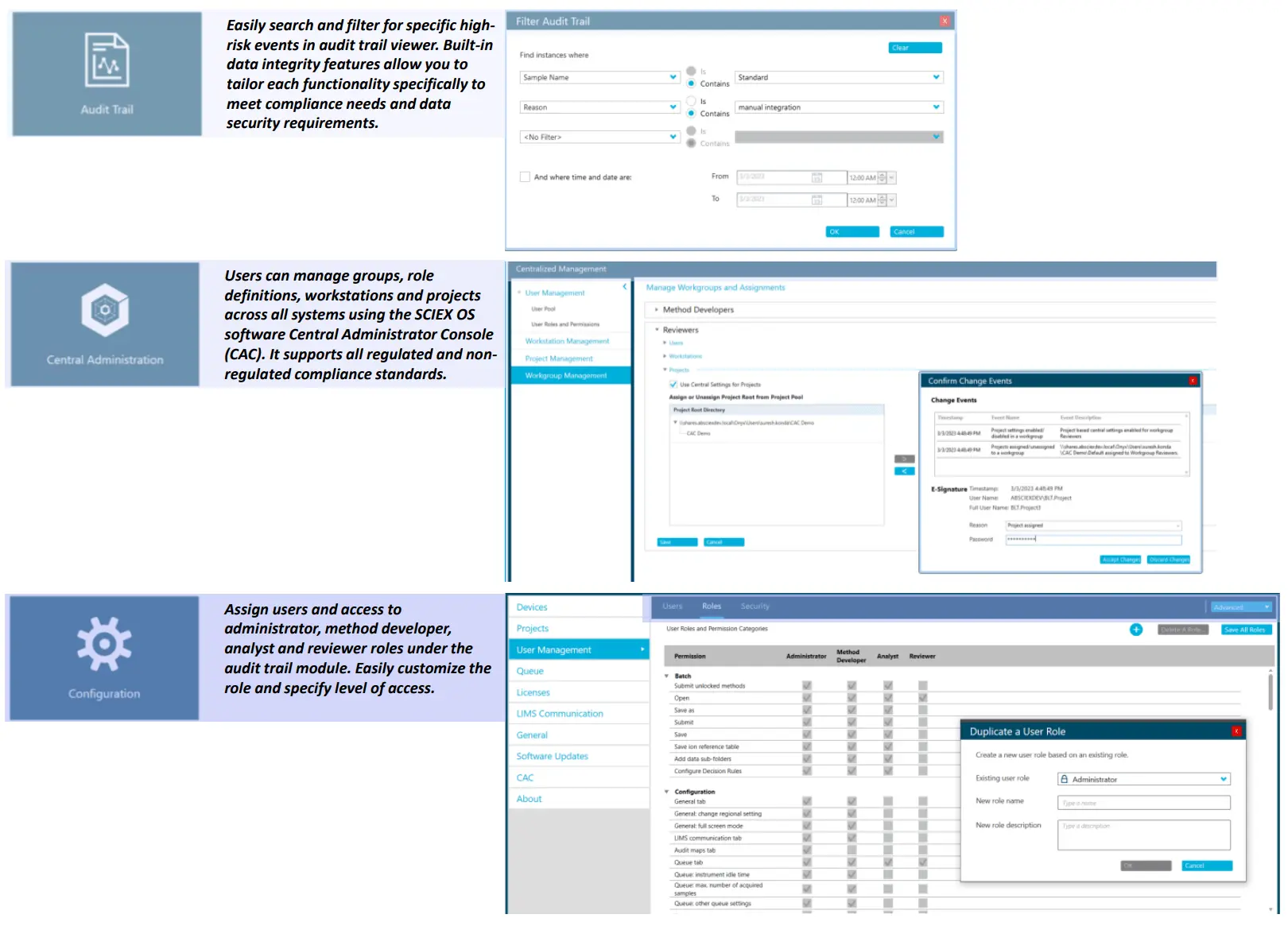
Figure 5. Features of the SCIEX OS software for monitoring user access and evaluating the audit trail. The audit trail view allows users to easily filter high-risk events and enables data integrity features to meet compliance requirements. The software features a central administrator console (CAC) to manage users and groups, role definitions, workstations, and projects across all systems. The CAC feature supports both regulated and non-regulated compliance standards. The configuration module enables users to quickly set up roles and access levels for the administrator, method developer, analyst, and reviewer. Image Credit: SCIEX
Conclusions
- A LLOQ of 25 pg/mL was achieved for quantifying insulin degludec in rat plasma.
- Improve quantitative versatility for peptide therapeutic analysis with the broad mass range on the quadrupoles using the novus V55 system.
- Excellent quantitative performance was exhibited with precise and highly reproducible (%CV < 3%) outcomes using novus V55.
- Linearity was obtained at concentrations ranging from 25 to 25,000 pg/mL with an r2>0.993, resulting in an LDR of three orders of magnitude.
- Preserve quantitative rigor while lowering operating expenses using the novus V55 system, the most compact triple quadrupole mass spectrometer in its class.
- Data management and compliance-readiness (21 CFR Part 11) features were demonstrated with the SCIEX OS software to support peptide quantitation on the novus V55 system.
References and further reading
- Atkin, S., Javed, Z. and Fulcher, G. (2015). Insulin degludec and insulin aspart: novel insulins for the management of diabetes mellitus. Therapeutic Advances in Chronic Disease, [online] 6(6), p.375. DOI:10.1177/2040622315608646. https://journals.sagepub.com/doi/10.1177/2040622315608646.
- SCIEX (2026). The SCIEX novus V55 system. SCIEX brochure, MKT-38393-A. Available at: https://sciex.com/products/mass-spectrometers/triple-quad-systems/novus-v55-system.
- FDA (2018). Bioanalytical Method Validation Guidance for Industry. FDA. Available at: https://www.fda.gov/files/drugs/published/Bioanalytical-Method-Validation-Guidance-for-Industry.pdf.
Acknowledgments
Produced from materials originally authored by Ebru Selen, John Gibbons, Rahul Baghla, and Eshani Galermo, SCIEX, USA and SCIEX, Canada.
About SCIEX
SCIEX mission is to deliver solutions for the precision detection and quantification of molecules, empowering its customers to protect and advance the wellness and safety of all.
SCIEX has led the field of mass spectrometry for 50 years. From the moment it launched the first ever commercially successful triple quad in 1981, SCIEX has developed groundbreaking technologies and solutions that influence life-changing research and outcomes.
Today, as part of the Danaher family of global life science and technology innovators, it continues to pioneer robust solutions in mass spectrometry and capillary electrophoresis. But SCIEX doesn’t just develop products. It is what the company does together with its customers that sets it apart. That’s why thousands of life science experts around the world choose SCIEX to get the answers they can trust to better inform critical decisions. Decisions that positively impact lives.
SCIEX stands proudly by its tagline: The Power of Precision.
Sponsored Content Policy: News-Medical.net publishes articles and related content that may be derived from sources where we have existing commercial relationships, provided such content adds value to the core editorial ethos of News-Medical.net, which is to educate and inform site visitors interested in medical research, science, medical devices and treatments.