Multiplex immunohistochemistry lets researchers see several proteins in the same tissue section. We asked Catrine Siöberg, Head of R&D at Atlas Antibodies, six questions about where multiplexing helps, where it gets difficult, and how to build a panel that works.
Why are more researchers moving from single-marker IHC to multiplexing?
Biology rarely happens one protein at a time. A single stain tells you where a protein is, whereas a multiplex panel tells you which cells express it, which cells sit next to them, and how that changes with disease or treatment. In tumor, brain, or inflamed tissues, cell type and position matter as much as expression level.
There is also a key practical reason: Many samples are small or irreplaceable, such as biopsies and archived FFPE blocks. Staining several markers on one section gets more data from each sample. This also avoids comparing serial sections, which never quite line up.
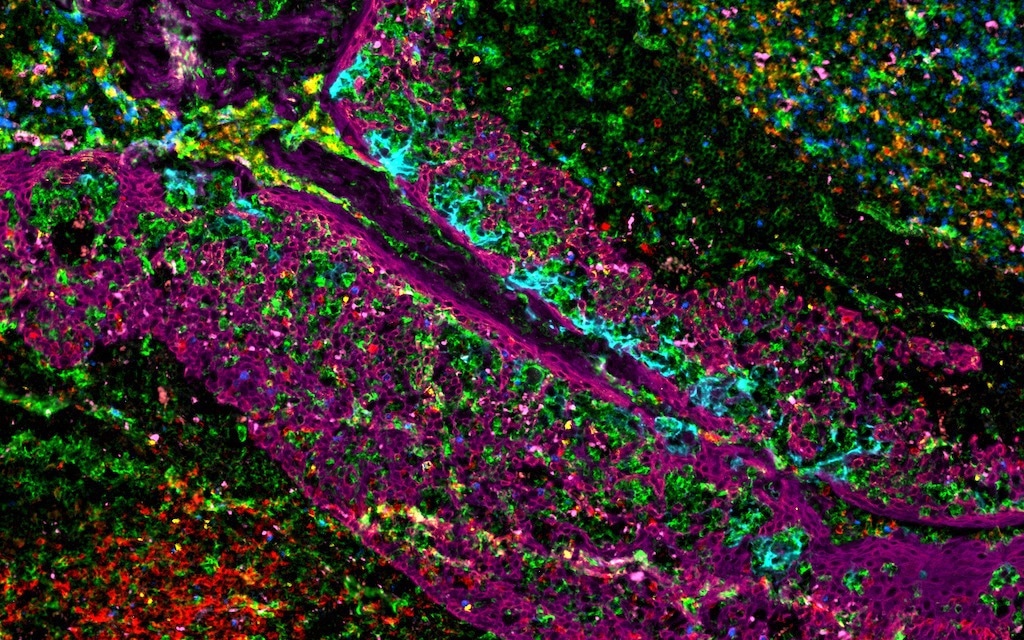
Image Credit: Atlas Antibodies
What are the main bottlenecks when building a multiplex panel?
Most problems come from the detection chemistry, not the biology. Classic indirect detection uses a secondary antibody against the host species of the primary. If two primaries are both raised in a rabbit sample, the secondary cannot tell them apart. Panels end up designed around host species instead of the markers the experiment needs.
Secondary antibodies also add steps, cross-reactivity, and background. This is a known problem when tissue contains endogenous immunoglobulins, for example mouse antibodies on mouse tissue.
After this, there is validation. An antibody that works well on its own can behave differently in a panel because of staining order, antigen retrieval, or repeated heating. Each marker needs to be checked in the multiplex setting, not only as a single stain.
How should researchers choose and validate antibodies for a panel?
Start with the question, then pick the fewest markers that answer it. For each marker, check that the antibody is specific in your tissue type. Human Protein Atlas expression data is a good first reference for where a protein should, and should not, be found.
With traditional multiplex methods, compare each marker in the panel with its single-stain pattern on the same tissue. The distribution and intensity should match. Include positive and negative control tissue and test the staining order: epitopes that are sensitive to heat or retrieval often work better early in the sequence. This is why traditional panels are built one marker at a time.
Where does Atlas Antibodies come into the picture?
Atlas Antibodies was founded in 2006 as part of the Human Protein Atlas project. Our antibodies were made and characterized to map where human proteins are expressed across tissues and cell types. All expression data for each antibody are publicly available on the Human Protein Atlas website (proteinatlas.org).
In multiplexing settings, this availability matters. Before building a panel, researchers can see how each antibody stains the tissue they work with and which cells express the protein, reducing trial and error at the start of the process. AtlasPlex builds on this collection and turns validated single antibodies into custom multiplex panels.
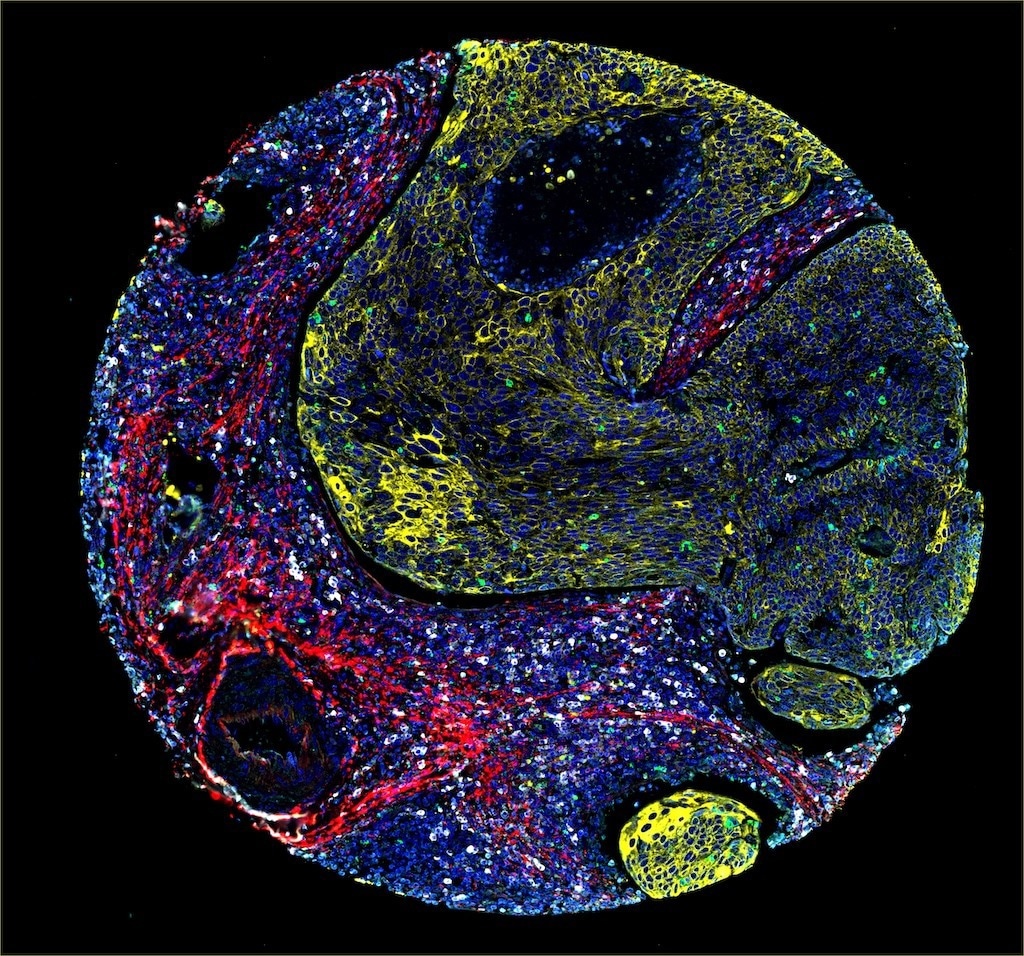
Image Credit: Atlas Antibodies
How does AtlasPlex address these bottlenecks?
AtlasPlex uses primary antibodies that are already conjugated to biotin, combined with tyramide signal amplification. Detection does not depend on a secondary antibody, so the host species of the primary no longer matters.
Two rabbit antibodies can sit in the same panel, and there is no cross-reactivity from secondaries. Because the tissue remains intact, there is no staining order to optimize and no need to stain sensitive markers first as you would with traditional multiplex methods.
This changes how panels are designed. Instead of working around host species, researchers choose targets from more than 17,000 Human Protein Atlas–validated antibodies and build a panel of up to five markers on FFPE tissue. The validation behind each antibody is the starting point for the panel.
How can a lab get started with AtlasPlex?
Start with the biological question and a short list of targets. Check where those proteins are expressed in the Human Protein Atlas, and choose a tissue in which you can confirm each staining pattern. Our team can help match targets to antibodies and suggest a staining order.
The protocol runs on standard FFPE sections in a single day, so a first panel can be tested quickly. For labs new to multiplexing, a panel of three or four well-characterized markers is a good first step before moving to five.
What is your key take-home message for those working with multiplexing and interested in AtlasPlex?
With AtlasPlex, panel design starts from the markers your research needs, not from antibody host species. Pre-biotinylated, Human Protein Atlas–validated antibodies remove the need for secondary antibodies, so researchers can build a custom panel of up to five markers on FFPE tissue in a single day.
About Catrine Siöberg 
Catrine Siöberg, PhD, is Head of Research and Development at Atlas Antibodies, which she joined in 2022. Today she is a key player in product development, leading the team that brings new antibody products and applications to market. She holds a PhD in Medical Biochemistry from Karolinska Institutet in Stockholm and has long experience in protein research.

About Atlas Antibodies AB
Born from the Human Protein Atlas, Atlas Antibodies develops antibodies covering more than 75% of the human proteome. Full validation data for every antibody is on our website, with additional characterization data at proteinatlas.org.
Our portfolio includes:
- Triple A Polyclonals™: Rabbit polyclonals, validated in the Human Protein Atlas
- PrecisA Monoclonals™: Mouse monoclonals for high specificity
- PrEST Antigens™: Recombinant protein fragments for blocking and control experiments
- AtlasPlex™: Custom multiplex immunohistochemistry kits
- MolBoolean™: In situ detection of protein–protein interactions, quantifying both interacting and free proteins
All products are made in Sweden and shipped worldwide.
 Shaping the Future of Neuroscience: A Conversation with Atlas Antibodies on the MolBoolean™ and the Impact of SfN 2024