Atlas Antibodies has launched MolBoolean™, a new in situ proximity assay. It detects free protein A, free protein B, and the A–B complex together in fixed cells and tissue. This lets researchers normalize interaction signals to total protein levels, and see not only where two proteins interact but how much of each protein takes part.
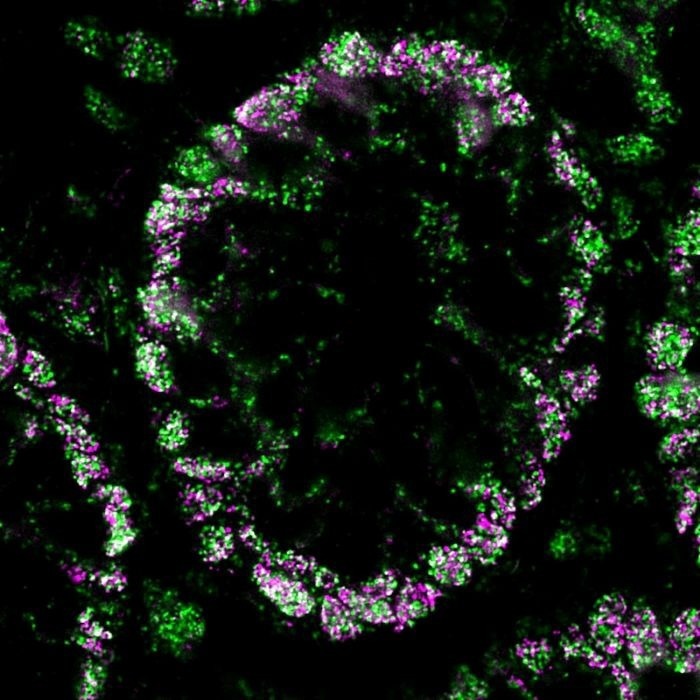 Human colon: SATB2 and HDAC1. MolBoolean™ detection of free SATB2 (magenta), free HDAC1 (green), and the SATB2–HDAC1 complex (white) in human colon. Antibodies used: anti-SATB2 monoclonal (AMAb90682) and anti-HDAC1 polyclonal (HPA029693). Image Credit: Atlas Antibodies AB
Beyond standard PLA
Protein interactions drive most cellular processes, from signaling to gene regulation. Proximity ligation assays (PLA) made it possible to see these interactions directly in cells and tissue. But standard PLA detects only interacting proteins.
This creates a problem when interpreting results. When an interaction signal rises, it is hard to tell whether binding increased or the proteins were simply expressed at higher levels. Without information on the free fractions, a change in protein expression can look like a change in interaction.
MolBoolean answers this question by reporting both the free and the bound fractions from the same sample. Researchers can see what share of each protein is engaged in the complex, cell by cell, and compare this across conditions, treatments, or tissue regions.
How MolBoolean works
The assay uses mouse and rabbit secondary proximity probes with a proprietary oligonucleotide design. When the two target proteins are bound together, the probes generate a signal for the complex. When a protein is free, the assay generates a separate signal for that protein alone. This gives researchers:
- Free and bound proteins in one experiment: Free protein A, free protein B, and the A–B complex are detected together.
- Interaction signals normalized to total protein: A rise in binding can be told apart from a rise in expression.
- Single-cell resolution: Image analysis software included with the kit separates the signals for relative quantification of free and interacting fractions.
- Your own antibodies: the assay uses your validated mouse and rabbit primary antibodies, so it fits into existing projects and antibody panels.
- Strong signal: Rolling circle amplification boosts each signal.
- Standard equipment: Signals are read on a standard fluorescence microscope.
- No genetic engineering: The sample needs no modification.
- Native context: The assay works on fixed cells and tissue, so researchers can study endogenous proteins where they are naturally expressed.
Built by a PLA pioneer
MolBoolean was developed with Professor Ola Söderberg of Uppsala University, one of the inventors of the original in situ PLA technology. The new assay builds on that work and adds what standard PLA leaves out: the free protein fractions.
Applications
MolBoolean is designed for researchers who need to understand how protein interactions change, not just whether they occur. Applications include drug discovery, where it can show whether a compound affects binding between two proteins, as well as biomarker research and studies of disease mechanisms.