Per- and Polyfluoroalkyl Substances (PFAS) encompass a family of more than 4,700 chemical molecules known for their waterproof and non-stick properties.
These versatile compounds are widely used across industries such as textiles, cosmetics, and automobiles. However, their resistance to degradation and their persistence in soil, water, and atmosphere are significant environmental concerns.
This article outlines how the Arium® Comfort I UV from Sartorius can reduce the concentration of PFAS contaminants from below detection limits to up to single-digit ppt or sub-ppt levels (parts per trillion, dependent on the compound) in water. Two complementary analytical techniques are used in this work: liquid chromatography – mass spectrometry and combustion ion chromatography.
It also highlights the Arium® Comfort I UV’s capacity to efficiently reduce PFAS in water, whether in its standard or PTFE-free setup.
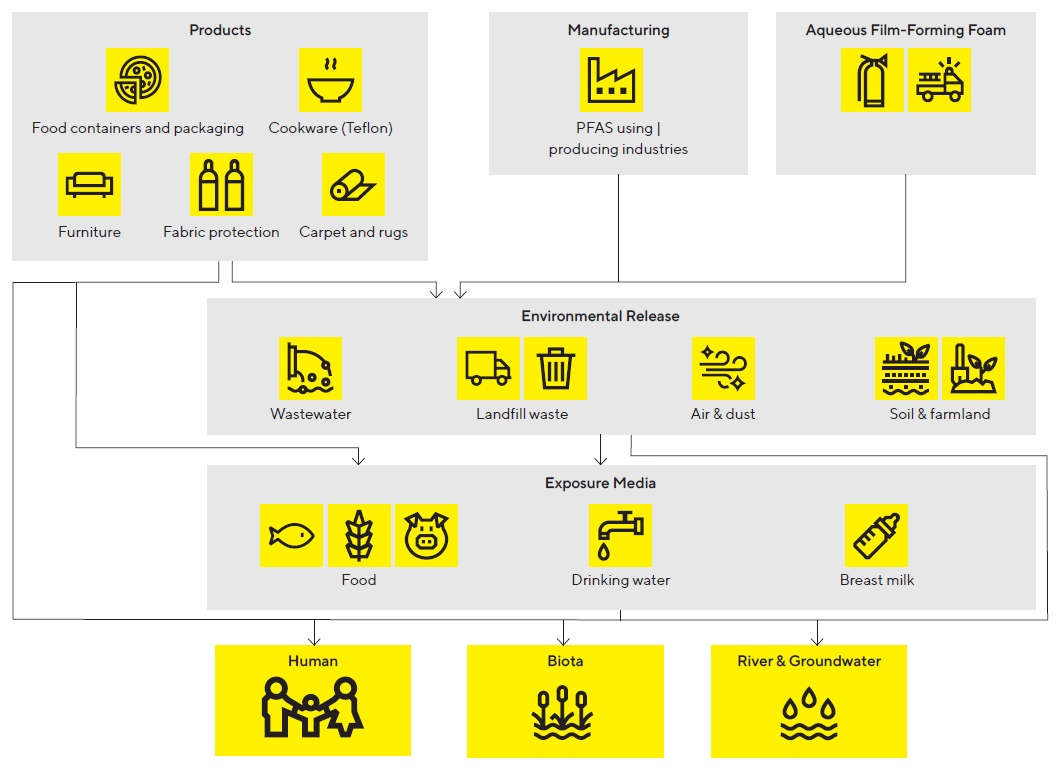
Figure 1. Main PFAS Exposure Pathways for Humans and Biota. Image Credit: Bălan, S.A. and Meng, Q. (2021)
PFAS are synthetic chemicals that are widely used in industrial and consumer products, such as waterproof clothing, non-stick cookware, and firefighting foam. Their potential adverse health effects and their persistence in the environment have raised concerns about their presence in water sources, including drinking water.
Human exposure to PFAS can take place through ingestion of contaminated water and food, inhalation of air and dust, and skin contact with products containing PFAS.
PFAS released into the environment can persist for long periods, potentially leaching into soil and water, harming wildlife, and contaminating drinking water sources.
Ultrapure water purification system overview
The Arium® Comfort I UV is a comprehensive water treatment solution that produces ultrapure water from in-house potable water. This ultrapure water is suitable for a range of applications and has reduced levels of contaminants, including PFAS, trace metal ions, and organic contaminants.
The system achieves efficient PFAS removal from potable water through a multi-stage approach combining activated carbon, reverse osmosis, and resin ion exchange.
PFAS removal process
The Arium® Comfort I UV’s multi-stage PFAS removal process ensures the highest level of water purity.
Reverse osmosis (RO) module
This process begins with the water initially passing through the RO module. The instrument’s PFAS removal approach is underpinned by its use of advanced RO technology, with RO proven to efficiently remove PFAS compounds, achieving up to 99 % PFOS removal from feedwater.
This comprehensive efficacy includes a major reduction in both long- and short-chain PFAS molecules (C4-C14).
Activated carbon filtration
The water enters the activated carbon filtration stage after RO filtration. Activated carbon is widely recognized for its excellent adsorption properties, further targeting PFAS molecules. This step improves the purification process by capturing organic impurities and residual PFAS.
Resin ion exchange
The final purification stage uses ion-exchange resin. This process further polishes the water by exchanging undesirable ions with ions on the resin. This includes any remaining traces of PFAS.
Using this approach, even the minute concentrations of PFAS that have passed through earlier stages are effectively removed at this final step.
Achieving below detection limit removal
The powerful combination of RO treatment, activated carbon, and resin ion exchange used by the Arium® Comfort I UV can facilitate reducing PFAS concentrations to below detection limits in tap water.
This produces high-quality water that has been shown to reduce the risk of PFAS contamination from the original water source, meeting even the most strict purity requirements in a range of applications.
Treating highly contaminated PFAS solutions
The Arium® Comfort I UV’s effectiveness is not limited to potable water, with the system already tested and proven to treat highly contaminated solutions containing up to ∼4 ppb (parts per billion) of different PFAS compounds.
These advanced purification capabilities highlight the system’s efficiency and robustness in addressing challenging contamination scenarios.
Acknowledgments
Produced from materials originally authored by Mary ‘Tricia’ Vail and Dr. Kunal Kureja from Sartorius Lab Instruments, Dr. Zijie ‘Beryl’ Xia from Claros Technologies, and Andrew Chrisitianson from Novem Scientific.
About Sartorius Lab Instruments GmbH & Co. KG
The Sartorius Group is a leading international partner of life science research and the biopharmaceutical industry.
With innovative laboratory instruments and consumables, the Group’s Lab Products & Services Division concentrates on serving the needs of laboratories performing research and quality control at pharma and biopharma companies and those of academic research institutes.
The Bioprocess Solutions Division with its broad product portfolio focusing on single-use solutions helps customers to manufacture biotech medications and vaccines safely and efficiently. The Group has been annually growing by double digits on average and has been regularly expanding its portfolio by acquisitions of complementary technologies.
In fiscal 2021, the company earned sales revenue of some 3.45 billion euros. At the end of 2021, nearly 14,000 people were employed at the Group’s approximately 60 manufacturing and sales sites, serving customers around the globe.
Sponsored Content Policy: News-Medical.net publishes articles and related content that may be derived from sources where we have existing commercial relationships, provided such content adds value to the core editorial ethos of News-Medical.net, which is to educate and inform site visitors interested in medical research, science, medical devices and treatments.