Spatial proteomics, the analysis of proteins in their native tissue context, has become a major development in biological research and was named Method of the Year 2024 by Nature.¹ By preserving information about where proteins are located within tissue, these approaches reveal how cells function and interact within the surrounding microenvironment.
Multiplex immunofluorescence (mIF) is central to spatial proteomics as it allows several protein targets to be detected concurrently on one tissue section.
COMET simplifies mIF workflows by supporting fast optimization of antibody panels. Developing a new panel on COMET uses a fully automated, high-throughput process that can be completed in under one week. The infographic below summarizes the principal stages and benefits of antibody panel optimization using COMET.
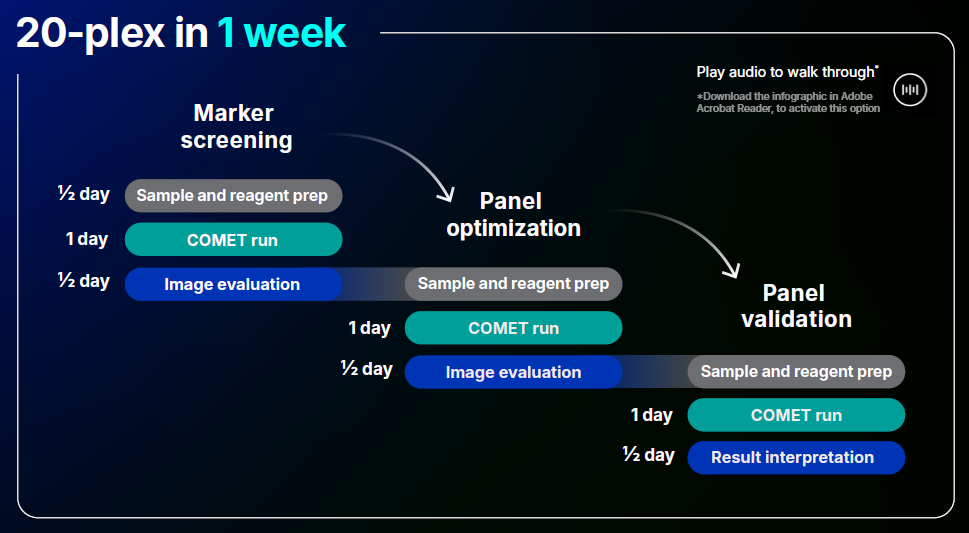
Image Credit: Bio-Techne Spatial
Building a 20-plex panel on COMET in one week
The process starts with experimental design. COMET permits several protein markers to be detected on the same tissue section and does not require conjugation of primary antibodies. Through COMET’s marker characterization and optimization protocols, staining conditions can be adjusted directly for the tissue being studied.
Accelerating performance through exceptional flexibility
- Walk-away automation: A fully integrated workflow combines staining and imaging
- Exceptional throughput: Four slides can be analyzed simultaneously at 40-plex per run
- Fast, adaptable panel development: A 20-plex protein panel can be constructed using any antibody marker within one week
- Broad tissue compatibility: The platform has been validated across multiple tissue types, including skin, prostate, breast, pancreas, and bone marrow
References
- Method of the year 2024: Spatial proteomics. (2024). Nature Methods, 21(12), pp.2195–2196. doi:10.1038/s41592-024-02565-3. https://www.nature.com/articles/s41592-024-02565-3

About Bio-Techne Spatial
Bio-Techne Spatial is a leader in applied spatial biology solutions, empowering scientists abnd clinicians to push the boundaries of science and medicine.
Bio-Techne Spatial build on technological excellence to deliver targeted, scalable spatial biology solutions and accelerate breakthroughs that improve patient lives.
Sponsored Content Policy: News-Medical.net publishes articles and related content that may be derived from sources where we have existing commercial relationships, provided such content adds value to the core editorial ethos of News-Medical.net, which is to educate and inform site visitors interested in medical research, science, medical devices and treatments.