Sponsored Content by LabmanReviewed by Olivia FrostNov 12 2026
Recursion collaborated with Labman to create an automated reaction-synthesis platform that improves repeatability, reduces hands-on time, and increases throughput for difficult chemical processes.
Challenge
Recursion's automated synthesis team has previously relied heavily on human methods to identify and debug reaction conditions.
The existing procedure had low throughput, relied on equipment that had been adapted for the application, and provided little reproducibility. The reaction environment was also variable, with no glovebox provided as part of the process.
Solution
Recursion approached the project looking for a solid-handling solution. As needs evolved, the scope expanded to include a fully automated reaction-synthesis platform.
Labman created a custom system that included automated solid- and liquid-handling, reaction incubation, scheduling, and integration with the Recursion software and LIMS environment.
Results
The automated platform has raised output from two plates to an average of about 10 per month, a fivefold gain.
The decrease in hands-on time is even more significant. A chemist can spend two to three weeks working on a single reaction using a manual optimization technique; when using the manual HTE technique, this reduces to approximately three days. However, with the automated platform, the same task often takes only two to three hours of hands-on time.
A flexible approach to automation
Recursion is a clinical-stage TechBio startup that decodes biology to dramatically improve people's lives.
Recursion's AI-native, end-to-end drug discovery and development platform, which integrates biology, chemistry, and clinical development into a unified intelligence system, enables the company to advance a portfolio of differentiated investigational medicines.
Its automated synthesis team investigates and optimizes chemical reactions, producing high-quality, machine-readable data to enable high-throughput testing.
As the team sought to increase its high-throughput experimentation (HTE) capabilities, the goal was to develop a platform capable of properly dosing small amounts of material, consistently handling liquids and reaction incubation, and operating with minimal hands-on interaction.
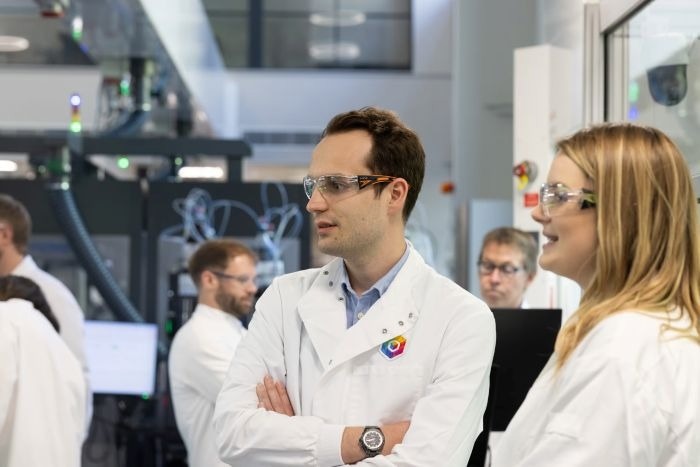
Image Credit: Labman
Most importantly, the system required to interface easily with Recursion's current software ecosystem, allowing the resulting reaction data to be captured in a uniform, machine-readable way.
The end result is an automated synthesis platform that allows Recursion to examine reaction conditions in a more reproducible and flexible manner, while drastically lowering the amount of hands-on time required of its scientists.
Since having our automation platform specifically designed for HTE, we’ve been able to increase productivity by five times as much so far.
Chloe Austin, Senior Automation Chemist, Recursion
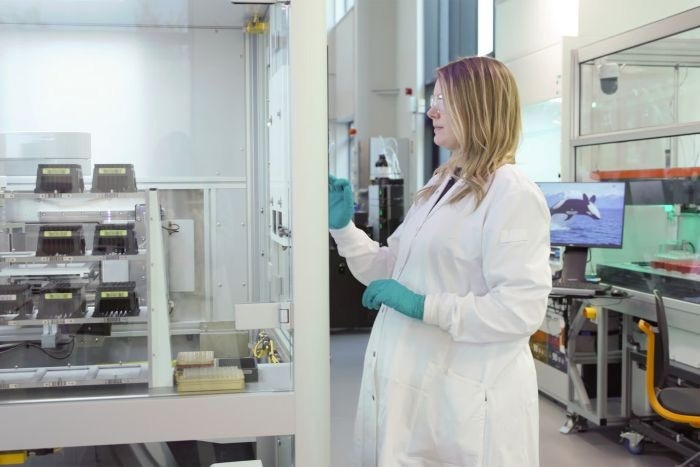
Image Credit: Labman
The capacity to handle extremely small response volumes was an important feature of the development process. With average quantities <100 µL, minimizing solvent loss during reactions was crucial.
To address this, Labman collaborated with Recursion to develop a proof of concept for an automated plate-sealing mechanism. The team created a new reaction lid and sealing system while allowing Recursion to keep using its current commercial reaction blocks.
Labman [was] really willing to work with us [and] generate a proof of concept, to de-risk the project ahead of time.
Chloe Austin, Senior Automation Chemist, Recursion
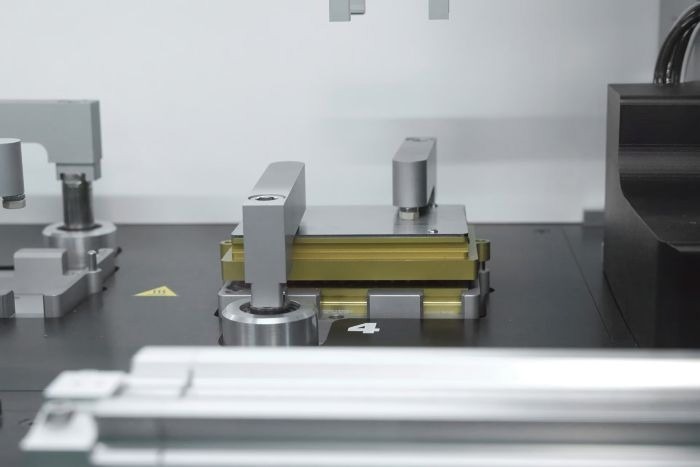
Image Credit: Labman
The platform's API was tailored to Recursion's workflow requirements, providing the team greater freedom in how the system was used and in how it was troubleshot. Following installation, the platform was integrated into the Recursion LIMS environment.
As the team investigates increasingly complex reactions, the platform lays the groundwork to take on more concurrent tasks and expand the role of automation in automated synthesis.
Working with Labman to develop this automated HTE platform has allowed us to automate the synthesis of more chemistry. It’s also allowed us to generate high-fidelity datasets that we can use elsewhere in the business.
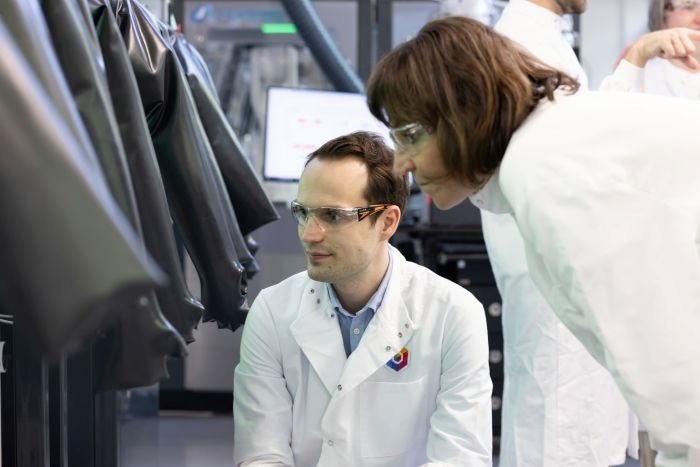
Image Credit: Labman
 About Labman
Labman is a global leader in creating custom automated laboratory technologies, products, and software that empower and advance scientific discovery. We collaborate across diverse industries, including medical, pharmaceutical, agritech, paints and coatings, and FMCG, to deliver innovative solutions. From our state-of-the-art manufacturing facilities, Labman’s multi-disciplinary teams design, build, and support systems used worldwide, enabling groundbreaking science in leading laboratories every day.
Labman in 2025
Video Credit: Labman
Sponsored Content Policy: News-Medical.net publishes articles and related content that may be derived from sources where we have existing commercial relationships, provided such content adds value to the core editorial ethos of News-Medical.net, which is to educate and inform site visitors interested in medical research, science, medical devices and treatments.