This article is based on a poster originally authored by Bo Wang, Lu Zhang, Yufang Yan, Hongchun Zhang, Yuwei Zhao, Wenqi Zhang, Xiaopan Nie, Liyuan Zhang, Ruixiu Wang, and Jingqi Huang.
Human iPSC-derived cerebral organoids provide a physiologically appropriate 3D model of multiple neural differentiation, mimicking brain architecture and cellular variety while overcoming significant limitations of 2D cultures.
This article investigates disease-in-a-dish models that capture complicated disease characteristics while demonstrating pharmaceutical responsiveness. The researchers used organoids for two translational applications: cytokine-induced neuroinflammation and Aβ42-driven Alzheimer's disease pathogenesis.
Using human iPSC-derived cerebral organoids and disease-relevant stimulation, the study demonstrates that the technology is scalable, human-relevant, and suitable for screening and mechanistic studies in CNS research.
Methods
Cerebral organoids (COs) were created from human iPSCs and maintained for more than 100 days to increase neuronal maturity. Immunofluorescent labeling for GFAP, Olig2, TH, and MAP2 confirmed the presence of astrocytes, oligodendrocytes, dopaminergic neurons, and both mature and immature neurons.
Two important disease-in-a-dish models were investigated:
- Cytokine-driven neuroinflammation: To induce neuroinflammation, organoids were incubated with a cocktail of pro-inflammatory cytokines (TNF-α, IL-1α, IL-1β). Dexamethasone, a glucocorticoid receptor agonist, was utilized to reduce neuroinflammation.
- Alzheimer’s disease: Aftin-4 treatment resulted in an Alzheimer's phenotype, including higher Ab42 and Ab40 ratios. LY2886721, a BACE1 inhibitor, was used to investigate the therapeutic control of amyloidogenic processes.
Characterization of multiple neural differentiation using iPSC-derived cerebral organoids

Neural lineage markers in iPSC-derived cerebral organoids confirm the presence of key CNS cell types. Image Credit: Pharmaron
Immunofluorescent labeling of CNS cell types in 120-day-old cerebral organoids. Astrocytes express GFAP, oligodendrocytes express Olig2, dopaminergic neurons express TH, adult neurons express MAP2, immature neurons express TUJI, and neural stem/progenitor cells express Nestin.
Neuroinflammation model
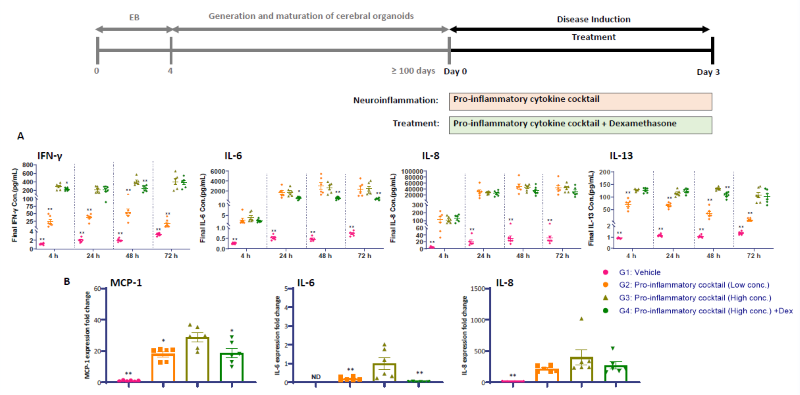
Neuroinflammation induction and drug testing in cerebral organoids. Image Credit: Pharmaron
When cerebral organoids were activated with a pro-inflammatory cocktail (TNF-α, IL-1α, IL-1β), they released more cytokines as measured by MSD. Increases in inflammatory gene expression were found through PCR.
(B). Treatment with Dexamethasone (Dex), a glucocorticoid receptor agonist that suppresses inflammatory signals, demonstrated the organoid system's potential to respond to neuroinflammation pharmacology. EB = Embryoid Bodies. The groups were compared to G3 (high-concentration cocktail), with *p < 0.05 and **p < 0.01.
Alzheimer’s disease model
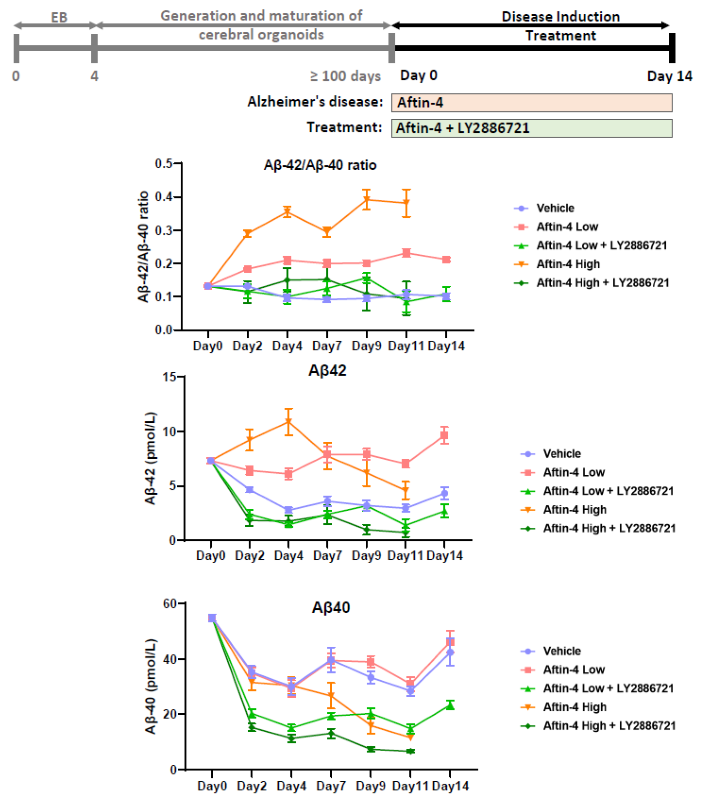
Induction of AD phenotype in cerebral organoids and reversal through LY2886721 treatment. Image Credit: Pharmaron
Incubation with Aftin-4 resulted in Alzheimer's-like characteristics in cerebral organoids, including increased Aβ42 secretion and an Aβ42/Aβ40 ratio.
Treatment with LY2886721, a BACE1 inhibitor, drastically reduced this ratio, indicating that amyloidogenic processing can be pharmacologically reversed. Aβ40 and Aβ42 levels in the culture media were measured using ELISA.
Pharmacology 3D microphysiological platform
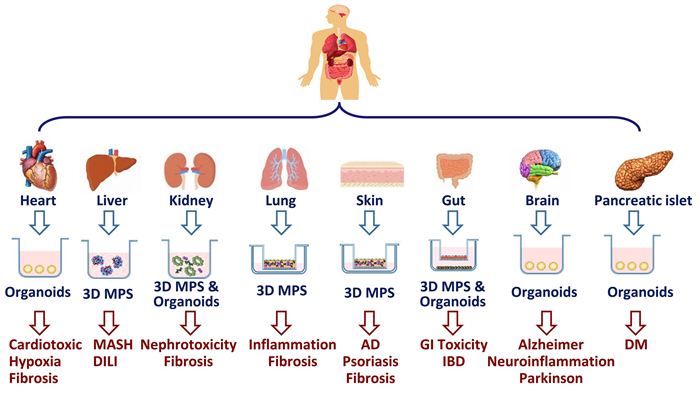
Image Credit: Pharmaron
Pharmaron’s pharmacology team created and validated over 20 toxicity and disease models using a 3D microphysiological system (MPS) and organoid platform. MASH: Metabolic Dysfunction-Associated Steatohepatitis. DILI: Drug-induced liver injury. Atopic dermatitis (AD). Inflammatory Bowel Disease (IBD). DM stands for diabetes mellitus.
Result and conclusion
The findings show that COs can be successfully grown into cortical neuron-like spheres with numerous mature neurons and astrocytes.
Incubation of COs with pro-inflammatory cytokines activated neuroinflammation, resulting in enhanced cytokine release and inflammatory gene mRNA expression. Incubation with Aftin-4 led to a rise in Aβ42 secretion and the Aβ42/Aβ40 ratio, both of which are associated with Alzheimer's disease.
Treatment with reference drugs (dexamethasone for inflammation and LY2886721 for Aβ pathology) reversed disease characteristics.
These findings provide evidence that the organoid system can be used to test and assess CNS-targeted therapies. Overall, the study demonstrated that iPSC-derived brain organoids not only display disease phenotypes but can also be reversed using pharmacological treatments.
As a disease-in-a-dish model, the study demonstrates its effectiveness as an effective screening platform for research and therapeutic discovery. It shows translational promise for accelerating the development of treatments for neuroinflammation and Alzheimer's disease.
Bo Wang, Lu Zhang, Yufang Yan, Hongchun Zhang, Yuwei Zhao, Wenqi Zhang, Xiaopan Nie, Liyuan Zhang, Ruixiu Wang, Jingqi Huang*
*Corresponding author: Jingqi Huang, SVP Pharmacology; Pharmaron Inc, Beijing, China
About Pharmaron
Pharmaron is a premier R&D service provider for the life sciences industry. Founded in 2004, Pharmaron has invested in its people and facilities and established a broad spectrum of research, development, and manufacturing service capabilities throughout the entire drug discovery, preclinical, and clinical development process across multiple therapeutic modalities, including small molecules, biologics, and CGT products. With over 17,000 employees and operations in China, the U.S., and the U.K., Pharmaron has an excellent track record of delivering R&D solutions to its partners in North America, Europe, Japan, and China.
Sponsored Content Policy: News-Medical.net publishes articles and related content that may be derived from sources where we have existing commercial relationships, provided such content adds value to the core editorial ethos of News-Medical.net, which is to educate and inform site visitors interested in medical research, science, medical devices, and treatments.
Last Updated: Mar 19, 2026