This article and associated images are based on a poster originally authored by Lucia Dunajová, Richard Newman, Steven R. Brown, Craig Rouse, and Stuart Robjohns and presented at ELRIG Drug Discovery 2026 in affiliation with Synthace.
This poster is being hosted on this website in its raw form, without modifications. It has not undergone peer review but has been reviewed to meet AZoNetwork's editorial quality standards. The information contained is for informational purposes only and should not be considered validated by independent peer assessment.

Cytochrome P450 (CYP450) enzymes are the liver's primary metabolic engine, mediating phase I metabolism of roughly 80% of marketed therapeutics.
Unintended inhibition of major CYP450 isoforms by novel drug candidates is a leading cause of dangerous drug-drug interactions (DDIs) and systemic toxicity, making early screening critical to prevent costly late-stage clinical failures.
Current state: 96-well manual CYP450 inhibition assay
- Limited number of compounds testable on one plate
- High reagent volumes and costs
Our approach: Smarter miniaturization with Synthace
We used multivariate experimental design and automation to gain a systematic understanding of the assay while simultaneously optimizing and miniaturizing it to a 384-well format.
Key tools
Experiment planning
Design of Experiments (DOE)
- A statistical approach that lets scientists explore multiple variables at the same time in a systematic, efficient way.
- It reveals how variables interact and fundamentally change biological behavior.
Synthace
- End-to-end software that translates powerful experimental designs into executable automation instructions and captures all experimental data and metadata
- The result is multidimensional, context-rich, AI-ready data, which yields faster biological insight.
Experiment execution
CERTUS FLEX
- Accurate, reproducible, and rapid low-volume transfers.
- 8 independent non-contact dispensing channels.
- Low dead volumes
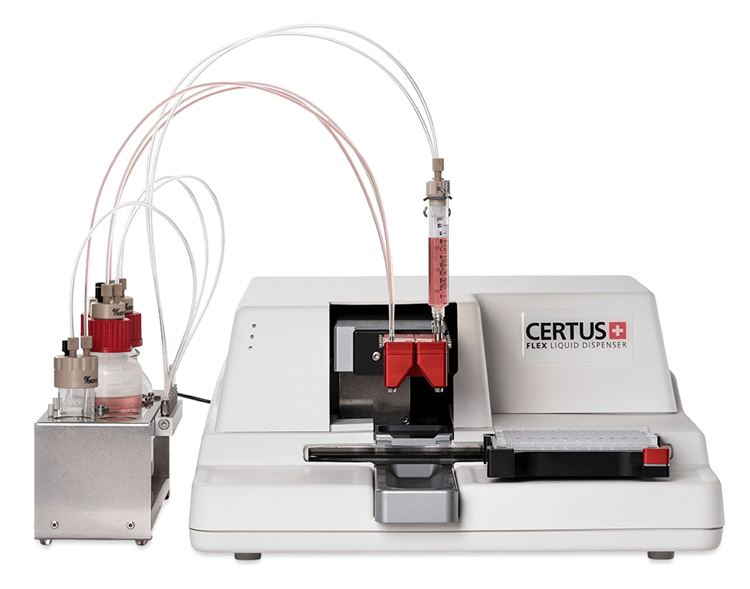
Image Credit: Lucia Dunajová et al., in partnership with ELRIG (UK) Ltd.
Results
✔ Four variables investigated
✔ Seven CYP450s, eight FDA-approved probe substrates
✔ 100 → 30 μL incubation vol
Integrated miniaturization and DOE optimization
- Reduced assay volume by 70% (100 μL to 30 μL), eight-fold reduced FTE time
- Unified experiment design: Combined standard SOP miniaturization and a multidimensional DOE on the same 384-well plate, assessing 2 CYP450 isoforms per 384W plate.
✔ Four days of experimentation for all eight isoform – probe substrate combinations across 4 x 384W plates
- Baseline IC50 concordance: Control inhibitor dose-response curves under SOP conditions in 384W matched legacy 96W data across all CYP450 isoforms, with IC50 values falling within target ranges (n=4) or an acceptable two-fold variance (n=4).
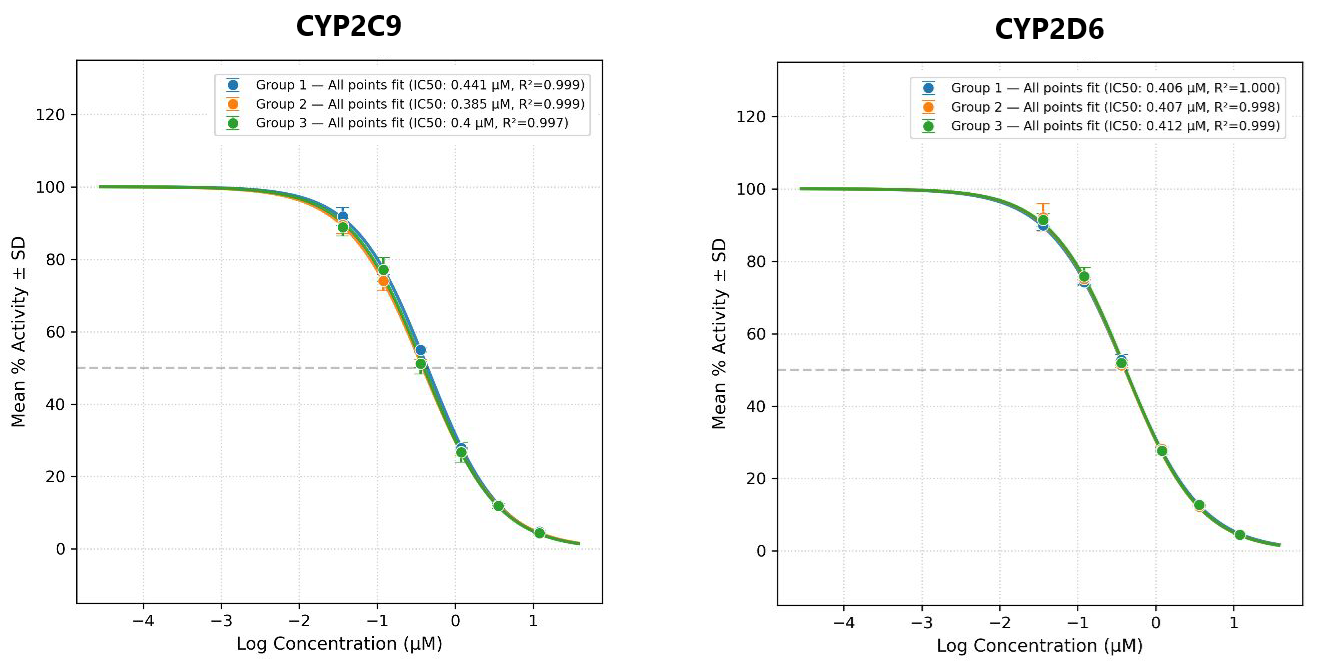
IC50 dose-response curves (n=3) for CYP2C9 (Sulphaphenazole) and CYP2D6 (Quinidine). Image Credit: Lucia Dunajová et al., in partnership with ELRIG (UK) Ltd.
- Concurrent DOE exploration: Simultaneously executed a custom DOE design with 75 unique variable combinations, in duplicate, for each isoform, to evaluate main effects, up to three-factor interactions, and quadratic effects using substrate conversion as a response.
- DOE Variables tested: Phosphate buffer, MgCl2, Human liver microsome (HLM), NADPH:HLM ratio
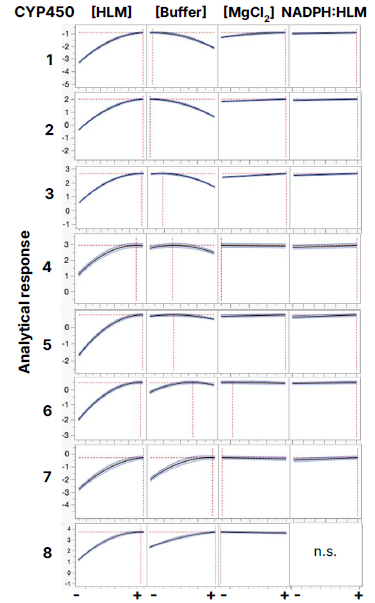
JMP profiler representation of significant factors and their impact on substrate conversion. Image Credit: Lucia Dunajová et al., in partnership with ELRIG (UK) Ltd.
Key optimization insights
- Buffer concentration directly influenced substrate conversion, with different CYP450 isoforms favoring low, medium, or high levels.
- Increasing HLM concentration consistently enhanced substrate conversion as expected.
- MgCl2 and NADPH:HLM ratio had minimal impact on assay.
Validation
- Shortened five- or 10-minute incubation time compared to the 96 W format while strictly maintaining substrate depletion below 20%.
- Derived Km values aligned with historical data for seven of the probe substrates in the new 384 W format.
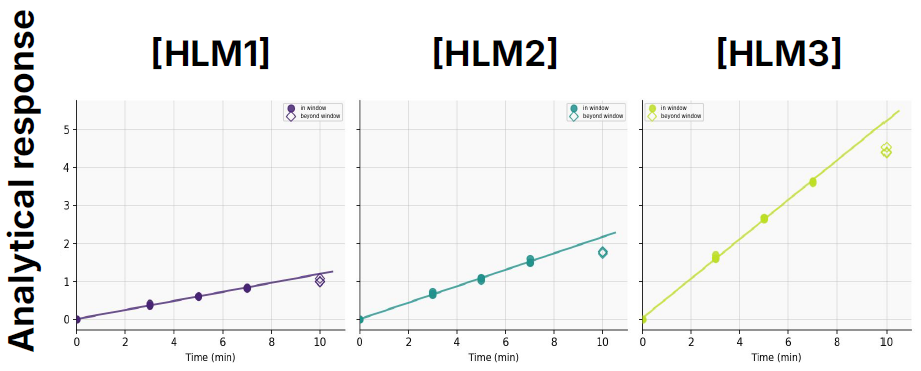
Substrate conversion over 10 min incubation at 3 HLM concentrations. Image Credit: Image courtesy of Lucia Dunajová et al., in partnership with ELRIG (UK) Ltd.
While demonstrated here for CYP450 inhibition, integrating DOE and Synthace represents a highly scalable strategy for accelerating assay optimization.
 About Synthace
Synthace is a digital experiment platform built for life science R&D teams to help them run more powerful experiments. It digitizes experiments from end to end: with minimal training, scientists can design and plan reproducible experiments, simulate them ahead of time, run them on their automation equipment, and automatically structure all of their experimental data and metadata in a single place. Controlled from a browser window and needing no code to operate, it makes experiments easier to run in the lab, increases the scientific value of experiments, and also makes it possible to run experiments that were previously thought impossible.
About ELRIG (UK) Ltd.
The European Laboratory Research & Innovation Group (ELRIG) is a leading European not-for-profit organization that exists to provide outstanding scientific content to the life science community. The foundation of the organization is based on the use and application of automation, robotics and instrumentation in life science laboratories, but over time, we have evolved to respond to the needs of biopharma by developing scientific programmes that focus on cutting-edge research areas that have the potential to revolutionize drug discovery.
Comprised of a global community of over 12,000 life science professionals, participating in our events, whether it be at one of our scientific conferences or one of our networking meetings, will enable any of our community to exchange information, within disciplines and across academic and biopharmaceutical organizations, on an open access basis, as all our events are free-of-charge to attend!
Our values
Our values are to always ensure the highest quality of content and that content will be made readily accessible to all, and that we will always be an inclusive organization, serving a diverse scientific network. In addition, ELRIG will always be a volunteer led organization, run by and for the life sciences community, on a not-for-profit basis.
Our purpose
ELRIG is a company whose purpose is to bring the life science and drug discovery communities together to learn, share, connect, innovate and collaborate, on an open access basis. We achieve this through the provision of world class conferences, networking events, webinars and digital content.
Sponsored Content Policy: News-Medical.net publishes articles and related content that may be derived from sources where we have existing commercial relationships, provided such content adds value to the core editorial ethos of News-Medical.net, which is to educate and inform site visitors interested in medical research, science, medical devices and treatments.
Last Updated: Nov 3, 2026