This article and associated images are based on a poster originally authored by K. W. Harlow, K. Blume, F. Andersson, L. Guanghui, P. Corish, and S. Echwald and presented at ELRIG Drug Discovery 2026 in affiliation with Aligned Bio AB.
This poster is being hosted on this website in its raw form, without modifications. It has not undergone peer review but has been reviewed to meet AZoNetwork's editorial quality standards. The information contained is for informational purposes only and should not be considered validated by independent peer assessment.

High-sensitivity immunoassays employing various methodologies have been instrumental in pushing the limits of detection for immunoassay techniques to lower values for many biomarkers of interest both for diagnostics and for drug target research. Increasingly, there is a need for ultra-sensitive assay platforms, which can reliably detect single molecules, while simultaneously being compatible with existing laboratory infrastructure, chemistries, and automated workflows. Ultra-sensitive assays interpret rare, low-concentration biomarkers and can enable low sample volumes of valuable clinical samples.
Aim
The unique ability of semiconductor nanowires of specific diameters to enhance and amplify the fluorescence of fluorescent reporter molecules provides a generic way to increase the sensitivity of fluorescent immunoassays (FLIA) and has allowed us to demonstrate a generically applicable mode of FLIA enhancement using semiconductor nanowire arrays. Nanowire-enhanced fluorescence thus provides a general way to extend the utility of FLIAs and other light-emitting bioassays in drug discovery research.
Method
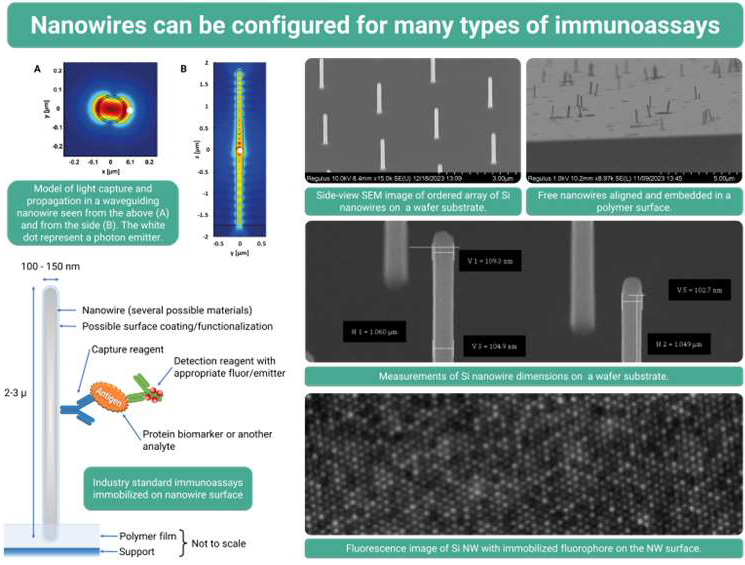
Image Credit: K. W. Harlow, et al., in partnership with ELRIG (UK) Ltd.
Arrays containing silicon nanowires with dimensions designed to interact with specific wavelengths of light were fabricated and used as substrates for performing sandwich-type FLIAs for a variety of protein biomarkers.
A range of biomarkers, including CEA, Troponin, and IL-6, were used to evaluate how broadly the sensitivity-enhancement effects applied across different analyte assays.
Commercially available antibodies and reagents were used to set up the immunoassays in these studies. FLIA assays were performed on these nanowire array substrates using standard immunochemical procedures. After assaying a particular biomarker analyte on the nanowire arrays, the arrays were imaged at low magnification on an inverted fluorescence microscope to record the spatial distribution and intensity of fluorescent signals. These images were further analyzed using a proprietary analysis algorithm to extract values for total fluorescence intensities, to locate and enumerate the number of fluorescent nanowires, and to determine the average fluorescence intensity per nanowire. These values were then used to calculate concentrations of analytes present in calibrator solutions.
Results
In general, we were able to demonstrate an enhancement in sensitivity of 50-200-fold over the same assay conducted on a planar material such as plastic or glass and using the same reagents. Assays for Troponin T and CEA have demonstrated 5- and 50-fold enhancement over planar assays (data not shown). Results for IL-6 are shown in Fig. 1. For this assay, we are beginning to demonstrate reproducible sensitivities at the clinically important medical decision point concentration of 5 pg/mL with an assay format that would be compatible with simple point-of-care devices.
In addition, we have observed extended dynamic ranges compared to assays run on planar surfaces, often with dynamic ranges of between 6-7 orders of magnitude. Fluorescent intensity measurements of individual nanowires at low concentrations were constant over a range of concentrations, while the number of fluorescing nanowires increased with increasing concentrations at these low levels. This suggests single-molecule binding events on individual nanowires and thus implies a simple method for digitizing FLIAs using the nanowire arrays.
We are continuing to enhance the capabilities of performing immunoassays on the surface of nanowires by customizing the surface chemistry of the wires to allow for a range of covalent coupling chemistries. This will provide opportunities to develop tailored surfaces suited to individual assays and aid in further increasing sensitivities through retention of capture reagents and the reduction of non-specific adsorption by controlling the ability of surfaces to reject low-affinity interactions.
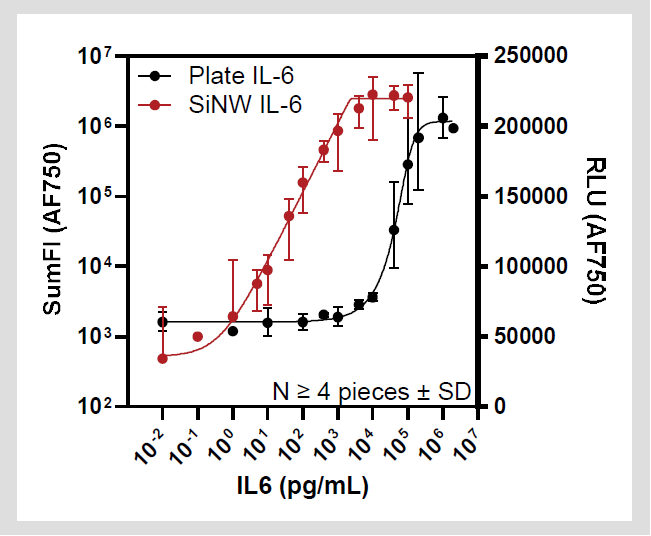
Figure 1. Titration of recombinant human IL-6 (HEK293) using IL-6 antibody clone MAB206 as capture reagent and IL-6 antibody clone IC2061S conjugated with Alexa Fluor™ 750 as detection reagent. The red curve was performed on NW surface and the black curve on Nunc™ 96-well black plate. Image Credit: Image courtesy of K. W. Harlow, et al., in partnership with ELRIG (UK) Ltd.
Conclusions
The ability of Si-nanowire arrays to enhance the sensitivities of FLIA using low-cost materials and low-magnification standard instrumentation has been demonstrated. Nanowire-assisted FLIA will provide commercial solutions for establishing high-sensitivity biomarker assays at a substantial fraction of the cost/assay of existing competitor solutions. We also note and are developing single nucleic acid molecule detection which is enabling Next-Gen Sequencing capabilities that produce Long Read data from short–read chemistries.
References
Platchek, M., et al. (2020) Comparative analysis of multiple immunoassays for cytokine profiling in drug discovery, SLAS Discovery, 25(10), pp. 1197–1213. DOI:10.1177/2472555220954389. https://www.slas-discovery.org/article/S2472-5552(22)06647-3/fulltext.
Acknowledgments
Funded by the European Union: 190196128 NanoWi EIC Accelerator grant.
About Aligned Bio
Aligned Bio is a nanotechnology company whose simple and quick single molecule detection capability will have positive impact on the DNA sequencing and biomarker detection industry. Aligned Bio provides a versatile nanowire sensing platform tailored to your application.
Aligned Bio is developing a nanowire-based, intermediate to long-read Nucleic Acid (NA) sequencing platform that will provide 8X the amount of genetic information in less time and cost.
Our nanowire platforms for molecular biomarkers have demonstrated orders of magnitude increase in sensitivity over standard planar substrates.
About ELRIG (UK) Ltd.
The European Laboratory Research & Innovation Group (ELRIG) is a leading European not-for-profit organization that exists to provide outstanding scientific content to the life science community. The foundation of the organization is based on the use and application of automation, robotics and instrumentation in life science laboratories, but over time, we have evolved to respond to the needs of biopharma by developing scientific programs that focus on cutting-edge research areas that have the potential to revolutionize drug discovery.
Comprised of a global community of over 12,000 life science professionals, participating in our events, whether it be at one of our scientific conferences or one of our networking meetings, will enable any of our community to exchange information, within disciplines and across academic and biopharmaceutical organizations, on an open access basis, as all our events are free-of-charge to attend!
Our values
Our values are to always ensure the highest quality of content and that content will be made readily accessible to all, and that we will always be an inclusive organization, serving a diverse scientific network. In addition, ELRIG will always be a volunteer led organization, run by and for the life sciences community, on a not-for-profit basis.
Our purpose
ELRIG is a company whose purpose is to bring the life science and drug discovery communities together to learn, share, connect, innovate and collaborate, on an open access basis. We achieve this through the provision of world class conferences, networking events, webinars and digital content.
Sponsored Content Policy: News-Medical.net publishes articles and related content that may be derived from sources where we have existing commercial relationships, provided such content adds value to the core editorial ethos of News-Medical.net, which is to educate and inform site visitors interested in medical research, science, medical devices and treatments.
Last Updated: Oct 27, 2026