From LifeArcReviewed by Olivia Frost
This article and associated images are based on a poster originally authored by Gina Pereira, João Pisco, Natasha Bury, Sandra Kuemper and Jonathan Large and presented at ELRIG Drug Discovery 2026 in affiliation with LifeArc.
This poster is being hosted on this website in its raw form, without modifications. It has not undergone peer review but has been reviewed to meet AZoNetwork's editorial quality standards. The information contained is for informational purposes only and should not be considered validated by independent peer assessment.

Introduction
Targeted Protein Degradation (TPD) is an emerging therapeutic field that aims to address proteins whose function is not meaningfully mitigated by small molecule inhibitors (SMIs). This likely results from the lack of an active binding pocket in the protein for SMIs to bind to. PROTACs surpass this impasse by not requiring a well-defined site and eliminating the disease-causing protein altogether.
Proteolysis Targeting Chimeras (PROTACs) are heterobifunctional molecules, consisting of an E3 ligase warhead, a protein of interest (POI) ligand, and a linker adjoining the two ligands. By binding the E3 ligase and the POI, these are brought into close proximity, so that the E3 ligase can ubiquitinate the POI, in turn, leading to Ubiquitin Proteasome System (UPS)-driven POI degradation.1 Only two E3 ligases out of over 600 are clinically exploited and validated. Given this limited set of well-characterized ligases and chemotypes, our objective was to expand the E3 ligase repertoire and the PROTAC chemical matter for recruitment of novel E3 ligases.2 Therefore, we established an integrated assay workflow to characterize these E3 ligases.
Forced proximity assay: An E3-agnostic approach
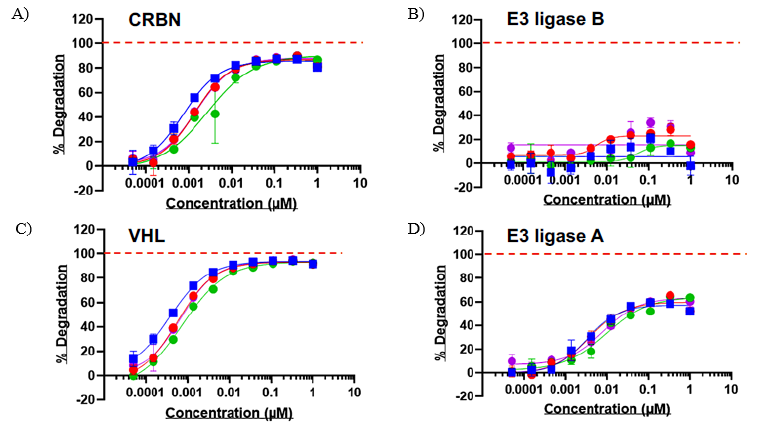
Image Credit: Gina Pereira et al., in partnership with ELRIG (UK) Ltd.
Orange dotted line represents degradation achieved by positive control compounds.
No PROTACs tested affected cell viability. VHL and CRBN were the control E3 ligases and 12 compounds, with 2 control compounds were tested in total.
This approach involved multiplexing HiBiT degradation and CellTiter Glo (CTG) assays to assess degradation potential of specific POIs by specific E3 ligases.3
The HiBiT tag is a small peptide tag that was introduced at the endogenous locus of the POI A via a CRISPR knock-in. A549 cell lines expressing HiBiT-tagged POIs were established, and E3 ligases were fused in-frame at the C-terminus with the FKBP12(F36V) tag, with an N-terminus FKBP12(F36V) tag also included on E3 ligase A as a separate construct.3
PROTACs with varying linker lengths and a common FKBP12(F36V) ligand could recruit multiple ligases in a concentration-dependent manner.
Main finding: E3 ligase A had a weaker degradation potency than VHL and CRBN, and E3 ligase B did not degrade cytosolic POI A, as it was localized to the nucleus.
E3 ligase A ligand discovery via high-throughput FP screen
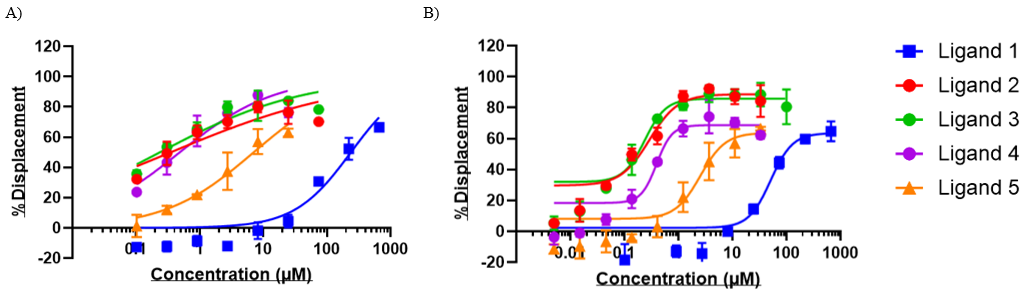
Image Credit: Gina Pereira et al., in partnership with ELRIG (UK) Ltd.
The miniaturized FP assay reported on the E3 ligase A-TAMRA peptide interaction was developed. Increased concentrations of ligands displaced the TAMRA-labelled peptide, leading to a decrease in the FP signal.4
All ligands achieved close to 100% displacement, with ligand 1 (control compound) being reproducible across all assays
Source: LifeArc
| Ligand ID |
Apparent IC50 (µM) at 2000 µM top assay concentration |
Apparent IC50 (µM) at 100 µM top assay concentration |
| Ligand 1 |
148 (81.3-269) |
N/A |
| Ligand 2 |
0.428 (0.307-0.595) |
0.147 (0.103-0.211) |
| Ligand 3 |
0.305 (0.205-0.453) |
0.146 (0.113-0.187) |
| Ligand 4 |
0.519 (0.393-0.686) |
0.569 (0.438-0.738) |
| Ligand 5 |
7.160 (4.88-10.50) |
6.940 (4.43-10.90) |
IC50 values (ligand concentration at which half-maximal probe displacement occurs), obtained by FP.4
Main finding: Three three-digit nanomolar ligands in FP assays, with overall ligand affinity ranking being preserved
Discordance between biochemical and in-cell assays
Source: LifeArc
| PROTAC ID |
B-A Papp (10-6/cm) |
A-B Papp (10-6/cm) |
Efflux Ratio |
| PROTAC 5 |
0.15 |
0.14 |
1.1 |
A-B Papp (10-6/cm) is the apical to basolateral permeability coefficient. B-A Papp (10-6/cm) is the basolateral to apical permeability coefficient. The efflux ratio is calculated as B-A Papp/A-B Papp.
Efflux ratio of 1.1 implies that there is no directional bias for PROTAC 5.5
Once PROTAC 5 was made from one of these nanomolar potent ligands, it was tested for its ability to degrade in-cell and to form a ternary complex in solution. Whilst PROTAC 5 did form a ternary complex in vitro, it did not degrade in-cell. An ADME Caco-2 permeability assay showed that the likely reason for the discrepancy was lack of intracellular accumulation to maintain a stable ternary complex and permit ensuing degradation.5
Characterization of purified PROTACs for E3 ligase B
Selection of VHL construct that favored ternary complex formation
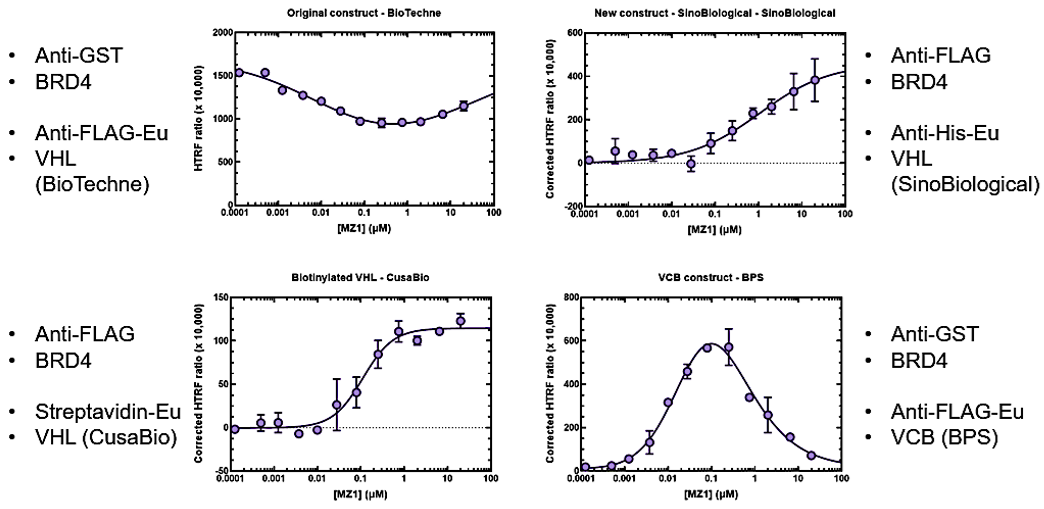
Image Credit: Gina Pereira et al., in partnership with ELRIG (UK) Ltd.
The HTRF ternary complex assay is a fluorescence-based technique used to assess whether the E3 ligase and POI each bind to their respective ligands in a given PROTAC and so form a ternary complex.6
Four VHL constructs were tested in total to note which would give the canonical bell-shaped concentration-response curve for ternary complex formation.6
Main finding: Only the VHL construct, VCB, gave the expected bell-shaped curve.
Matrix of protein and antibody concentrations for optimal HTRF ratio
A matrix of VCB and BRD4 protein concentrations was run in parallel to a matrix of anti-FLAG-Eu and anti-GST concentrations to determine which concentration pairings gave the best HTRF ratio for subsequent dose-response protocols.6
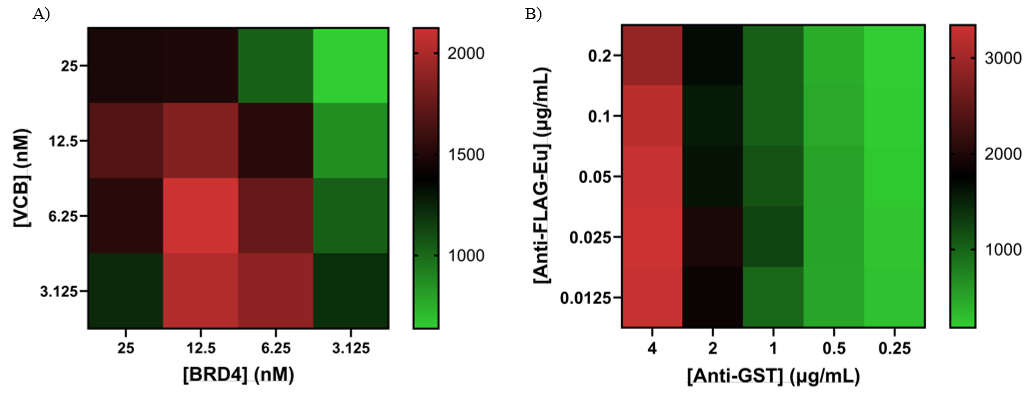
Image Credit: Gina Pereira et al., in partnership with ELRIG (UK) Ltd.
Main finding: 12.5nM of BRD4 and 6.25nM of VCB were selected as the protein concentrations that gave the highest HTRF ratio, representative of maximal ternary complex formation.6
0.0125 µg/mL of anti-FLAG-Eu and 4 µg/mL of anti-GST were selected as the antibody concentrations that have the greatest HTRF ratio.6
Dose-response protocol as confirmation of matrix concentrations
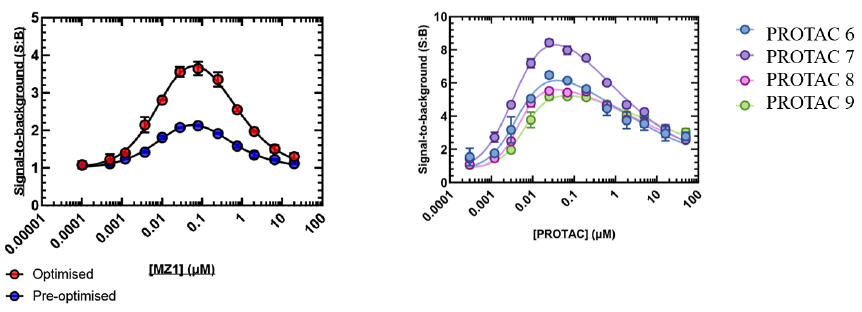
Image Credit: Gina Pereira et al., in partnership with ELRIG (UK) Ltd.
Main finding: The protein and antibody concentrations determined in the matrix experiments were confirmed to be the ones that gave the greatest HTRF ratio (shown here as S:B) in the dose-response protocol, with a 2-fold improvement observed from pre-optimized to optimized conditions. This approach could then be extended to E3 ligase B and POI B.6
Addition of binders to confirm PROTAC mode of action
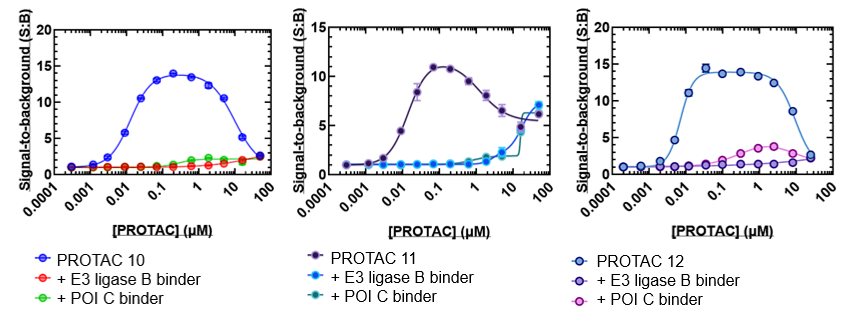
Image Credit: Gina Pereira et al., in partnership with ELRIG (UK) Ltd.
Binders for E3 ligase B and POI C were added in the HTRF assay to sequester these entities, so that they would no longer be available for PROTAC binding. This would disrupt ternary complex formation.6
Main findings: All three PROTACs gave a bell-shaped curve for ternary complex formation, with nanomolar potency. In all cases, the addition of the E3 ligase B and POI C binders disrupted the bell-shaped curve. PROTAC 11 revealed compound interference at over 1 µM PROTAC. The lack of complete flat lines for PROTAC 12 reinforces PROTAC potency. 6
Conclusions
- Co-localization of E3 ligase and POI is required for stable ternary complex formation and subsequent proteasomal degradation. Whilst nuclear E3 ligase B did not degrade cytosolic POI A, cytosolic E3 ligase A did. However, weaker degradation was observed with E3 ligase A, compared with VHL and CRBN.
- Three nanomolar hits were identified in an FP screen, and a PROTAC was made from one of these ligands. This PROTAC formed a ternary complex with E3 ligase A and BRD4 in solution but did not degrade in an in-cell assay. The Caco-2 permeability assay showed that the compound had no directional bias and so did not accumulate sufficiently inside the cell for productive ternary complex formation and resultant degradation.
- We developed and optimized an HTRF assay using the VHL-BRD4 model system. The same principles were applied for E3 ligase B and POIs B and C. Competition with binders confirmed the mode of action through which ternary complex and degradation were achieved.
References
- Toure, M. and Crews, C.M. (2016). Small-molecule PROTACS: New approaches to protein degradation. Angewandte Chemie International Edition, 55(6), pp.1966–1973. DOI:10.1002/anie.201507978. https://onlinelibrary.wiley.com/doi/10.1002/anie.201507978.
- Ishida, T. and Ciulli, A. (2020). E3 ligase ligands for PROTACs: How they were found and how to discover new ones. SLAS DISCOVERY: Advancing the Science of Drug Discovery, 26(4), pp.484–502. DOI:10.1177/2472555220965528. https://www.slas-discovery.org/article/S2472-5552(22)06695-3/fulltext
- Riching, K.M., et al. (2020). High-throughput cellular profiling of targeted protein degradation compounds using HiBiT CRISPR cell lines. Journal of Visualized Experiments, (165). DOI:10.3791/61787. https://www.jove.com/t/61787/high-throughput-cellular-profiling-targeted-protein-degradation
- Moerke, N.J. (2009). Fluorescence polarization (FP) assays for monitoring peptide‐protein or nucleic acid‐protein binding. Current Protocols in Chemical Biology, 1(1), pp.1–15. DOI:10.1002/9780470559277.ch090102. https://currentprotocols.onlinelibrary.wiley.com/doi/10.1002/9780470559277.ch090102
- Zou, X., et al. (2024). The in vitro intestinal cell model: Different co-cultured cells create different applications. Journal of drug targeting, 32(5), pp.529–543. DOI:10.1080/1061186X.2024.2333877. https://www.tandfonline.com/doi/full/10.1080/1061186X.2024.2333877
- Degorce, F. (2009). HTRF: A technology tailored for drug discovery - a review of theoretical aspects and recent applications. Current Chemical Genomics, 3(1), pp.22–32. DOI:10.2174/1875397300903010022. https://benthamopenarchives.com/abstract.php?ArticleCode=CCGTM-3-22
About LifeArc
LifeArc® is a medical research charity making life science life changing, transforming promising life science ideas into medical breakthroughs that change patients’ lives. We are self-funding and specialize in early-stage translation – advancing lab-based scientific discoveries to a point at which they can be developed into the next generation of diagnostics, treatments and cures. We have been doing this for more than 25 years and our work has resulted in a diagnostic for antibiotic resistance and four licensed medicines. This includes Keytruda®(cancer), Actemra® (rheumatoid arthritis), Tysabr® (multiple sclerosis) and Entyvio® (Crohn’s disease) and a test for antimicrobial resistance.
About ELRIG (UK) Ltd.
The European Laboratory Research & Innovation Group (ELRIG) is a leading European not-for-profit organization that exists to provide outstanding scientific content to the life science community. The foundation of the organization is based on the use and application of automation, robotics and instrumentation in life science laboratories, but over time, we have evolved to respond to the needs of biopharma by developing scientific programmes that focus on cutting-edge research areas that have the potential to revolutionize drug discovery.
Comprised of a global community of over 12,000 life science professionals, participating in our events, whether it be at one of our scientific conferences or one of our networking meetings, will enable any of our community to exchange information, within disciplines and across academic and biopharmaceutical organizations, on an open access basis, as all our events are free to attend!
Our values
Our values are to always ensure the highest quality of content, that content will be made readily accessible to all, and that we will always be an inclusive organization, serving a diverse scientific network. In addition, ELRIG will always be a volunteer-led organization, run by and for the life sciences community, on a not-for-profit basis.
Our purpose
ELRIG is a company whose purpose is to bring the life science and drug discovery communities together to learn, share, connect, innovate and collaborate, on an open access basis. We achieve this through the provision of world-class conferences, networking events, webinars, and digital content.
Sponsored Content Policy: News-Medical.net publishes articles and related content that may be derived from sources where we have existing commercial relationships, provided such content adds value to the core editorial ethos of News-Medical.Net which is to educate and inform site visitors interested in medical research, science, medical devices and treatments.
Last Updated: Oct 29, 2026