This article is based on a poster originally authored by Zhaozhao Wu, Kaiqiang Hu, Lei Liu, Tingting Guo, Pengwei Pan, and Fang He.
This study set out to develop a comprehensive cell profiling platform for a systematic phenotypic drug discovery approach.
The platform combines four main components.
- Cell Culture and Drug Transfer
- Cell Painting
- High-content imaging
- Machine learning for picture analysis
Pharmaron’s advanced high-content screening platform uses multiplexed fluorescent dyes to expose several organelles within cells. The subsequent image processing step extracts detailed morphological information, yielding rich, multi-parametric profiles.
With a pilot assessment of 390 kinase inhibitors, the researchers confirm the effectiveness of this method for categorizing drugs with comparable targets or modes of action (MoA).
Automated high-throughput workflow for cytological profiling of compounds via cell painting assay
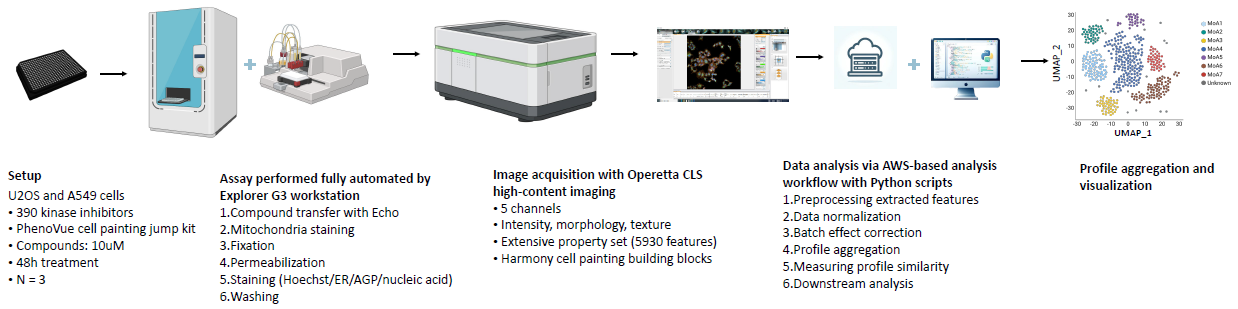
Image Credit: Pharmaron
Assay quality assessment on plate, image, and cell level effect
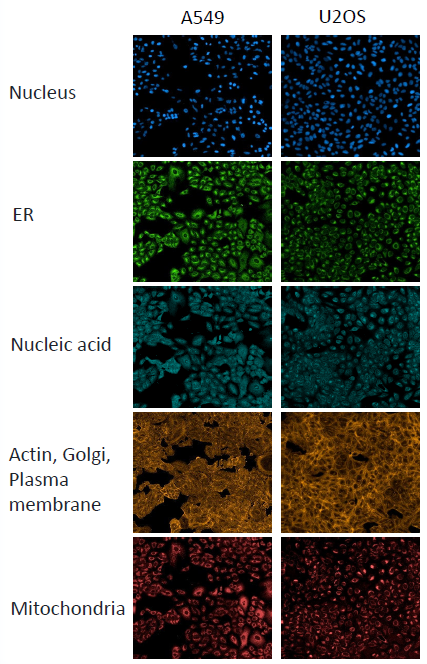
Image Credit: Pharmaron
Two cell lines, A549 and U2OS, were treated with 390 kinase inhibitors and then stained with various dyes. Shown are untreated cell lines.
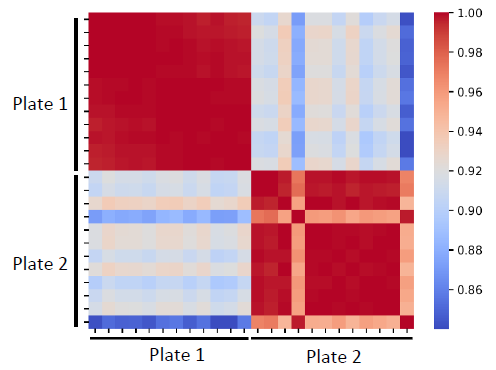
Image Credit: Pharmaron
Batch effects were investigated using cosine similarity between the median profiles of DMSO-treated wells from two plates with varied plate layouts.
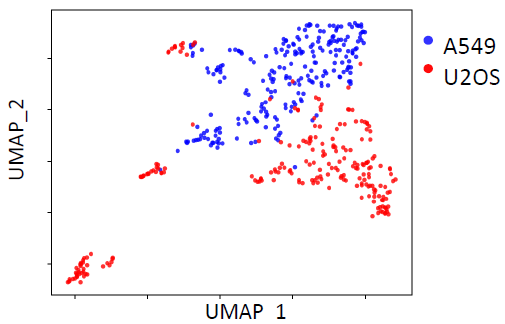
Image Credit: Pharmaron
UMAP displays cells treated with the chemical clustered by cell type rather than the compound's effects. As a result, each cell type's data was evaluated individually for this poster.
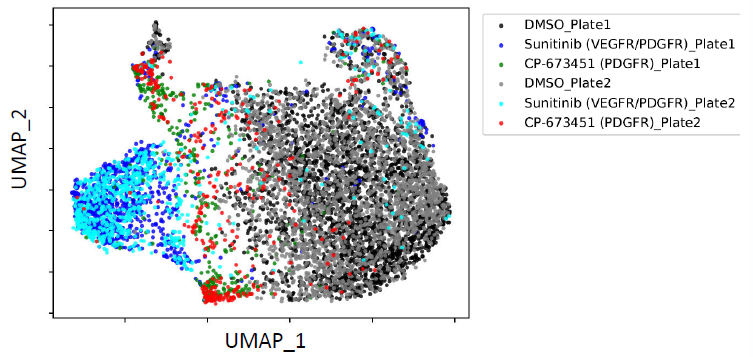
Image Credit: Pharmaron
The batch effect was corrected using the ComBat transformation. The UMAP plot visualizes the performance by grouping the DMSO-treated wells of plates 1 and 2 (black and gray dots).
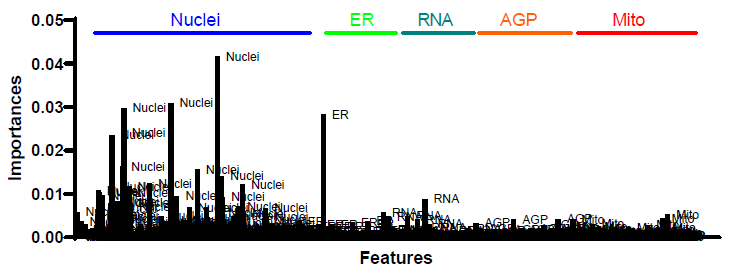
Image Credit: Pharmaron
Ranking of cell traits that contribute the most to U2OS and A549 cell line differentiation across all perturbations.
Compound clustering by MoA or target
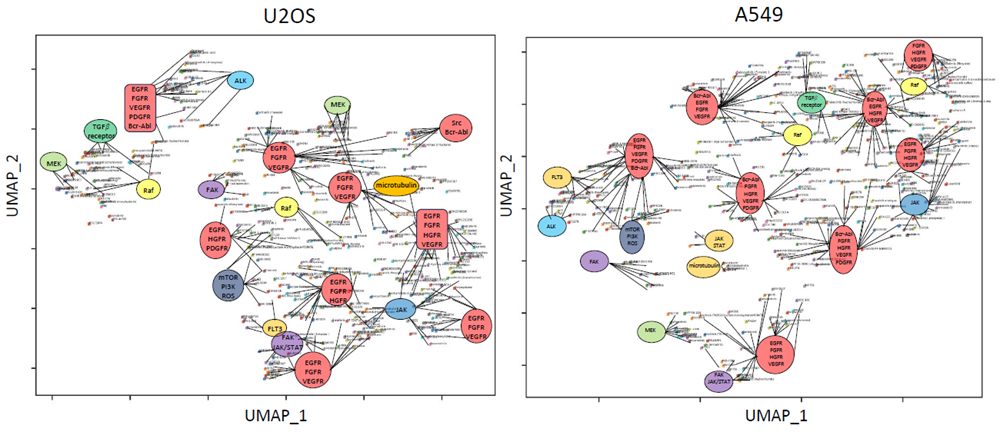
Image Credit: Pharmaron
Phenotypic screening can help identify or validate a new compound's target or mode of action. Based on data from the cell painting assay, UMAP clusters 390 chemicals by mode of action or target(s). Compound median profiles are used to perform this at the population level.
- Inhibitors with comparable targets or MoAs tend to cluster together.
- Inhibitors with various targets can be classified into separate clusters.
- Clustering was consistent across cell lines.
Machine learning-based clustering and classification algorithms discern and categorize compound profiles
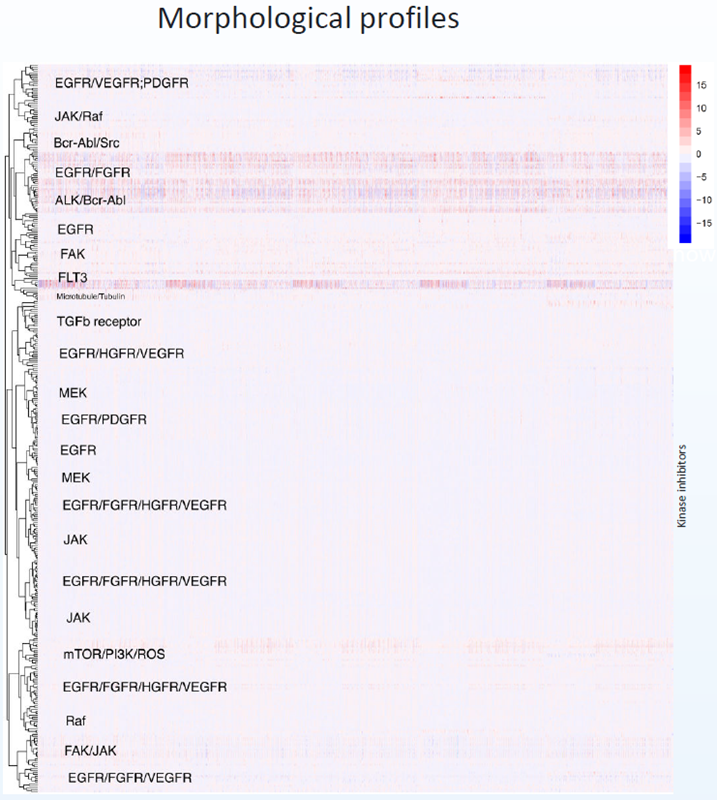
Image Credit: Pharmaron
To establish a more precise, quantitative clustering of substances by MoA or target, the researchers used a hierarchical unsupervised test based on the Euclidean distance between cells' cytological profiles. The results were equivalent to those obtained using the visual UMAP technique.
Source: Pharmaron
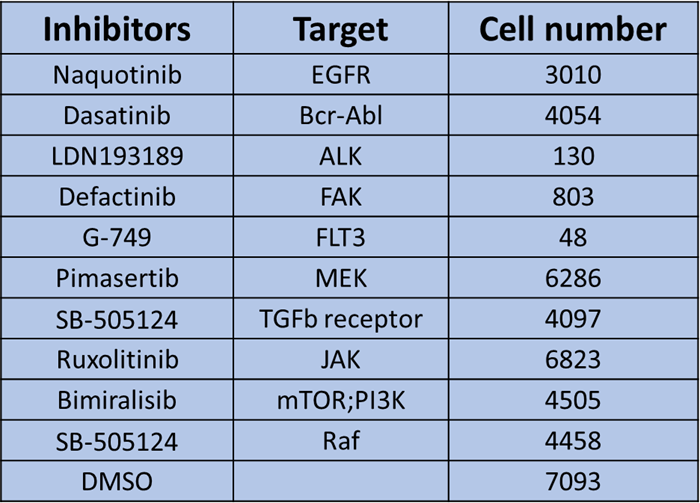
11 inhibitors targeting a single target were used to demonstrate machine learning-based classification at the single-cell level.
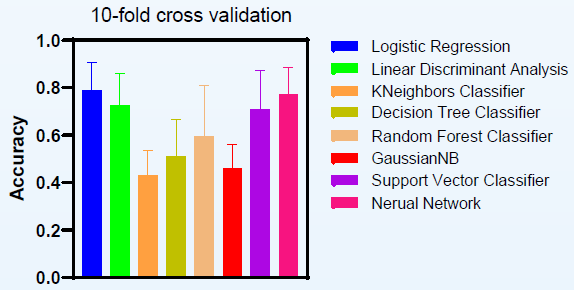
Image Credit: Pharmaron
Machine learning systems can predict compound effects on cells with up to 80 % accuracy, showing a great potential for precise compound MoA prediction.
Cell painting can capture subtle variations in cellular responses to compounds with the same target
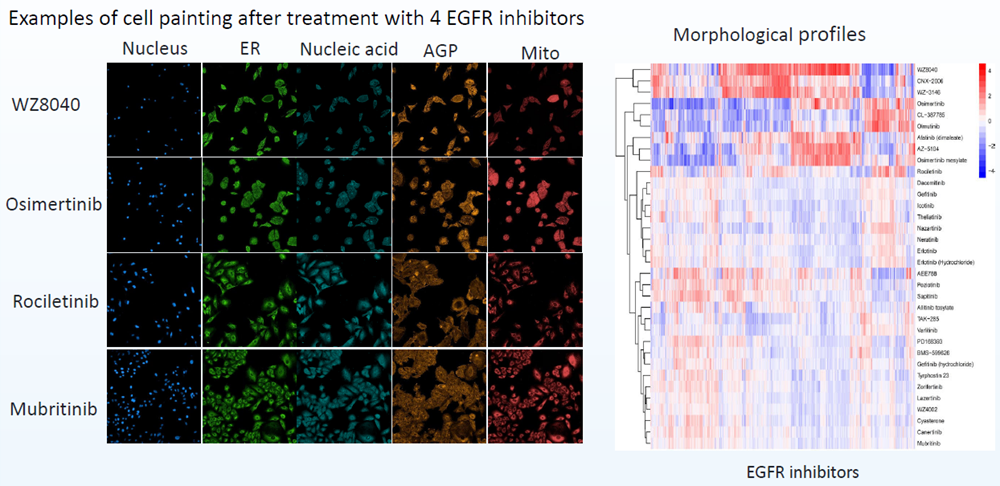
Image Credit: Pharmaron
The images above show the clustering of EGFR inhibitors into various groups. Given that these inhibitors all target the same EGFR, cell painting profiles may be able to identify EGFR drugs based on their distinct off-target effects.
The researchers performed unsupervised hierarchical clustering of EGFR inhibitors and found that those with greater morphological and cytotoxic effects (at the top of the heatmap) were likely irreversible binders, whereas those at the bottom of the heatmap were likely reversible binders.
Key findings
- The automated cell painting platform identifies detailed phenotypic patterns indicating cells responses to treatments.
- Phenotypic screening aims to organize inhibitors with similar targets or modes of action into clusters.
- Multiple inhibitors of the same target can cause distinct phenotypic variations.
- Limitation: Compound therapy affects different cell lines differently, hence phenotypic assessment of compound effects requires a diverse range of cell lines.
- Summary: Automated high-throughput cell painting and picture processing can improve chemical grouping and mode of action characterization, leading to faster phenotypic drug discovery.
Zhaozhao Wu, Kaiqiang Hu, Lei Liu, Tingting Guo, Pengwei Pan, Fang He
About Pharmaron
Pharmaron is a premier R&D service provider for the life sciences industry. Founded in 2004, Pharmaron has invested in its people and facilities and established a broad spectrum of research, development, and manufacturing service capabilities throughout the entire drug discovery, preclinical, and clinical development process across multiple therapeutic modalities, including small molecules, biologics, and CGT products. With over 17,000 employees and operations in China, the U.S., and the U.K., Pharmaron has an excellent track record of delivering R&D solutions to its partners in North America, Europe, Japan, and China.
Sponsored Content Policy: News-Medical.net publishes articles and related content that may be derived from sources where we have existing commercial relationships, provided such content adds value to the core editorial ethos of News-Medical.net, which is to educate and inform site visitors interested in medical research, science, medical devices, and treatments.
Last Updated: Mar 19, 2026