This article and associated images are based on a poster originally authored by Fazel Gorjipour and Şerif Şentürk and presented at ELRIG Drug Discovery 2026 in affiliation with İzmir Biomedicine and Genome Center and İzmir International Biomedicine and Genome Institute.
This poster is being hosted on this website in its raw form, without modifications. It has not undergone peer review but has been reviewed to meet AZoNetwork's editorial quality standards. The information contained is for informational purposes only and should not be considered validated by independent peer assessment.

Why this matters
- BAY-1816032 is a selective BUB1 kinase inhibitor with growing preclinical relevance.
- Routine bioanalysis has lacked accessible optical and non-MS chromatographic methods.
- The study characterized its photophysics and developed three complementary serum assays.
Goal: Match analytical performance to the needs of screening, formulation, and pharmacokinetic studies.
At a glance
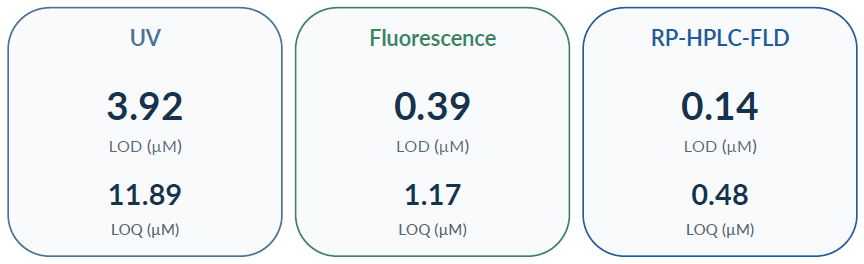
Sensitivity improved ∼28-fold from UV to RP-HPLC-FLD by LOD. Image Credit: Image courtesy of Fazel Gorjipour et al., in partnership with ELRIG (UK) Ltd.
Photophysical signature
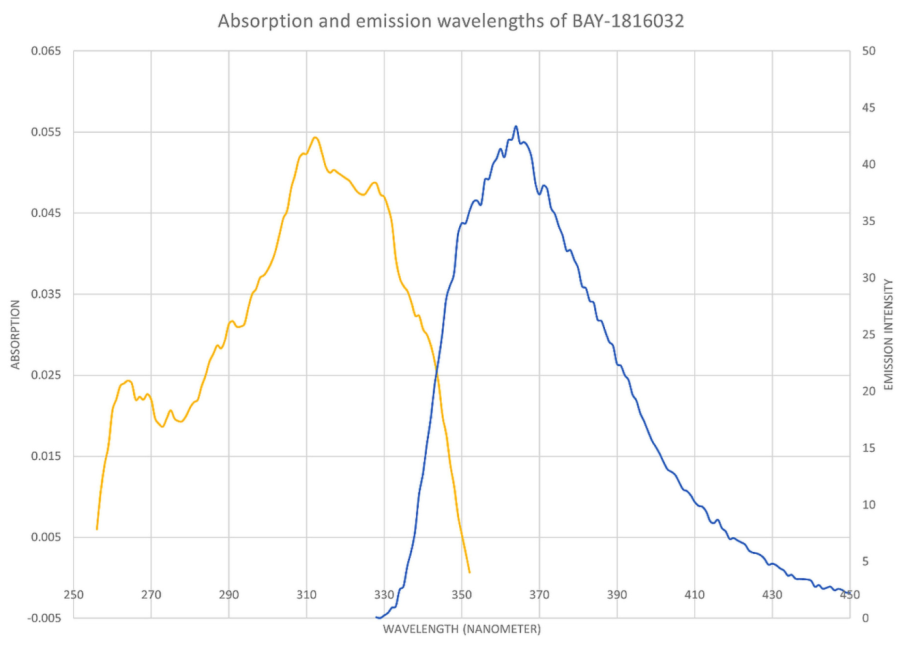
λmax ≈ 313 nm in aqueous media; intrinsic fluorescence λem ≈ 362 nm. Image Credit: Image courtesy of Fazel Gorjipour et al., in partnership with ELRIG (UK) Ltd.
1. Direct fluorescence: Extraction-free
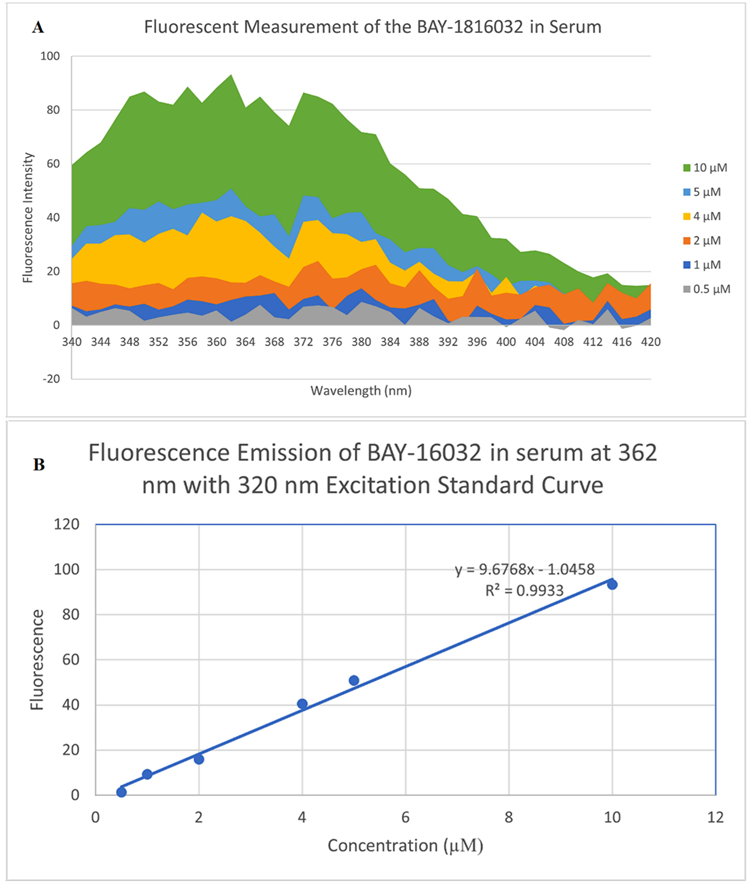
Image Credit: Image courtesy of Fazel Gorjipour et al., in partnership with ELRIG (UK) Ltd.
- Ex 320/Em 362 nm; R2 = 0.9933; SNR = 28.21.
- No extraction, dilution, or organic solvent required.
- 100 μL serum; compatible with high-throughput plate analysis.
2. RP-HPLC-FLD: Analytical anchor
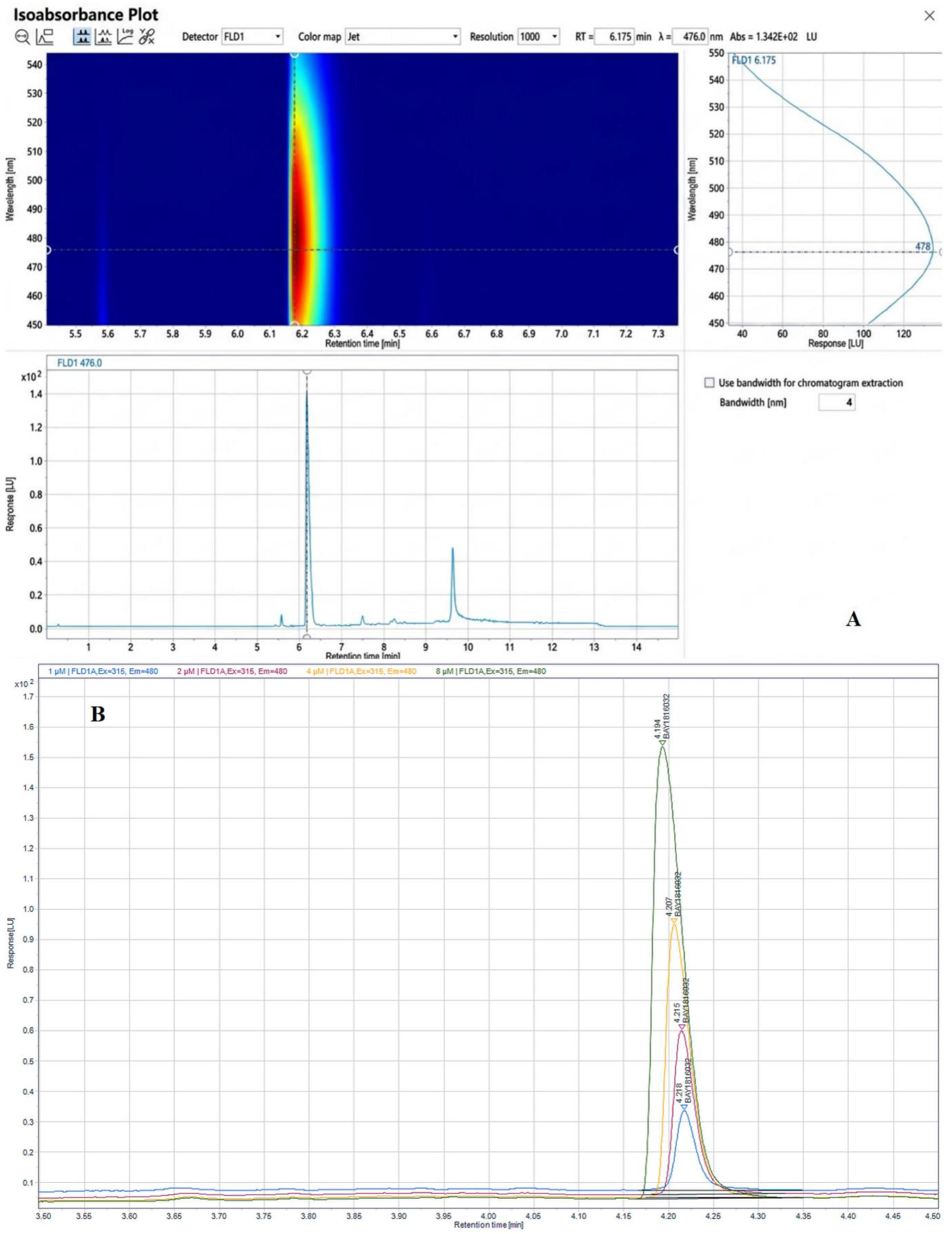
Image Credit: Image courtesy of Fazel Gorjipour et al., in partnership with ELRIG (UK) Ltd.
- C18, 0.80 mL/min; Ex 315/Em 480 nm.
- BAY-1816032 eluted at ∼4.21 min with concentration-dependent peak area.
- Highest sensitivity and selectivity for detailed pharmacokinetic work.
Choose the best assay for the specific question
Source: İzmir Biomedicine and Genome Center
| Method |
Best use |
Sample |
AGREE |
| UV |
Fast concentration checks |
1–2 μL |
0.85 |
| Fluorescence |
High-throughput screening |
100 μL |
0.91 |
| RP-HPLC-FLD |
Definitive PK/selectivity |
5 μL* |
0.58 |
*processed concentrated sample injected
A key analytical challenge: Serum protein binding
Initial acetonitrile precipitation produced no detectable analyte. Preconditioning serum with 20% DMSO before protein precipitation released BAY-1816032 and enabled quantitative chromatographic recovery.
Direct fluorescence bypassed this extraction problem entirely.
A complementary analytical framework for preclinical development

Image Credit: Image courtesy of Fazel Gorjipour et al., in partnership with ELRIG (UK) Ltd.
What is new?
- First comprehensive UV–visible, fluorescence and chromatographic characterization of BAY-1816032
- First direct, extraction-free fluorescence assay for BAY-1816032 in serum
- First non-LC–MS chromatographic method for BAY-1816032 quantification
- Method choice can be matched to throughput, sensitivity, sample volume, and sustainability
Take-home message
One compound does not require a single analytical method.
Direct fluorescence provides a rapid, sensitive, and solvent-free screen; RP-HPLC-FLD provides the sensitivity and selectivity needed for detailed pharmacokinetic work; and UV remains useful for ultra-low-volume concentration checks.
Together, the assays support formulation optimization and broader preclinical development of BAY-1816032.
Published study • funding • contact
Gorjipour, F. and Senturk, S. (2026). Spectral characterization and development of UV, direct fluorescence, and RP-HPLC-FLD assays for quantifying the BUB1 inhibitor BAY-1816032 in serum to support preclinical development. Results in Chemistry, 29, p.103693. DOI:10.1016/j.rechem.2026.103693. https://www.sciencedirect.com/science/article/pii/S2211715626006673.
This work was supported by the 2236-B Marie Skłodowska-Curie Actions (MSCA) Cofund Scholarship Programs Contribution Fund Program (TÜBİTAK project ID: 123C460) and the Horizon Europe MSCA Cofund Postdoctoral Program (EU project ID: 101126492). BAY-1816032 was kindly provided by Bayer AG and the Structural Genomics Consortium. We thank İbrahim Oğuzhan Tarman (IBG-FARMA) for assistance with RP-HPLC-FLD instrumentation.
About İzmir Biomedicine and Genome Center
The Izmir Biomedical and Genome Center (IBG) officially commenced operations in January 2018 as Turkey's first Thematic Research Center under Law No. 6550. IBG's aim is to develop innovative technologies and products for the prevention, diagnosis, and treatment of diseases, using fundamental research in the life sciences as a driving force. Located on the Dokuz Eylül University (DEÜ) health campus, IBG houses laboratories where research in biomedicine and genomics is conducted, including IBG-NEVCELL and the IBG Drug Analysis and Control Lab. Furthermore, the center has a total of 9 service units, 6 of which are open to all public and private sector organizations in Turkey.
Established within Dokuz Eylül University (DEÜ) with a concept dating back 15 years, and operational since 2014 as an Application and Research Center and in 2015 as a Research Institute, İBG is a "Research Infrastructure" with public legal personality. The İBG Board of Directors consists of DEÜ faculty members, valuable scientists and experienced senior executives from other higher education institutions, the private sector, relevant public institutions and organizations, and non-governmental organizations.
IBG has approximately 26,650 m2 of indoor space, comprising the Responsible Researcher laboratories and offices, cell culture laboratories, well-equipped common areas, the Aziz Sancar Auditorium, and seminar, meeting, and rooms. 6,600 m2 of the total area is allocated to service units.
About ELRIG (UK) Ltd.
The European Laboratory Research & Innovation Group (ELRIG) is a leading European not-for-profit organization that exists to provide outstanding scientific content to the life science community. The foundation of the organization is based on the use and application of automation, robotics and instrumentation in life science laboratories, but over time, we have evolved to respond to the needs of biopharma by developing scientific programs that focus on cutting-edge research areas that have the potential to revolutionize drug discovery.
Comprised of a global community of over 12,000 life science professionals, participating in our events, whether it be at one of our scientific conferences or one of our networking meetings, will enable any of our community to exchange information, within disciplines and across academic and biopharmaceutical organizations, on an open access basis, as all our events are free-of-charge to attend!
Our values
Our values are to always ensure the highest quality of content and that content will be made readily accessible to all, and that we will always be an inclusive organization, serving a diverse scientific network. In addition, ELRIG will always be a volunteer led organization, run by and for the life sciences community, on a not-for-profit basis.
Our purpose
ELRIG is a company whose purpose is to bring the life science and drug discovery communities together to learn, share, connect, innovate and collaborate, on an open access basis. We achieve this through the provision of world class conferences, networking events, webinars and digital content.
Sponsored Content Policy: News-Medical.net publishes articles and related content that may be derived from sources where we have existing commercial relationships, provided such content adds value to the core editorial ethos of News-Medical.net, which is to educate and inform site visitors interested in medical research, science, medical devices and treatments.
Last Updated: Oct 12, 2026