This article and associated images are based on a poster originally authored by Alfira Miftakova, Nargiz Uali, and Abdul Rahim Kabiry and presented at ELRIG Drug Discovery 2026 in affiliation with the University of Reading and Al-Farabi Kazakh National University.
This poster is being hosted on this website in its raw form, without modifications. It has not undergone peer review but has been reviewed to meet AZoNetwork's editorial quality standards. The information contained is for informational purposes only and should not be considered validated by independent peer assessment.

Background
HSV-1
- Common human viral pathogen, major cause of recurrent orolabial herpes (seroprevalence >67%)
- Standard therapy: Acyclovir, valacyclovir
- Limitation: Emergence of drug-resistant strains (TK-deficient altered), especially in immunocompromised patients
Glycyrrhiza glabra (licorice)
- Contains triterpenoid saponins and flavonoids (e.g., glycyrrhizin, 18ß-glycyrrhetinic acid)
- Previously reported antiviral, anti-inflammatory, antioxidant, and tissue-repairing properties
Rationale for topical formulation
- May provide localized delivery and a protective formulation for the lip area.
2. Objectives
The aim of this study was to formulate a 1% (w/w) Glycyrrhiza glabra root extract lip balm and evaluate its phytochemical profile, physicochemical properties, stability, and preliminary microbiological quality.
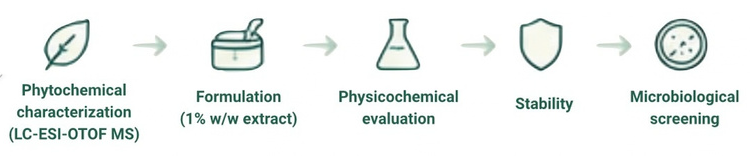
Image Credit: Image courtesy of Alfira Miftakova et al., in partnership with ELRIG (UK) Ltd.
3. Extraction and UHPLC-MS

Image Credit: Image courtesy of Alfira Miftakova et al., in partnership with ELRIG (UK) Ltd.
Analytical conditions: Agilent 1290 Infinity UHPLC; Agilent 6530 Q-TOF MS; SB-C18 column; Positive-ion ESI; 67-minute gradient
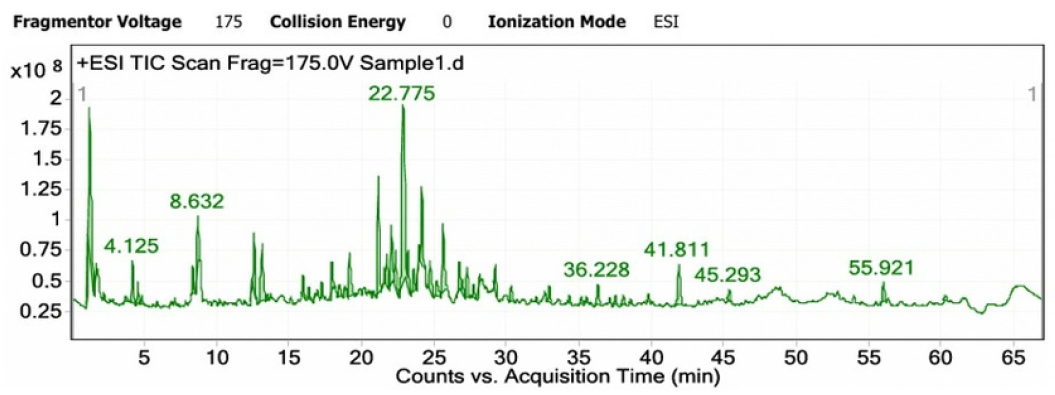
Figure 1. Total ion chromatogram (TIC) of Glycyrrhiza glabra root extract obtained by LC-ESI-QTOF-MS in positive-ion mode. Image Credit: Image courtesy of Alfira Miftakova et al., in partnership with ELRIG (UK) Ltd.
4. Formulation and characterization
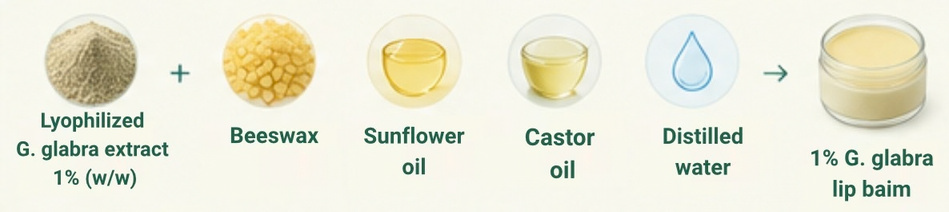
Image Credit: Image courtesy of Alfira Miftakova et al., in partnership with ELRIG (UK) Ltd.
Preparation workflow:
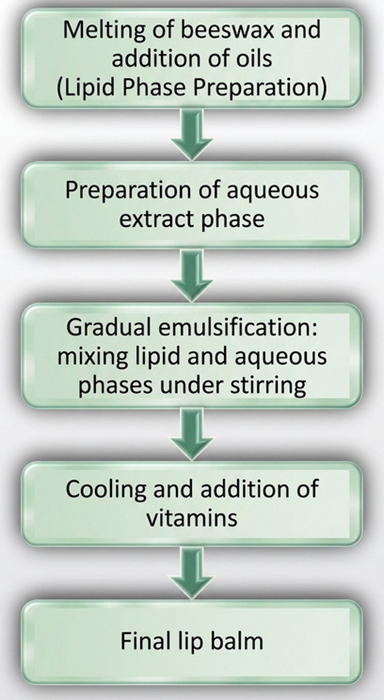
Image Credit: Image courtesy of Alfira Miftakova et al., in partnership with ELRIG (UK) Ltd.
Physicochemical and organoleptic properties:
Source: University of Reading
| Parameter |
Result |
| Appearance |
Smooth, semi-solid, homogeneous |
| Color |
Pale yellow, herbal tint |
| Odor |
Mild, sweet herbal aroma |
| Texture |
Soft, non-grainy |
| Melting point |
52–56 °C |
| pH |
≈5.4 |
| Spreadability |
Uniform, non-greasy |
| Homogeneity |
No particle aggregation |
Microbiological screening:
- Nutrient Agar (bacteria): No visible growth (two days)
- Sabouraud Dextrose Agar (fungi/yeast): No visible growth (seven days)
5. Phytochemical profile
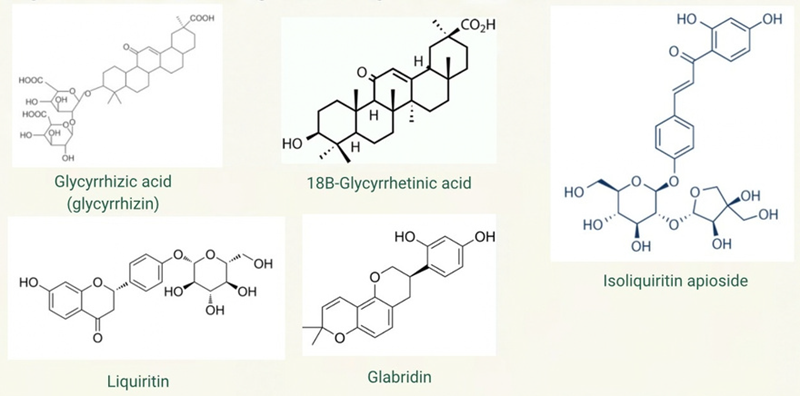
Figure 2. Major metabolites tentatively identified by LC-ESI-QTOF-MS. Key mass signals: m/z 823.29 and m/z 839.29-840.29 (RT 21.29-22.77 min), corresponding to glycyrrhizic acid and its ammonium/sodium adducts. Image Credit: Image courtesy of Alfira Miftakova et al., in partnership with ELRIG (UK) Ltd.
Conclusion
A 1% Glycyrrhiza glabra lip balm was successfully formulated, demonstrating excellent physical stability and a complex saponin/flavonoid profile. These results demonstrate the potential of licorice bioactives as a topical formulation and provide a foundation for further in vitro HSV-1 antiviral and cytotoxicity studies, as well as future clinical evaluation.
References
- James, C., et al. (2020). Herpes simplex virus: global infection prevalence and incidence estimates, 2016. Bulletin of the World Health Organization, 98(5), pp.315–329. DOI:10.2471/blt.19.237149. https://pmc.ncbi.nlm.nih.gov/articles/PMC7265941/pdf/BLT.19.237149.pdf.
- Pompei, R., et al. (1979). Glycyrrhizic acid inhibits virus growth and inactivates virus particles. Nature, 281(5733), pp.689–690. DOI:10.1038/281689a0. https://www.nature.com/articles/281689a0.
- Sabouri Ghannad, M., et al. (2014). The Effect of Aqueous Extract of Glycyrrhiza glabra on Herpes Simplex Virus 1. Jundishapur Journal of Microbiology, 7(7). DOI:10.5812/jjm.11616. https://brieflands.com/journals/jjm/articles/18755.
- Baltina, L. (2003). Chemical Modification of Glycyrrhizic Acid As A Route to New Bioactive Compounds for Medicine. Current Medicinal Chemistry, 10(2), pp.155–171. DOI:10.2174/0929867033368538. https://www.eurekaselect.com/article/8913.
About University of Reading

The University of Reading is one of the UK’s leading research intensive universities and ranked in the top 200 universities in the world by QS.
We have a proud history. In 2016 we celebrated the 90th anniversary of being granted a Royal Charter. From our appointment of the UK’s first female professor, Edith Morley, to the social reform campaigner Lord Wolfenden being our Vice-Chancellor, we have 100,000 alumni and students at the top of their professions in academia, arts, broadcasting, business, government and sport.
We have a global outlook, with 17,000 current students from 150 countries and our state-of-the-art University of Reading Malaysia campus opened in 2015. We offer 250 undergraduate and 150 postgraduate courses, with great research-led teaching, a top-class 24/7 library and 94% of our graduates in work or further study after six months. We have a 89% student satisfaction rate with a top 10-ranked Student’s Union, which runs 150 clubs and societies.
We do world-leading research, across the sciences, arts and humanities, including tackling the planet’s biggest challenges – climate change; food security; poor nutrition; and disease. The national Research Excellence Framework 2014 classed 78% of our research was classed as internationally excellent and 27% world-leading – ranking us 19th in the UK for research intensity and 27th for research power.
We have invested more than £400 m in excellent research, teaching and student facilities in the last decade. We have three UK campuses, including our award-winning 130-hectare main Whiteknights Campus and our London Road campus, home to the Institute of Education and from September 2016, our new School of Architecture.
We are home to the triple-accredited Henley Business School – one of the leading business schools in the UK and Europe.
About ELRIG (UK) Ltd.
The European Laboratory Research & Innovation Group (ELRIG) is a leading European not-for-profit organization that exists to provide outstanding scientific content to the life science community. The foundation of the organization is based on the use and application of automation, robotics and instrumentation in life science laboratories, but over time, we have evolved to respond to the needs of biopharma by developing scientific programs that focus on cutting-edge research areas that have the potential to revolutionize drug discovery.
Comprised of a global community of over 12,000 life science professionals, participating in our events, whether it be at one of our scientific conferences or one of our networking meetings, will enable any of our community to exchange information, within disciplines and across academic and biopharmaceutical organizations, on an open access basis, as all our events are free-of-charge to attend!
Our values
Our values are to always ensure the highest quality of content and that content will be made readily accessible to all, and that we will always be an inclusive organization, serving a diverse scientific network. In addition, ELRIG will always be a volunteer led organization, run by and for the life sciences community, on a not-for-profit basis.
Our purpose
ELRIG is a company whose purpose is to bring the life science and drug discovery communities together to learn, share, connect, innovate and collaborate, on an open access basis. We achieve this through the provision of world class conferences, networking events, webinars and digital content.
Sponsored Content Policy: News-Medical.net publishes articles and related content that may be derived from sources where we have existing commercial relationships, provided such content adds value to the core editorial ethos of News-Medical.net, which is to educate and inform site visitors interested in medical research, science, medical devices and treatments.
Last Updated: Oct 12, 2026