This article and associated images are based on a poster originally authored by Sam Hoare, Luciana Leo, Anastasia Schultz, and Thom Hughes and presented at ELRIG Drug Discovery 2025 in affiliation with Montana Molecular.
This poster is being hosted on this website in its raw form, without modifications. It has not undergone peer review but has been reviewed to meet AZoNetwork's editorial quality standards. The information contained is for informational purposes only and should not be considered validated by independent peer assessment.

Summary
From human physiology to cellular signaling, GPCR activity changes over time.1,2 Measuring signaling kinetics has been greatly aided by the invention and optimization of fluorescent biosensors, which convert signaling events into changes in fluorescence, which can be measured using plate readers.3,4
Montana Molecular has developed biosensors of GPCR signaling with unprecedented performance.3,4 enabling total read times of 12 hours or more, and sub-second read frequency, for Gs, Gi, Gq, and arrestin pathways.
GLP-1, glucagon, and GIP receptor signaling dynamics were quantified using these biosensors, identifying significant differences in the duration of signaling between receptors and between different agonists activating the GLP-1 receptor.
cAMP dynamics: Comparing receptors
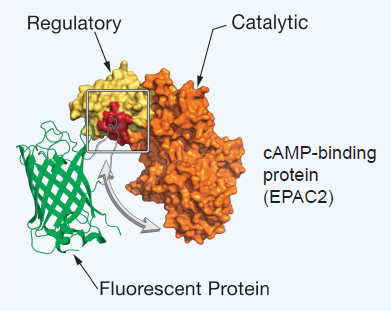
Image Credit: Image courtesy of Sam Hoare et al., in partnership with ELRIG (UK) Ltd.
cAMP binding to cADDis biosensor causes a change in fluorescence intensity that can be measured in plate readers.3
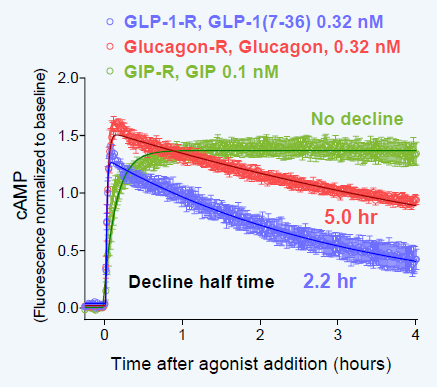
Image Credit: Image courtesy of Sam Hoare et al., in partnership with ELRIG (UK) Ltd.
- cAMP measured using cADDis biosensor3 in HEK293T cells. Curve fitting in Prism, as described.5,6
- Different cAMP dynamics for GLP-1, glucagon, and GIP receptors.
- Consistent with differences of receptor regulation, e.g. desensitization.5,6
cAMP dynamics: Comparing GLP-1 receptor agonists
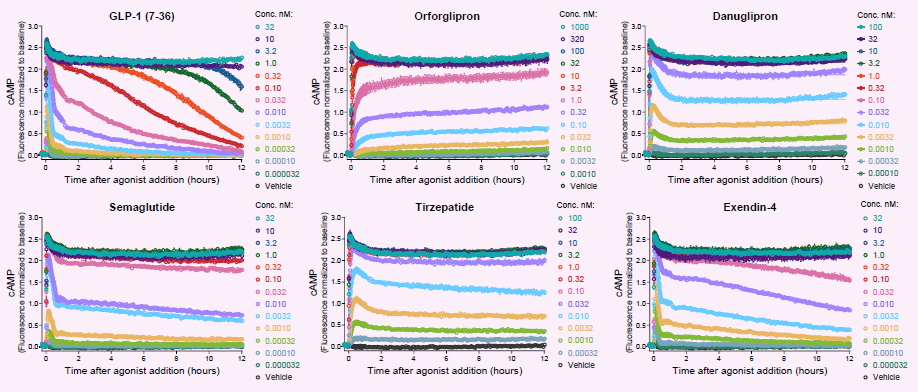
Image Credit: Image courtesy of Sam Hoare et al., in partnership with ELRIG (UK) Ltd.
- Radically different time course curve shapes for the different agonists, from profound decline of cAMP for GLP-1 (7-36), to sustained cAMP for orforglipron. Note the slow rise for orforglipron, and the peak-and-decline time course for other agonists.
- Suggests major differences in receptor desensitization mechanisms for the different agonists, especially forforglipron.
- cAMP measured for 12 hours in continuous presence of GLP-1 agonists, in HEK293T cells expressing GLP-1 receptor.
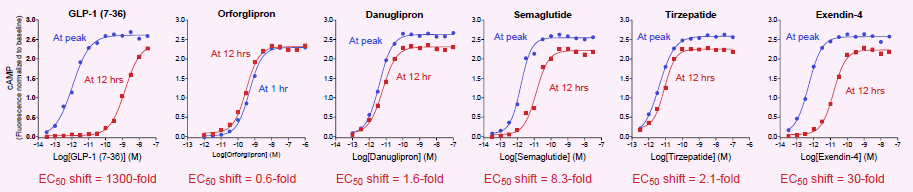
Image Credit: Image courtesy of Sam Hoare et al., in partnership with ELRIG (UK) Ltd.
- Persistence of cAMP signaling quantified as the shift of potency (EC50) over time, from cAMP at the peak to cAMP at 12 hours (or from 1 hour to 12 hours for orforglipron).
- Major differences in potency shift were observed between agonists, from 1300-fold for GLP-1 to 0.6-fold for orforglipron.
cAMP dynamics after agonist washout
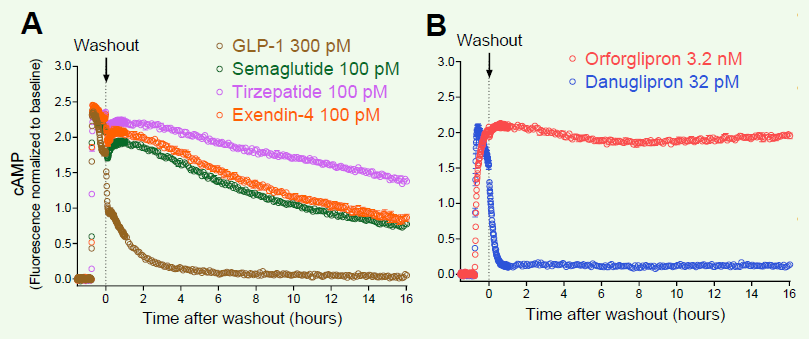
Image Credit: Image courtesy of Sam Hoare et al., in partnership with ELRIG (UK) Ltd.
- Agonists were applied for one hour, then washed out. cAMP was then recorded for 16 hours.
- cAMP signaling declined slowly after washout for peptide therapeutics semaglutide, tirzepatide, and exendin-4 (A), suggesting persistent binding to the GLP-1 receptor.
- For the small molecules (B) orforglipron signaling was completely wash-resistant, whereas danuglipron signaling declined rapidly, suggesting different receptor binding and regulation mechanisms.
Arrestin recruitment dynamics
Fluorescent arrestin biosensor (Borealis) (A) directly quantifies arrestin interaction with unmodified GLP-1-R (B) and Glucagon-R (C) in HEK cells.7 Arrestin recruitment to GIP-R was not detectable.
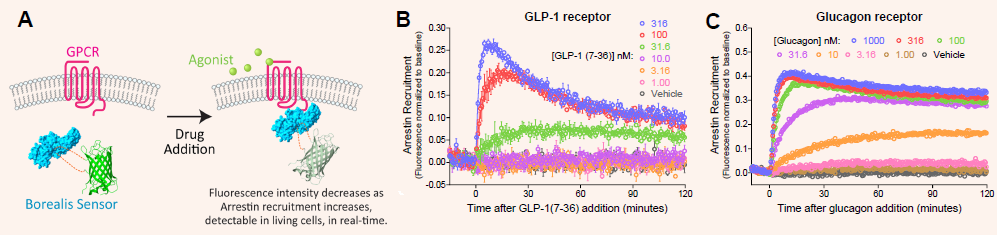
A) Normalized fluorescence units (NFU). B) For highest tested conc. C) Initial rate, units of NFU per minute. Image Credit: Image courtesy of Sam Hoare et al., in partnership with ELRIG (UK) Ltd.
Source: ELRIG (UK) Ltd.
| Parameter |
GLP-1-R, GLP-1(7-36) |
Glucagon-R, glucagon |
| Peak EC50 (nM) |
62 |
14 |
| Peak Emax A |
0.28 |
0.40 |
| Recruitment rate B,C |
0.15 |
0.19 |
| Decline t1/2 (min) B |
30 |
36 |
This research was supported by the National Institute of Drug Abuse of the National Institutes of Health under award number R44DA050357.
References
- Lobingier, B.T. and von Zastrow, M. (2019). When trafficking and signaling mix: How subcellular location shapes G protein-coupled receptor activation of heterotrimeric G proteins. Traffic, 20(2), pp.130–136. https://doi.org/10.1111/tra.12634.
- Halls, M.L. and Canals, M. (2018). Genetically Encoded FRET Biosensors to Illuminate Compartmentalised GPCR Signalling. Trends in Pharmacological Sciences, 39(2), pp.148–157. https://doi.org/10.1016/j.tips.2017.09.005.
- Tewson, P.H., et al. (2016). New DAG and cAMP Sensors Optimized for Live-Cell Assays in Automated Laboratories. SLAS DISCOVERY, 21(3), pp.298–305. https://doi.org/10.1177/1087057115618608.
- Hoare, S.R.J. and Hughes, T.E. (2021). Biosensor Assays for Measuring the Kinetics of G-Protein and Arrestin-Mediated Signaling in Live Cells. Assay Guidance Manual. (online) Available at: https://pubmed.ncbi.nlm.nih.gov/34606191/.
- Sam R.J. Hoare, et al. (2022). Quantifying the Kinetics of Signaling and Arrestin Recruitment by Nervous System G-Protein Coupled Receptors. Frontiers in Cellular Neuroscience, 15. https://doi.org/10.3389/fncel.2021.814547.
- Sci Reports 2020, 10: 12263
- Sci Reports 2020, 10: 1766
About Montana Molecular
Montana Molecular develops genetically encoded fluorescent biosensors and probes for cell-based assays and live cell imaging. Our products are used for drug discovery and to observe and measure cell signaling processes. Our scientific team is focused on creating breakthrough innovations that empower both basic research scientists and drug discovery teams.
About ELRIG (UK) Ltd.
The European Laboratory Research & Innovation Group (ELRIG) is a leading European not-for-profit organization that exists to provide outstanding scientific content to the life science community. The foundation of the organization is based on the use and application of automation, robotics and instrumentation in life science laboratories, but over time, we have evolved to respond to the needs of biopharma by developing scientific programmes that focus on cutting-edge research areas that have the potential to revolutionize drug discovery.
Comprised of a global community of over 12,000 life science professionals, participating in our events, whether it be at one of our scientific conferences or one of our networking meetings, will enable any of our community to exchange information, within disciplines and across academic and biopharmaceutical organizations, on an open access basis, as all our events are free-of-charge to attend!
Our values
Our values are to always ensure the highest quality of content and that content will be made readily accessible to all, and that we will always be an inclusive organization, serving a diverse scientific network. In addition, ELRIG will always be a volunteer led organization, run by and for the life sciences community, on a not-for-profit basis.
Our purpose
ELRIG is a company whose purpose is to bring the life science and drug discovery communities together to learn, share, connect, innovate and collaborate, on an open access basis. We achieve this through the provision of world class conferences, networking events, webinars and digital content.
Sponsored Content Policy: News-Medical.net publishes articles and related content that may be derived from sources where we have existing commercial relationships, provided such content adds value to the core editorial ethos of News-Medical.Net which is to educate and inform site visitors interested in medical research, science, medical devices and treatments.
Last Updated: Nov 27, 2025