Introduction: The hidden impact of alcohol on nutrition and metabolism
Alcohol-induced gut dysbiosis and epithelial barrier damage
The gut-brain-liver axis and neuroinflammation
Microbiome dynamics and resilience in early abstinence
Nutritional and microbiota-targeted interventions
Conclusions
References
Further reading
What happens to nutrition, gut microbes, and metabolic signaling when alcohol use stops, and what might these changes mean for recovery?
Image Credit: Chizhevskaya Ekaterina / Shutterstock.com
Alcohol use disorder (AUD) is associated with various nutritional and metabolic disorders, as chronic alcohol consumption can reduce dietary quality, limit nutrient intake, as well as impair nutrient absorption and utilization. Adequate calorie intake does not rule out malnutrition; although alcohol supplies energy, it can reduce nutrient density and impair nutrient handling.
Nutritional deficiencies can adversely affect physical and emotional health, thereby complicating recovery. In fact, several studies have reported altered circulating proteins, micronutrients, and electrolytes across substance use disorders, including abnormal albumin, total protein, vitamin C, sodium, magnesium, potassium, zinc, and selenium levels. These findings should not be assumed to occur uniformly in AUD.1 Furthermore, albumin and total protein are circulating markers, not measurements of dietary macronutrient intake.1
Alcohol-related malnutrition may result from reduced food intake, impaired gastrointestinal absorption, and disrupted nutrient metabolism. Specifically, alcohol overconsumption is linked to poor nutritional status, lower grip strength, and lower blood vitamin C, magnesium, and sodium levels, emphasizing the importance of nutritional assessment during treatment.
“Sober nutrition” is used here as an informal description of nutritional care during alcohol recovery, rather than a standardized clinical treatment. It includes addressing inadequate intake and deficiencies while supporting gastrointestinal and metabolic health.1,6
This article explores how alcohol dependence can disrupt nutrition, gut microbiota, intestinal barrier function, and the gut-brain-liver axis, and distinguishes between established nutritional and experimental treatments.
Nutrition & Addiction Recovery: How Diet Heals the Brain and Reduces Cravings
Alcohol-induced gut dysbiosis and epithelial barrier damage
The gastrointestinal tract is an early target of chronic alcohol exposure. Alcohol can alter gut microbial composition and function, producing dysbiosis or microbial changes associated with disturbed intestinal health.
Human studies have identified patterns potentially linked to inflammation, including increased relative abundance of Proteobacteria and decreased abundance of Faecalibacterium, along with changes in other bacterial genera and a lower proportion of butyrate among stool short-chain fatty acids (SCFAs).2,6
Alcohol-induced dysbiosis can accompany disruption of the intestinal epithelial barrier, but increased permeability is not present in every patient with AUD. Increased intestinal permeability allows microbial products, including lipopolysaccharide (LPS), to move from the intestinal lumen into the circulation.
Alcohol disrupts tight junctions that regulate passage between epithelial cells, increasing the passage of bacteria and microbial products across the intestinal barrier. Once circulating, bacterial components can activate immune receptors and stimulate the production of pro-inflammatory cytokines, contributing to systemic inflammation.2,3,5
In patients with chronic alcohol overconsumption, predictive metagenomic analysis inferred enrichment of genes associated with epithelial-cell invasion from bacterial 16S rRNA data. These findings suggest that alcohol-associated dysbiosis may involve differences in microbial composition and predicted functional capacity, though the cross-sectional design and limited dietary information prevent causal conclusions.6
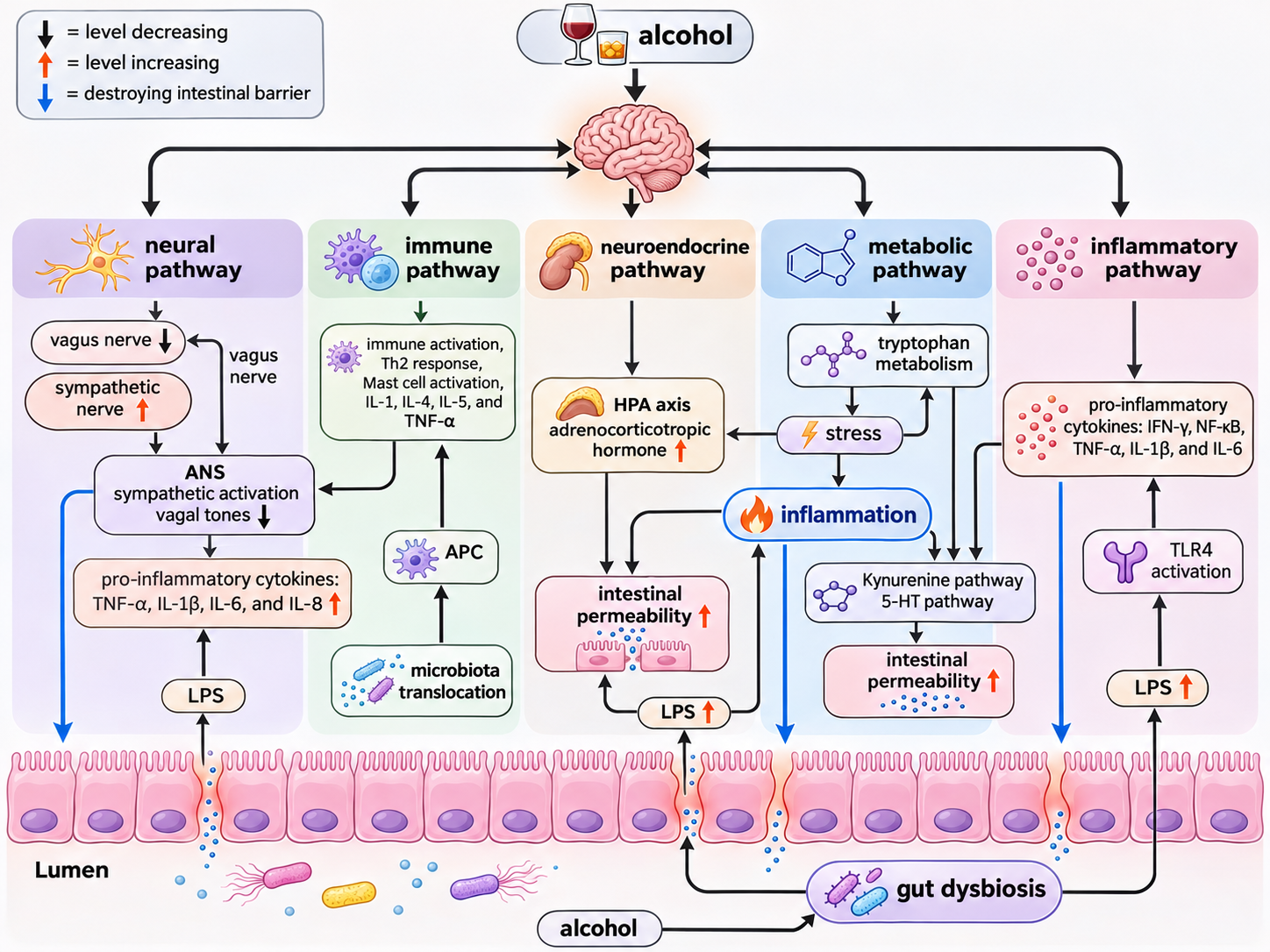
Possible mechanisms of alcohol effects function on the gut-brain axis. Alcohol can cause gut dysbiosis and affect brain function through the neural, immune, neuroendocrine, metabolic, and inflammatory pathways. Neural pathway: Alcohol leads to gut dysbiosis and increased lipopolysaccharides (LPS), which leads to increased release of proinflammatory cytokines [Tumor necrosis factor (TNF)-α, interleukin (IL)-1β, IL-6, and IL-8] and activation of the vagus nerve affecting the brain. The brain affects the gut by inhibiting the vagus nerve and exciting sympathetic nerves. Immune pathway: Alcohol promotes microbiota translocation, which leads to antigen-presenting cells activating the Th2 response and mast cells, releasing proinflammatory cytokines (IL-1, IL-4, IL-5, and TNF-α). The brain can affect the gut by activating the sympathetic nervous system and decreasing vagal tone, which can cause immune activation. Neuroendocrine pathway: LPS causes inflammation and activates the hypothalamic-pituitary-adrenal axis (HPA) axis to affect the brain. The brain can affect the gut by affecting the HPA axis to release adrenocorticotropic hormones, resulting in increased intestinal permeability. Metabolic pathway: Alcohol interferes with tryptophan metabolism by causing inflammation and affects the kynurenine and 5-HT pathways, which affect brain function. In addition, the reduction of short-chain fatty acids (SCFAs) can affect the brain and gut in both directions. Inflammatory pathways: Alcohol directly affects the brain and gut in both directions by mediating LPS-induced inflammation and releasing inflammatory factors [interferon (IFN)-γ, nuclear factor (NF)-κB, TNF-α, IL-1β, and IL-6]. ANS, autonomic nervous system; APC, antigen-presenting cell; HPA, hypothalamic-pituitary-adrenal axis; IFN-γ, interferon-γ; LPS, lipopolysaccharides; SCFAs, short-chain fatty acids; TLR4, toll-like receptor 4; TNF-α, tumor necrosis factor-α. 2
The gut-brain-liver axis and neuroinflammation
The consequences of alcohol-associated gut dysfunction extend beyond the gastrointestinal tract through bidirectional communication between the gut, brain, and liver. Microbial products and metabolites may affect host physiology through neural, immune, neuroendocrine, metabolic, and inflammatory mechanisms.
The vagus nerve carries signals between the gut and brain, while the hypothalamic-pituitary-adrenal axis coordinates stress responses. Inflammatory agents such as interleukin-1β and tumor necrosis factor-α have systemic and neurological effects.2,3,5
Increased gut permeability has been associated with greater severity of anxiety, depression, and alcohol craving in some patients, while systemic inflammation may impact brain mechanisms involved in craving and withdrawal. Microbial metabolites, such as SCFAs, bile acids, and tryptophan-derived metabolites, may also interfere with neuronal and immune pathways; however, these associations do not establish that gut permeability causes psychiatric symptoms or relapse.2,3,5
The gut-microbiome-liver-brain axis provides a model for understanding the multisystem effects of chronic alcohol exposure. In advanced liver disease, ammonia accumulation can contribute to hepatic encephalopathy, a disturbance of brain function. Circulating endotoxins and inflammatory mediators may also contribute to neurological injury. Stress may further interact with these pathways, worsening physiological and neurobehavioral disturbances.5
Microbiome dynamics and resilience in early abstinence
Alcohol-associated microbial alterations can change during abstinence. A small longitudinal study following 22 newly abstinent patients for up to four weeks found that the magnitude of microbiome change differed significantly between drinking groups from day one to day five and from day one to week three. The very-heavy-drinking group demonstrated greater changes from baseline than the less-heavy-drinking group.3
These findings suggest potential microbial resilience, or a capacity to recover after disruption. Nevertheless, microbiome restructuring should not automatically be interpreted as complete restoration of a healthy microbial community. Furthermore, the composition and functional consequences of these changes can vary between individuals and may be influenced by drinking intensity, diet, host characteristics, and other factors.3
Changes in microbial composition also need to be distinguished from recovery of microbial metabolism. Available evidence does not establish that butyrate consistently returns to normal within the first one to three weeks of abstinence. Whether abstinence restores SCFA production requires further investigation; stool measurements also reflect absorption and microbial use, rather than production alone.2,6
 Image Credit: Julien Tromeur / Shutterstock.com
Nutritional and microbiota-targeted interventions
Nutritional rehabilitation addresses malnutrition during AUD treatment, while dietary management addresses insufficient energy and protein intake, while identifying and correcting clinically important micronutrient deficiencies. Assessment should include dietary intake, muscle function, and relevant laboratory findings, as body weight alone can miss nutritional impairment.1,6 Thiamine deficiency deserves particular attention because it can cause Wernicke-Korsakoff syndrome; therefore, replacement and correction of electrolyte deficiencies require clinical assessment.1
Microbiota-targeted interventions aim to modify microbial composition, metabolism, barrier function, and inflammation. Probiotics, prebiotics, dietary interventions, and fecal microbiota transplantation (FMT) are emerging therapeutic strategies for AUD-associated gut dysbiosis. Prebiotics are substrates selectively used by host microorganisms to confer health benefits, while probiotics are microorganisms that confer health benefits when administered in adequate amounts.4
Dietary fiber supplies substrates for microbial fermentation, though available evidence does not define a fiber regimen that restores gut function in AUD. Furthermore, most probiotic evidence comes from animal studies or patients with alcohol-associated liver disease, limiting its application to the wider AUD population.1,2,4
FMT, which involves transferring donor-derived intestinal microorganisms, and other microbiome-based interventions for AUD remain investigational. Additional research is needed to determine their optimal patient selection, safety, durability, and clinical efficacy. Small FMT trials in patients with AUD and cirrhosis cannot establish benefits for all people recovering from alcohol dependence.
Nutritional status interacts with appetite- and reward-regulating hormones, including ghrelin and glucagon-like peptide-1 (GLP-1). Ghrelin stimulates appetite and can increase alcohol craving or consumption, while GLP-1 receptor stimulation has reduced alcohol intake in animal studies and selected human populations. These findings connect metabolic regulation with reward signaling; however, they do not establish that dietary changes reproduce drug effects or that these treatments benefit all patients with AUD.1
Conclusions
AUD can disrupt nutritional status, gut microbial composition, intestinal barrier integrity, and gut-brain-liver communication, creating interconnected metabolic and inflammatory disturbances. Nutritional rehabilitation, including adequate energy and protein intake, in addition to correction of clinically relevant nutrient deficiencies, should complement alcohol cessation.
Early microbial changes during abstinence do not fully restore intestinal or metabolic function. Larger controlled studies should establish which interventions improve clinical outcomes, their safety, and whether benefits persist.1,3,4,5
References
- White, B., & Sirohi, S. (2024). A complex interplay between nutrition and alcohol use disorder: Implications for breaking the vicious cycle. Current Pharmaceutical Design. 30(23); 1822-1837. DOI: 10.2174/0113816128292367240510111746. https://www.eurekaselect.com/article/140548
- Chen, G., Shi, F., Yin, W., et al. (2022). Gut microbiota dysbiosis: The potential mechanisms by which alcohol disrupts gut and brain functions. Frontiers in Microbiology 13. DOI: 10.3389/fmicb.2022.916765. https://www.frontiersin.org/journals/microbiology/articles/10.3389/fmicb.2022.916765/full
- Ames, N. J., Barb, J. J., Schuebel, K., et al. (2020). Longitudinal gut microbiome changes in alcohol use disorder are influenced by abstinence and drinking quantity. Gut Microbes 11(6); 1608-1631. DOI: 10.1080/19490976.2020.1758010. https://www.tandfonline.com/doi/full/10.1080/19490976.2020.1758010#d1e601
- Koutromanos, I., Legaki, E., Gazouli, M., et al. (2024). Gut microbiome in alcohol use disorder: Implications for health outcomes and therapeutic strategies - A literature review. World Journal of Methodology. 14(1). DOI: 10.5662/wjm.v14.i1.88519. http://wjgnet.com/2222-0682/full/v14/i1/88519.htm
- Merlo Pich, E., Tarnanas, I., Brigidi, P., & Collo, G. (2025). Gut microbiome-liver-brain axis in alcohol use disorder. The role of gut dysbiosis and stress in alcohol-related cognitive impairment progression: Possible therapeutic approaches. Neurobiology of Stress. 35. DOI: 10.1016/j.ynstr.2025.100713. https://www.sciencedirect.com/science/article/pii/S2352289525000074?via%3Dihub
- Bjørkhaug, S. T., Aanes, H., Neupane, S. P., et al (2019). Characterization of gut microbiota composition and functions in patients with chronic alcohol overconsumption. Gut Microbes. 10(6). 663–675. DOI: 10.1080/19490976.2019.1580097. https://www.tandfonline.com/doi/full/10.1080/19490976.2019.1580097
Further Reading
Last Updated: Nov 24, 2026