This article and associated images are based on a poster originally authored by Alison Porter, Kirsten Deytrikh, Brian McFerran, and Stuart McElroy and presented at ELRIG Drug Discovery 2026 in affiliation with BioAscent Discovery Ltd.
This poster is being hosted on this website in its raw form, without modifications. It has not undergone peer review but has been reviewed to meet AZoNetwork's editorial quality standards. The information contained is for informational purposes only and should not be considered validated by independent peer assessment.

Introduction
- During GPCR agonist discovery, receptor desensitization can significantly affect a compound’s efficacy, particularly following repeated dosing.
- Understanding how agonists influence receptor signaling and desensitization is therefore critical when selecting and optimizing candidate molecules.
- An attractive drug candidate is one that produces a strong initial response, maintains efficacy after repeated dosing, causes limited receptor downregulation, and does not induce rapid tolerance.
- HT-29 cells endogenously expressing constitutively active GPR35b were used to establish whether real-time cellular impedance could be used to characterize receptor desensitization in this reported physiologically relevant endogenous model system.1, 2, 3
Specifically, the study aimed to:
- Determine whether agonist pre-exposure induces GPR35b desensitization.
- Investigate the role of GRK5/6-mediated receptor phosphorylation.
- Understand the contribution of β-arrestin-2 to receptor regulation.
- Confirm the downstream signaling pathways responsible for impedance responses
Method
Cells were plated in 96-well E-plates for 18–22 hours, and impedance responses were monitored on the Agilent RTCA xCELLigence reader following application of GPR35 agonist lodoxamide
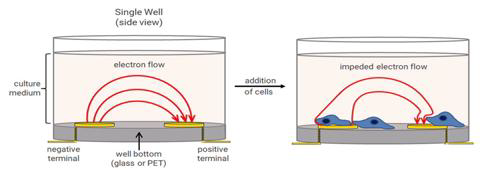
Figure 1. Principle of the cellular impedance xCELLigence assay. Image Credit: Adapted from Agilent, www.agilent.com/en/technology/cellular-impedance
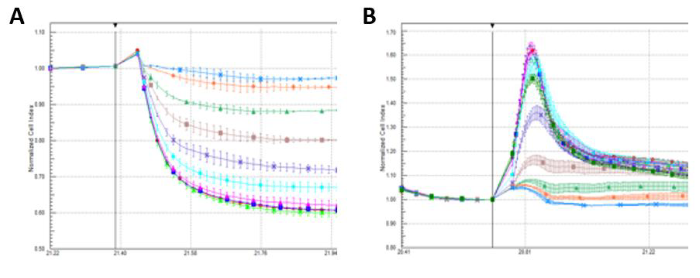
Figure 2. Impedance responses. Agonists can cause cells to retract, giving a negative impedance response (A), or to spread out, giving a positive impedance response (B). Image Credit: Image courtesy of Alison Porter et al., in partnership with ELRIG (UK) Ltd.
Agonist induces desensitization
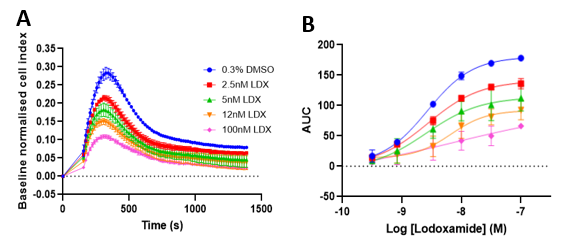
|
AUC |
| Pre-treatment |
pEC50 |
Emax |
| 0.3% DMSO |
8.57 |
181 |
| 2.5 nM LDX |
8.57 |
141 |
| 5 nM LDX |
8.63 |
114 |
| 12 nM LDX |
8.25 |
92 |
| 100 nM LDX |
8.15 |
98 |
Figure 3. Cellular impedance in HT-29 cells from a CRC to GPR35 agonist lodoxamide after 20 minutes of pretreatment with different lodoxamide concentrations and 0.3% DMSO wash-out for 30 minutes: A) baseline normalized impedance traces for 100 nM lodoxamide for each pre-condition concentration. B) area under the curve values versus lodoxamide concentrations for each condition. A four-parameter non-linear regression curve fit with variable slope was applied where pEC50 and Emax values are reported in the table. Image Credit: Image courtesy of Alison Porter et al., in partnership with ELRIG (UK) Ltd.
Grk5/6 regulates GPR35 desensitization
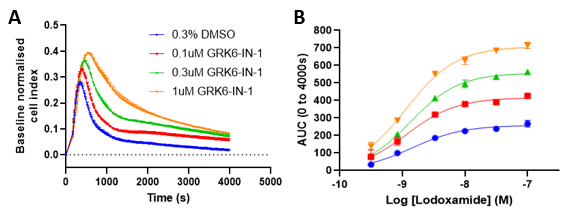
|
AUC |
| Pre-treatment |
pEC50 |
Emax |
| 0.3% DMSO |
8.85 |
259 |
| 0.1 µM GRK6-IN-1 |
8.93 |
416 |
| 0.3 µM GRK6-IN-1 |
8.87 |
558 |
| 1 uM GRK6-IN-1 |
8.94 |
708 |
Figure 4. Cellular impedance in HT-29 cells from a CRC to GPR35 agonist lodoxamide after 30 minutes of pre-treatment with different GRK6-IN-1 (GRK5/6 inhibitor) concentrations: A) baseline normalized impedance traces for 100 nM lodoxamide after each treatment, B) area under the curve values for ~60 minutes, all versus lodoxamide concentrations. The pEC50 and Emax are reported in the table. Image Credit: Image courtesy of Alison Porter et al., in partnership with ELRIG (UK) Ltd.
GRK 5/6 inhibition reduces desensitization
|
Treatment Steps |
| Condition |
1 |
2 |
3 (wash out) |
4 |
| 0.3% DMSO |
DMSO |
DMSO |
DMSO |
CRC LDX |
| GRK6-IN-1 |
DMSO |
DMSO |
GRK6-IN-1 |
CRC LDX |
| EC 80 LDX |
DMSO |
EC80 |
DMSO |
CRC LDX |
| GRK6-IN-1-EC80 |
GRK6-IN-1 |
EC80 |
DMSO |
CRC LDX |
| GRK6-IN-1-EC 80-GRK6-IN-1 |
GRK6-IN-1 |
EC80 |
GRK6-IN-1 |
CRC LDX |
| Pre-treatments |
Emax |
pEC50 |
| 0.3% DMSO |
365 |
8.63 |
| 0.5 μM GRK6-IN-1 |
1085 |
8.56 |
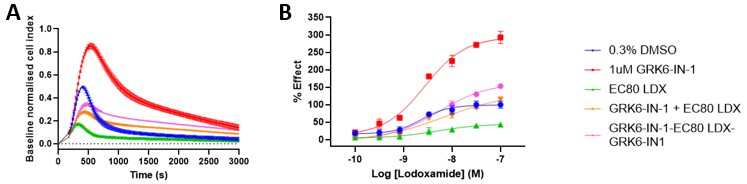
| EC80 LDX |
164 |
8.31 |
| GRK6-IN-1 + EC80 LDX |
475 |
8.26 |
| GRK6-IN-1-EC80-GRK6-IN-1 |
599 |
8.28 |
Figure 5. Cellular impedance in HT-29 cells from a CRC to GPR35 agonist lodoxamide after the pre-treatments (30 minutes for GRK6-IN-1 and 20 minutes for EC80 lodoxamide) detailed in Table 1, with wash-out for 30 minutes: A) baseline normalized impedance traces for 100 nM lodoxamide for each pre-condition, B) area under the curve values versus lodoxamide concentrations tested for each condition. The Emax and pEC50 values are shown in Table 2. Image Credit: Image courtesy of Alison Porter et al., in partnership with ELRIG (UK) Ltd.
Beta-arrestin-2 acts as a regulatory protein
|
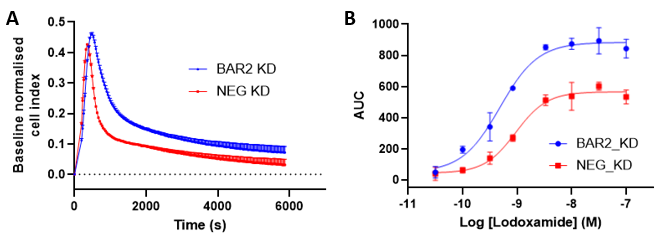
BAR2 LDX |
NEG LDX |
| pEC50 |
9.32 |
9.03 |
| Emax |
884 |
567 |
Figure 6. Cellular impedance in HT-29 cells from a CRC to GPR35 agonist lodoxamide 48 hours after transfection with siRNA for beta-arrestin-2 versus a negative scrambled siRNA: A) baseline normalized impedance traces for 100 nM lodoxamide for each siRNA transfection, B) area under the curve values versus lodoxamide concentrations for each condition plotted. The pEC50 and Emax values are reported in the table. In addition, qPCR confirmed a 56% knockdown of beta-arrestin-2 (data not shown). Image Credit: Image courtesy of Alison Porter et al., in partnership with ELRIG (UK) Ltd.
Confirmation of G12/13 -ROCK signaling
|
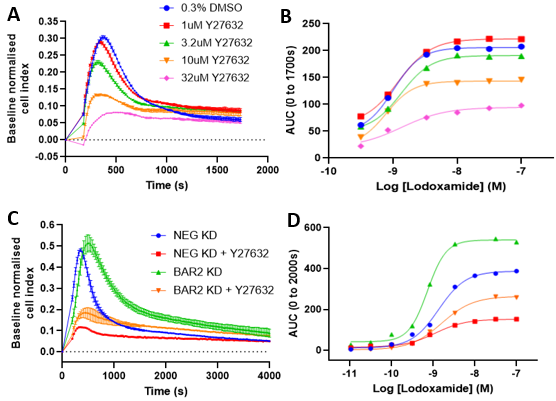
AUC (0 to 1700s) |
| Pre-treatment |
pEC50 |
Emax |
| 0.3% DMSO |
9.00 |
206 |
| 1 uM Y27632 |
8.92 |
222 |
| 3.2 uM Y27632 |
8.88 |
191 |
| 10 uM Y27632 |
9.11 |
143 |
| 32 uM Y27632 |
8.87 |
95 |
|
AUC (0 to 2000s) |
| Pre-treatment |
pEC50 |
Emax |
| NEG KD + DMSO |
8.87 |
388 |
| NEG KD + Y27632 |
8.96 |
153 |
| BAR2 KD + DMSO |
9.14 |
540 |
| BAR2 KD + Y27632 |
8.79 |
265 |
Figure 7. Cellular impedance in HT-29 cells from a CRC to GPR35b agonist lodoxamide after 30 minutes pre-treatment with different Y27632 concentrations: A) baseline normalized impedance traces for 100 nM lodoxamide after each treatment. B) area under the curve values for ~30 minutes versus lodoxamide concentration. The pEC50 and Emax are reported in Table 1. For graphs C and D, the experiment was performed 48 hours after transfection with siRNA targeting beta-arrestin-2 or a scrambled negative control.
C) baseline normalized impedance traces for 31.6 nM lodoxamide for each siRNA transfection and treatment, D) area under the curve values versus lodoxamide concentrations for each condition. The pEC50 and Emax values are reported in Table 2. Image Credit: Image courtesy of Alison Porter et al., in partnership with ELRIG (UK) Ltd.
Conclusions
Using the xCELLigence platform, researchers have characterized agonist-induced GPR35b desensitization, identified key regulatory roles for GRK5/6 and β-arrestin-2, and confirmed the dominant contribution of G12/13-ROCK signaling in HT-29 cells. The kinetic nature of the assay has enabled detection of subtle changes in signaling dynamics that may be missed with conventional endpoint approaches.
For drug discovery programs targeting GPCRs, these findings highlight the importance of assessing receptor desensitization alongside initial efficacy measurements. By incorporating physiologically relevant cellular models and real-time functional assays, the researchers have gained a more complete understanding of target biology, allowing BioAscent Discovery's clients to make better-informed decisions when selecting agonist candidates for progression.
References and further reading
- MacKenzie, A.E., et al. (2011) GPR35 as a novel therapeutic target, Frontiers in Endocrinology, 2, 68. DOI:10.3389/fendo.2011.00068. https://www.frontiersin.org/journals/endocrinology/articles/10.3389/fendo.2011.00068/full.
- Quon, T., et al. (2025) Biased constitutive signaling of the G protein-coupled receptor GPR35 suppresses gut barrier permeability, Journal of Biological Chemistry, 301(1), 108035. DOI:10.1016/j.jbc.2024.108035. https://www.jbc.org/article/S0021-9258(24)02537-7/fulltext.
- Deng, H., Hu, H., and Fang, Y. (2012) Multiple tyrosine metabolites are GPR35 agonists, Scientific Reports, 2, 373. DOI:10.1038/srep00373. https://www.nature.com/articles/srep00373.
About BioAscent Discovery
Founded in 2013, BioAscent is a leading provider of integrated drug discovery services based at the former Organon / MSD R&D site in Newhouse, Scotland, UK. Our drug discovery services include de novo assay development, target analysis and bespoke screening strategies, compound screening (including HTS), medicinal and synthetic chemistry, computational chemistry and compound management, all with access to in-house diversity and fragment libraries.
About ELRIG (UK) Ltd.
The European Laboratory Research & Innovation Group (ELRIG) is a leading European not-for-profit organization that exists to provide outstanding scientific content to the life science community. The foundation of the organization is based on the use and application of automation, robotics and instrumentation in life science laboratories, but over time, we have evolved to respond to the needs of biopharma by developing scientific programmes that focus on cutting-edge research areas that have the potential to revolutionize drug discovery.
Comprised of a global community of over 12,000 life science professionals, participating in our events, whether it be at one of our scientific conferences or one of our networking meetings, will enable any of our community to exchange information, within disciplines and across academic and biopharmaceutical organizations, on an open access basis, as all our events are free-of-charge to attend!
Our values
Our values are to always ensure the highest quality of content and that content will be made readily accessible to all, and that we will always be an inclusive organization, serving a diverse scientific network. In addition, ELRIG will always be a volunteer led organization, run by and for the life sciences community, on a not-for-profit basis.
Our purpose
ELRIG is a company whose purpose is to bring the life science and drug discovery communities together to learn, share, connect, innovate and collaborate, on an open access basis. We achieve this through the provision of world class conferences, networking events, webinars and digital content.
Sponsored Content Policy: News-Medical.net publishes articles and related content that may be derived from sources where we have existing commercial relationships, provided such content adds value to the core editorial ethos of News-Medical.net, which is to educate and inform site visitors interested in medical research, science, medical devices and treatments.
Last Updated: Nov 3, 2026