From SelvitaReviewed by Olivia Frost
This article and associated images are based on a poster originally authored by Price, S., Ignatyev, A., Markiewicz, M., Wolnik, J., Nosek-Ciesielczyk, K., Leśniak, K., Chorobik, P., and Olszewski, M.B. and presented at ELRIG Drug Discovery 2026 in affiliation with Selvita.
This poster is being hosted on this website in its raw form, without modifications. It has not undergone peer review but has been reviewed to meet AZoNetwork's editorial quality standards. The information contained is for informational purposes only and should not be considered validated by independent peer assessment.

Induced-proximity therapeutics, comprising PROTACs, molecular glues, RIPTACs and other heterobifunctional modalities, act through controlled assembly of multiprotein complexes. Their development requires understanding of protein–protein interactions, ternary complex formation, cooperativity, intracellular engagement and functional degradation, yet no single assay characterizes all of these stages.
In light of this, researchers have developed an integrated platform of cell-free and cellular assays that views each molecule from several angles, highlighting SPR-based cooperativity analysis and live-cell NanoBiT proximity assays.
One platform, six questions: A multi-angle view of induced proximity
Pillar 1
Each question is answered by at least one orthogonal readout; decisions rest on convergent evidence, not on a single assay
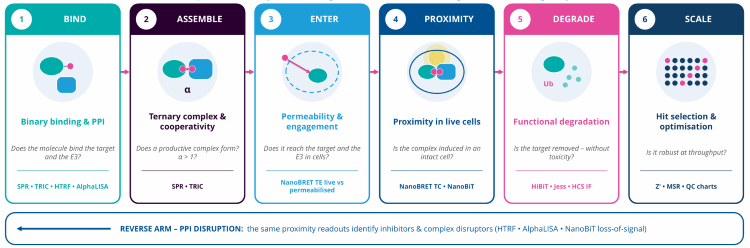
Image Credit: Image courtesy of Price, S. et al., in partnership with ELRIG (UK) Ltd.
Cell-free PPI and binary binding
SPR, TRIC, HTRF and AlphaLISA quantify binary binding and protein–protein interactions in label-free, immobilization-free, or homogeneous formats.
(2A) HTRF (TR-FRET): Reference inhibitors disrupt the PPI concentration-dependently; potency tracked by moving MSR.
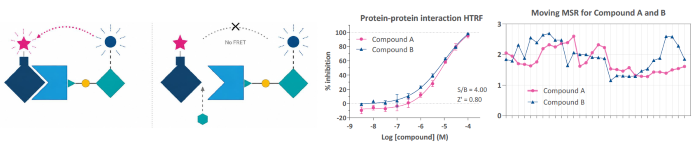
Image Credit: Image courtesy of Price, S. et al., in partnership with ELRIG (UK) Ltd.
(2B) TRIC: Affinity in solution without immobilization –Etanercept–TNFα, Kd = 27.3 ±3.5 nM (n = 2)
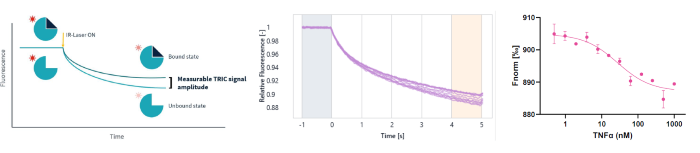
Image Credit: Image courtesy of Price, S. et al., in partnership with ELRIG (UK) Ltd.
SPR cooperativity & ternary complexes
Pillar 2
(3A) Format matters. Binary and ternary binding of VHL-based PROTACs by SPR (POI or VHL immobilized) and TRIC (solution). Ternary affinity was weaker than binary on the SPR surface but ~20-fold stronger in solution –surface steric constraints are a plausible explanation. KD (µM) TRIC SPR (VBC on chip) SPR (POI on chip) Binary 1.10 0.03 0.06 Ternary 0.05 0.20 0.19
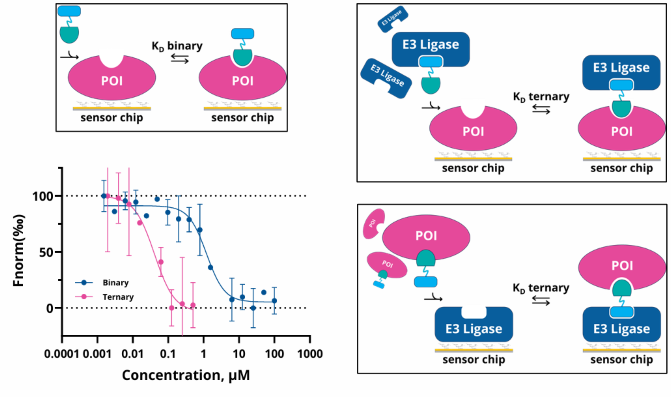
Image Credit: Image courtesy of Price, S. et al., in partnership with ELRIG (UK) Ltd.
Source: Selvita
| KD (μM) |
TRIC |
SPR (VBC on chip) |
SPR (POI on chip) |
| Binary |
1.10 |
0.03 |
0.06 |
| Ternary |
0.05 |
0.20 |
0.19 |
(3B) Cooperativity by SPR. α = KD(binary)/KD(ternary). Pre-forming the PROTAC–CRBN complex increased POI affinity for PROTAC 1 (164 → 23 nM; α = 7.1) and decreased it for PROTAC 2 (35 → 115 nM; α = 0.3), thereby separating complex-stabilizing from destabilizing degraders.
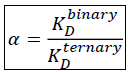
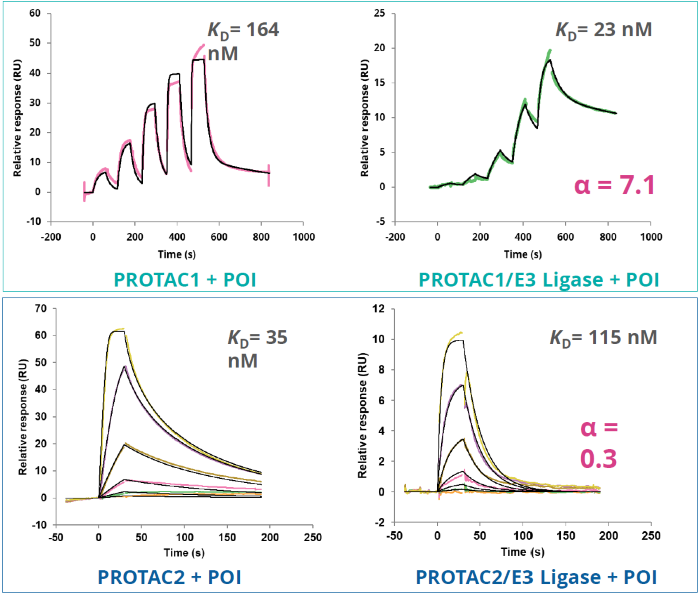
Image Credit: Image courtesy of Price, S. et al., in partnership with ELRIG (UK) Ltd.
NanoBiT: induced proximity in live cells: One readout, both directions
Pillar 3
(4A) Molecular glues (gain of signal). CRBN-LgBiTand GSPT1-SmBiT complement only when a glue recruits GSPT1 to CRBN. In a 384-well live-cell format (one-hour compound), eragidomide, CC-885, and SJ6986 gave S/B 12.6–13.6, Z′ 0.72–0.82 and EC50 of 6.7, 11.7 and 23.4 nM.
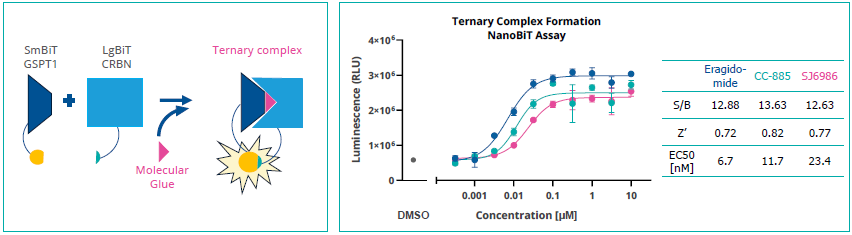
Image Credit: Image courtesy of Price, S. et al., in partnership with ELRIG (UK) Ltd.
(4B) Complex disruptors (loss of signal). An LgBiT/SmBiT pair reports a constitutive PPI; disruptors reduce luminescence concentration-dependently, and a fused LgBiT-linker-SmBiT control excludes luciferase inhibition. Z′ = 0.87; S/B = 26.1.
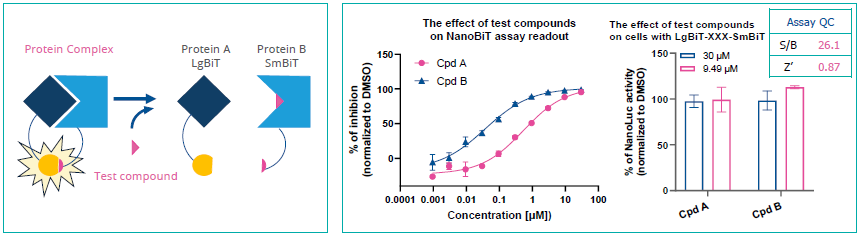
Image Credit: Image courtesy of Price, S. et al., in partnership with ELRIG (UK) Ltd.
Cellular engagement and functional degradation
(5A) NanoBRET. Target and E3 ligase engagement in live vs permeabilized cells gives relative binding affinity (RBA) and the availability index (AI), flagging potent but impermeable PROTACs.


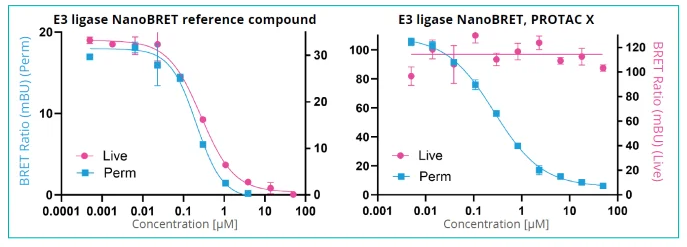
Image Credit: Image courtesy of Price, S. et al., in partnership with ELRIG (UK) Ltd.
(5B) HiBiT. Degradation assays (endpoint and kinetic formats); multiplexing with viability separates genuine degradation from target loss caused by cytotoxicity.
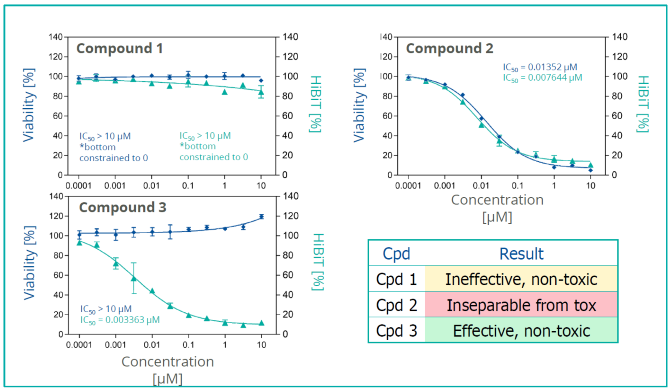
Image Credit: Image courtesy of Price, S. et al., in partnership with ELRIG (UK) Ltd.
(5C) Capillary Western and HCS. Jess and high-content immunofluorescence screening with run-by-run QC (HCS plate Z′ 0.91–0.96) support hit selection.
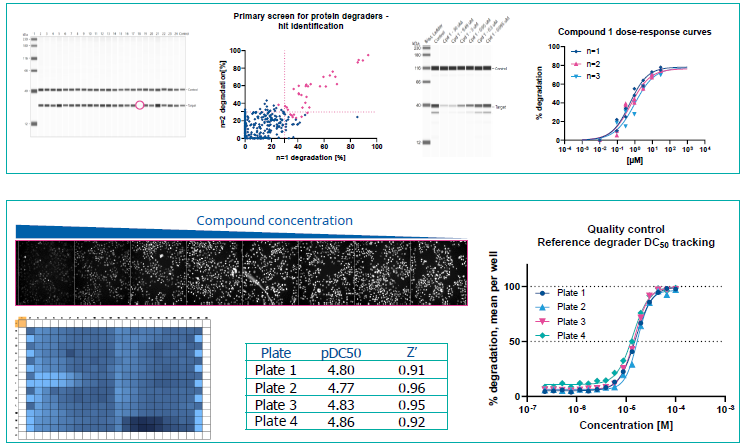
Image Credit: Image courtesy of Price, S. et al., in partnership with ELRIG (UK) Ltd.
Applications
One platform, any proximity modality
- PROTACs and degraders: from cooperativity to degradation
- Molecular glues: live-cell recruitment with toxicity triage
- RIPTACs and other chimeras: same binary → ternary → cell logic
- PPI inhibitors and disruptors: loss-of-signal readouts
- Biologics and peptides: label-free and in-solution affinity
Conclusions
- No single assay tells the whole story: cell-free and cellular readouts together follow each molecule from binding to degradation.
- Cooperativity matters: SPR α separates complex-stabilizing (α = 7.1) from destabilizing (α = 0.3) degraders.
- Proximity in both directions: NanoBiT quantifies glue recruitment and PPI disruption in live cells.
- Flag problems early: NanoBRET availability and viability multiplexing flags impermeable or cytotoxic compounds.
About Selvita
Selvita is a leading European CRO supporting pharma and biotech companies with flexible, science-driven R&D services. We offer integrated or standalone solutions in drug discovery, preclinical studies, and GMP/GLP-compliant analytical development. With strong expertise across early to late development stages, we help accelerate new therapies by delivering high-quality data that enables smart decisions and faster time to market.
About ELRIG (UK) Ltd.
The European Laboratory Research & Innovation Group (ELRIG) is a leading European not-for-profit organization that exists to provide outstanding scientific content to the life science community. The foundation of the organization is based on the use and application of automation, robotics and instrumentation in life science laboratories, but over time, we have evolved to respond to the needs of biopharma by developing scientific programmes that focus on cutting-edge research areas that have the potential to revolutionize drug discovery.
Comprised of a global community of over 12,000 life science professionals, participating in our events, whether it be at one of our scientific conferences or one of our networking meetings, will enable any of our community to exchange information, within disciplines and across academic and biopharmaceutical organizations, on an open access basis, as all our events are free-of-charge to attend!
Our values
Our values are to always ensure the highest quality of content and that content will be made readily accessible to all, and that we will always be an inclusive organization, serving a diverse scientific network. In addition, ELRIG will always be a volunteer led organization, run by and for the life sciences community, on a not-for-profit basis.
Our purpose
ELRIG is a company whose purpose is to bring the life science and drug discovery communities together to learn, share, connect, innovate and collaborate, on an open access basis. We achieve this through the provision of world class conferences, networking events, webinars and digital content.
Sponsored Content Policy: News-Medical.net publishes articles and related content that may be derived from sources where we have existing commercial relationships, provided such content adds value to the core editorial ethos of News-Medical.net, which is to educate and inform site visitors interested in medical research, science, medical devices and treatments.
Last Updated: Nov 3, 2026