This article and associated images are based on a poster originally authored by Daniel Lin-Arlow, Kennet Mattsson, Jaclyn Mabry, and David Marshall and presented at ELRIG Drug Discovery 2026 in affiliation with Ansa Biotechnologies and Axio BioPharma.
This poster is being hosted on this website in its raw form, without modifications. It has not undergone peer review but has been reviewed to meet AZoNetwork's editorial quality standards. The information contained is for informational purposes only and should not be considered validated by independent peer assessment.

Next generation DNA synthesis from Ansa Biotechnologies
Reliable DNA regardless of length and complexity
Ansa Biotechnologies creates high-quality custom DNA constructs using enzymatic synthesis, enabling scientists to work with sequences previously deemed too large or complex. In an in silico study (Figure 1), randomly sampled intervals of the human genome were selected, ranging in size from 500 bp to 5000 bp.
For one vendor (Vendor X), the percentage of sequences classified as “standard” dropped from 85% to 20% as the construct size increased. Ansa’s classification consistently remained “standard”. Regardless of construct size, over 97% of all submitted sequences to Ansa were classified as “standard”.
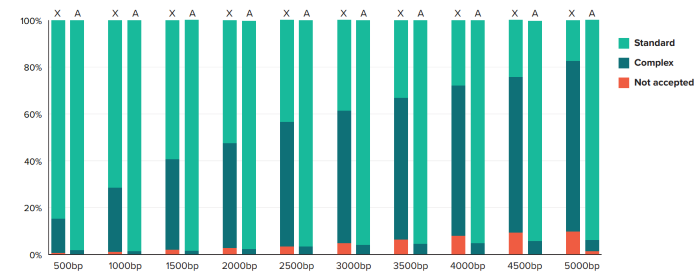
Figure 1. In silico comparison of randomly sampled sequences from the human genome classified by complexity by construct size. Image Credit: Image courtesy of Daniel Lin-Arlow et al., in partnership with ELRIG (UK) Ltd.
Significantly faster delivery
Long turnaround times from legacy DNA vendors are a major bottleneck for scientists working in the drug discovery pipeline. Ansa’s next-generation synthesis facilitates reliably rapid delivery (Figure 2).
In a case study evaluating an order composed of 24 constructs ranging from 1.1–3.6 kb, in which nine of the sequences contained complex elements (high/low GC, repeats, and hairpin structures), Ansa delivered 100% of the order weeks before the next-fastest provider.
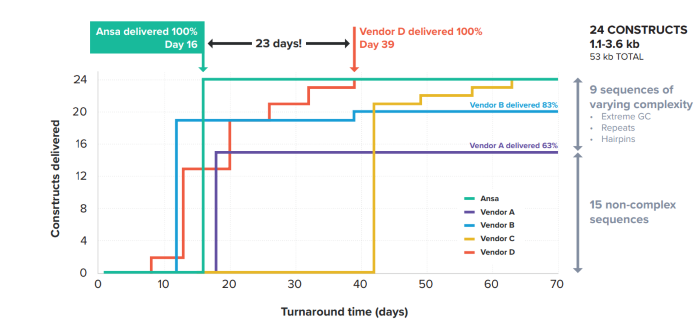
Figure 2. Ansa delivered a complex 24-construct order 23 days ahead of the fastest competitor. Image Credit: Image courtesy of Daniel Lin-Arlow et al., in partnership with ELRIG (UK) Ltd.
Codon optimization for expression, not ease of synthesis
Sequence-agnostic synthesis preserves optimal codon choice
When considering downstream gene expression, the best codon selection is not necessarily the easiest DNA sequence to build via traditional chemical synthesis. For legacy providers, low complexity may take priority over downstream applications. With Ansa’s sequence-agnostic enzymatic synthesis, compromising downstream optimization is not necessary.
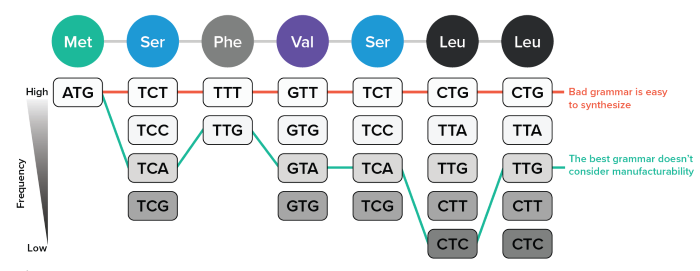
Figure 3. Optimal codon choice can conflict with ease of synthesis. Image Credit: Image courtesy of Daniel Lin-Arlow et al., in partnership with ELRIG (UK) Ltd.
Sequence manufacturability screening
To examine how codon optimization affects DNA synthesis, 21 monoclonal antibody sequences were codon optimized using Trias,1 an open-source large language model trained on the coding sequences of vertebrate genomes. The DNA sequences generated by Trias were screened for manufacturability by Ansa and Vendor X using each company’s standard ordering platform.
Ansa scored all 21 sequences as “standard” complexity, meaning customers could submit them directly for synthesis with high confidence in on-time delivery. By contrast, Vendor X scored 11 sequences as “not manufacturable” due to their complexity and suggested that the user modify them using its own codon optimization algorithm.
Vendor X scored the remaining 10 sequences as “complex,” a classification that can mean additional optimization, extra time, special handling, and higher pricing.
Table 1. Complexity classification for sequences optimized by Trias. Source: Ansa Biotechnologies
| Sequence Classification |
Vendor X |
Ansa |
| Not Manufacturable |
11 |
0 |
| Complex |
10 |
0 |
| Standard |
0 |
21 |
Antibody expression testing in CHO
To compare expression outcomes across different codon optimization tools, Ansa worked with Axio BioPharma to benchmark the antibody sequences codon-optimized by Trias or Vendor X’s program.
Mammalian expression vectors were synthesized by Ansa and provided to Axio BioPharma for testing. Axio used its standard CHO cell expression system to test transient expression of the monoclonal antibodies and measured titers using protein A HPLC.
The results showed that the Trias-generated sequences produced higher antibody titers for 19 of the 21 sequences and improved expression by an average of 1.9-fold.
Figure 4 below shows a representative sample of six sequences that were either codon optimized by Trias (green) or by Vendor X’s tool (red). These results show how Ansa can help customers preserve high-expression designs that might otherwise be constrained by a DNA manufacturability-first optimization.
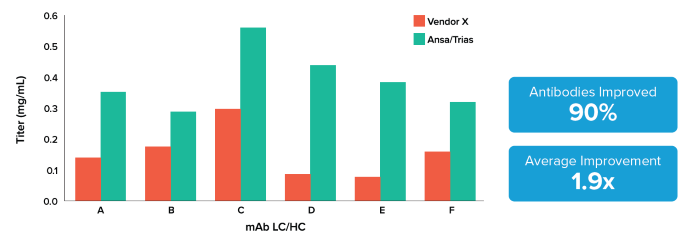
Figure 4. Monoclonal antibody expression in CHO Cells. Image Credit: Image courtesy of Daniel Lin-Arlow et al., in partnership with ELRIG (UK) Ltd.
Key findings
- Complexity is no longer a barrier. Ansa classified over 97% of randomly sampled human genomic sequences (500–5000 bp) as standard, while acceptance by a legacy vendor fell from 85% to 20% as length increased.
- Faster delivery, even for difficult orders. Ansa delivered a 24-construct order containing nine complex sequences in 16 days, 23 days ahead of the next-fastest provider.
- Design for expression, not manufacturability. All 21 Trias-optimized antibody sequences were scored standard by Ansa, while Vendor X rejected 11 and flagged the remaining 10 as complex.
- Better designs yield better titers. Trias-optimized sequences synthesized by Ansa improved transient CHO expression for 19 of 21 antibodies (90%), with an average 1.9-fold increase in titer.
References and further reading
- Faizi, M., Sakharova, H. and Lareau, L.F. (2025) A generative language model decodes contextual constraints on codon choice for mRNA design. Preprint, bioRxiv. Available at: DOI:10.1101/2025.05.13.653614. https://www.biorxiv.org/content/10.1101/2025.05.13.653614v3.
About Ansa Biotechnologies
At Ansa Biotechnologies, we’re developing a way to synthesize DNA that will accelerate innovation in medicine, agriculture, and industrial biotechnology. Our fast, clean, and accurate enzymatic DNA synthesis process can produce gene-length molecules directly, overcoming bottlenecks of traditional DNA synthesis methods. We envision a future where our technology empowers scientists to develop solutions for the world's biggest problems in health and sustainability.
About ELRIG (UK) Ltd.
The European Laboratory Research & Innovation Group (ELRIG) is a leading European not-for-profit organization that exists to provide outstanding scientific content to the life science community. The foundation of the organization is based on the use and application of automation, robotics and instrumentation in life science laboratories, but over time, we have evolved to respond to the needs of biopharma by developing scientific programmes that focus on cutting-edge research areas that have the potential to revolutionize drug discovery.
Comprised of a global community of over 12,000 life science professionals, participating in our events, whether it be at one of our scientific conferences or one of our networking meetings, will enable any of our community to exchange information, within disciplines and across academic and biopharmaceutical organizations, on an open access basis, as all our events are free-of-charge to attend!
Our values
Our values are to always ensure the highest quality of content and that content will be made readily accessible to all, and that we will always be an inclusive organization, serving a diverse scientific network. In addition, ELRIG will always be a volunteer led organization, run by and for the life sciences community, on a not-for-profit basis.
Our purpose
ELRIG is a company whose purpose is to bring the life science and drug discovery communities together to learn, share, connect, innovate and collaborate, on an open access basis. We achieve this through the provision of world class conferences, networking events, webinars and digital content.
Sponsored Content Policy: News-Medical.net publishes articles and related content that may be derived from sources where we have existing commercial relationships, provided such content adds value to the core editorial ethos of News-Medical.net, which is to educate and inform site visitors interested in medical research, science, medical devices and treatments.
Last Updated: Nov 3, 2026