This article and associated images are based on a poster originally authored by C. Salado, R. M. Mella, M. Roura-Ferrer, E. Hernández-Imaz, and P. Villacé and presented at ELRIG Drug Discovery 2026 in affiliation with Innoprot.
This poster is being hosted on this website in its raw form, without modifications. It has not undergone peer review but has been reviewed to meet AZoNetwork's editorial quality standards. The information contained is for informational purposes only and should not be considered validated by independent peer assessment.

Amyotrophic lateral sclerosis (ALS) is a progressive neurodegenerative disease marked by motor neuron loss and toxic protein aggregation. Mutations in the SOD1 gene, especially the A4V variant, produce rapid disease progression and poor outcomes.
Innoprot has developed a live-cell fluorescence assay to visualize and quantify SOD1 A4V aggregation in real time in human cells. This scalable, high-throughput platform enables efficient screening of compounds that prevent pathogenic aggregation and can be adapted to study other ALS-associated mutations.
Materials and methods
Cell Line: HEK293 cells were transfected with SOD1-FP602 wt and mutant cDNAs.
Aggregation assays:
- Aggregation: Cells were treated O/N with ALLN in OptiMEM.
- Protection: On day one, cells were treated overnight with test compounds. On day two, cells were co-incubated overnight with the test compounds and ALLN.
Imaging: Following treatment, culture medium was replaced with PBS, and images were acquired and analyzed using the Thermo Fisher CellInsight™ CX7 system.
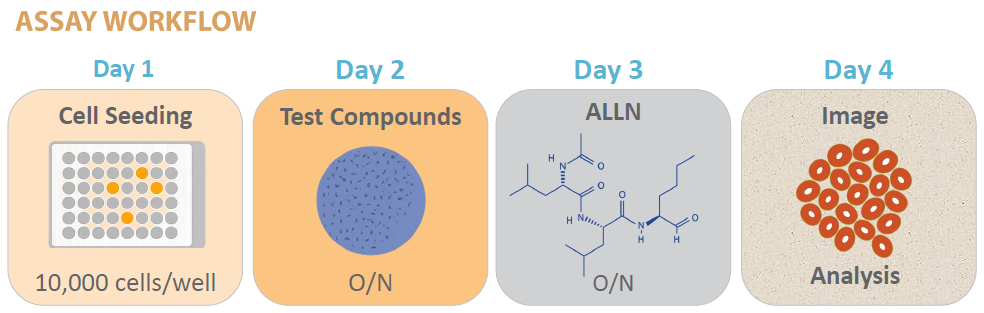
Figure 1. Assay Workflow: Cells were seeded at 10,000 cells per well in 96-well plates (day one). On day two, cells were treated overnight with test compounds in OptiMEM. ALLN was added on day three and incubated overnight. On day four, SOD1 aggregation spots were quantified. Image Credit: Image courtesy of C. Salado et al., in partnership with ELRIG (UK) Ltd.
Results
SOD1-A4V aggregation
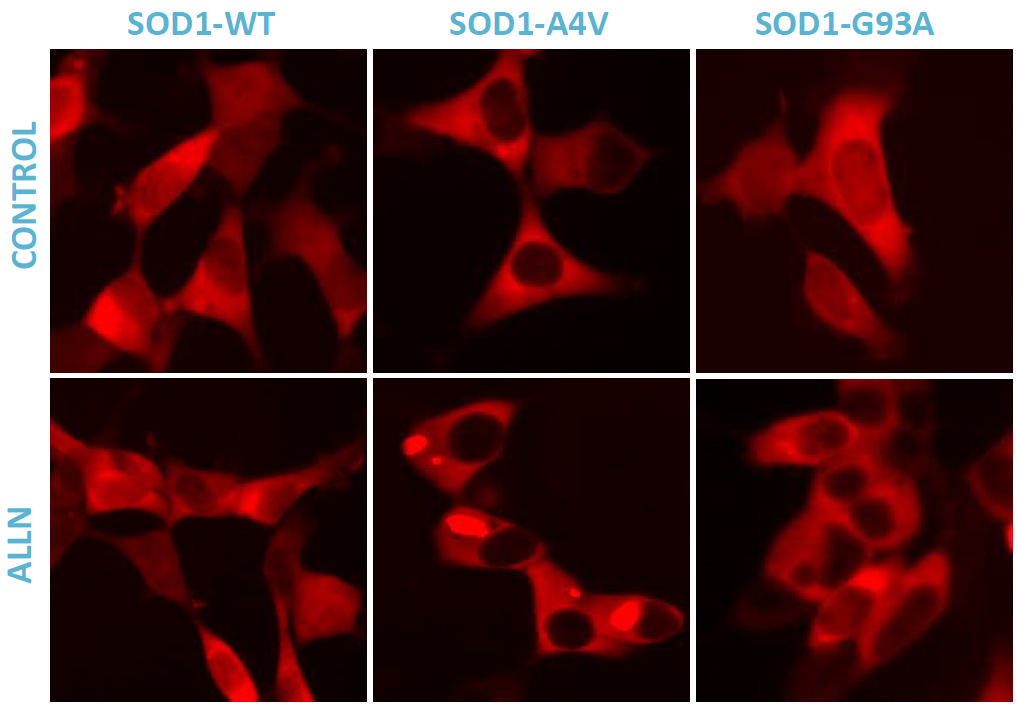
Figure 2. Representative images of SOD1-A4V aggregation. Under control conditions, SOD1- FP602 variants display a diffuse cytosolic distribution (upper panels). Exposure to 10 µM ALLN promotes the formation of prominent fluorescent aggregates specifically in cells expressing the SOD1-A4V mutant (lower panels). Image Credit: Image courtesy of C. Salado et al., in partnership with ELRIG (UK) Ltd.
High-content screening
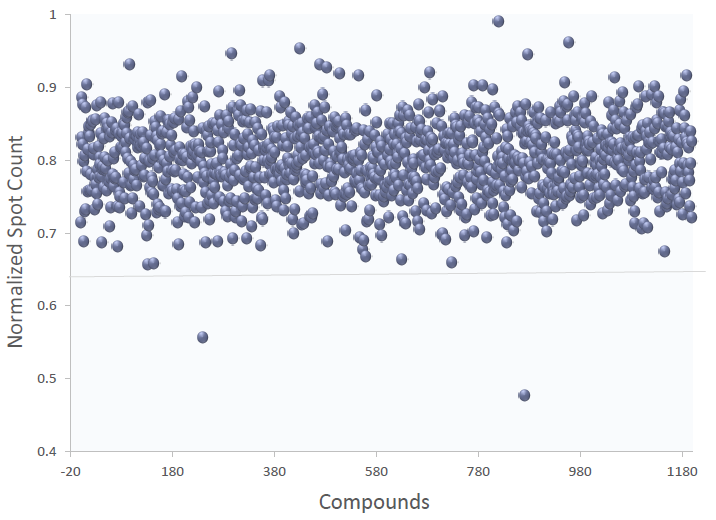
Figure 3. Assay development: A 1200-compound library was screened using SOD1-A4V cells. Compounds were tested at 10 µM. Hits were defined as mean ± 3 SD. Toxic compounds (<85% viability) were excluded. Two hits were identified (Z´ factor = 0.68 ± 0.12). Image Credit: Image courtesy of C. Salado et al., in partnership with ELRIG (UK) Ltd.
SOD1-A4V cellular response to screening hits
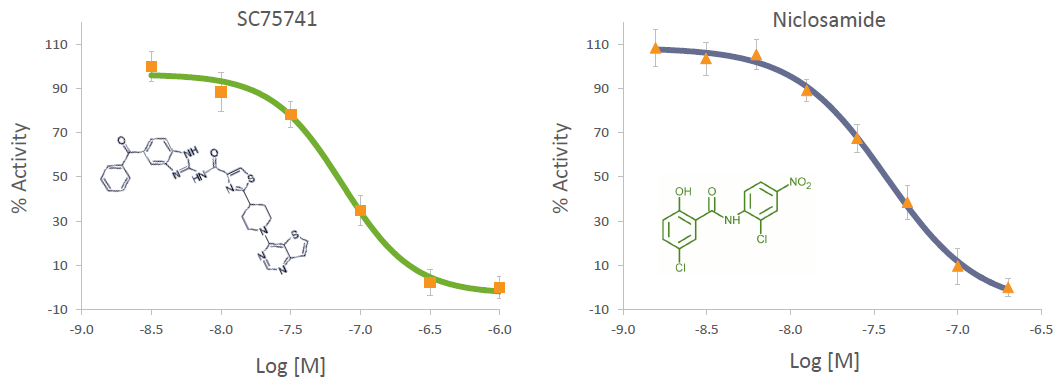
Figure 4. Hits dose-response curves: The curves illustrate the protection rate of SC75741 (right, green) and niclosamide (left, dark blue). The Ec50 of SC75741 was 7.39x10⁻⁸ M and the Ec50 of niclosamide was 3.47x10⁻⁸ M. The Z´ factors were 0.66 and 0.65, respectively. Image Credit: Image courtesy of C. Salado et al., in partnership with ELRIG (UK) Ltd.
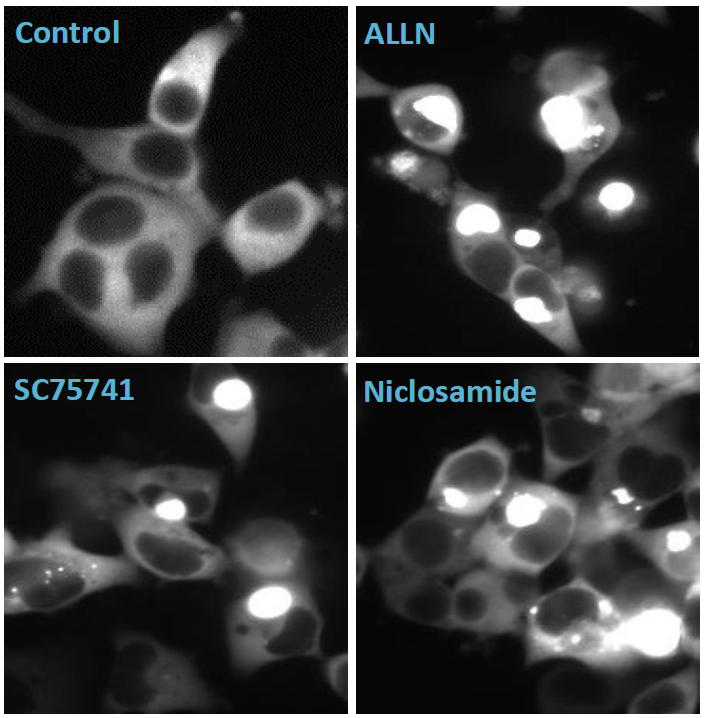
Figure 5. Protective activity of hit compounds in SOD1-A4V cells. Representative images showing SOD1-A4V cells under basal conditions, after ALLN treatment, and following co-treatment with ALLN and either SC75741 or Niclosamide. Image Credit: Image courtesy of C. Salado et al., in partnership with ELRIG (UK) Ltd.
Conclusions
This study established a robust live-cell fluorescence cellular model suitable for high-throughput screening.
The assay effectively tracked aggregate formation and protection, demonstrating its reliability in ALS disease research. Two-hit compounds prevented SOD1-A4V aggregation in a dose-dependent manner, highlighting their therapeutic potential for ALS.
About Innoprot

Innoprot, established in 2007 as a spin-off from the University of the Basque Country, is a leading biotechnology company specializing in the provision of cutting-edge products and technologies for multiplexing cell-based assays in drug discovery and development. Our offerings encompass a diverse range of solutions, including primary cells, immortalized cell lines, and recombinant cell lines.
Distinguished by a proprietary technology for G protein-coupled receptor (GPCR) screening, Innoprot excels in identifying compounds of the utmost efficacy while mitigating undesired side effects. Our commitment to advancing research in the pharmaceutical industry is underscored by our innovative approach to drug discovery.
In addition to our product offerings, Innoprot functions as a Contract Research Organization (C.R.O.), delivering comprehensive screening services with a specialized focus on GPCRs, Fibrosis, and Neurodegenerative diseases such as Alzheimer’s Disease, Parkinson’s Disease, and ALS.
At Innoprot, our dedicated team brings together a wealth of experience in drug discovery technologies and a robust track record as pharmaceutical services providers. We are steadfast in our pursuit of excellence, contributing to the advancement of scientific endeavors in the field.
About ELRIG (UK) Ltd.
The European Laboratory Research & Innovation Group (ELRIG) is a leading European not-for-profit organization that exists to provide outstanding scientific content to the life science community. The foundation of the organization is based on the use and application of automation, robotics and instrumentation in life science laboratories, but over time, we have evolved to respond to the needs of biopharma by developing scientific programs that focus on cutting-edge research areas that have the potential to revolutionize drug discovery.
Comprised of a global community of over 12,000 life science professionals, participating in our events, whether it be at one of our scientific conferences or one of our networking meetings, will enable any of our community to exchange information, within disciplines and across academic and biopharmaceutical organizations, on an open access basis, as all our events are free-of-charge to attend!
Our values
Our values are to always ensure the highest quality of content and that content will be made readily accessible to all, and that we will always be an inclusive organization, serving a diverse scientific network. In addition, ELRIG will always be a volunteer led organization, run by and for the life sciences community, on a not-for-profit basis.
Our purpose
ELRIG is a company whose purpose is to bring the life science and drug discovery communities together to learn, share, connect, innovate and collaborate, on an open access basis. We achieve this through the provision of world class conferences, networking events, webinars and digital content.
Sponsored Content Policy: News-Medical.net publishes articles and related content that may be derived from sources where we have existing commercial relationships, provided such content adds value to the core editorial ethos of News-Medical.net, which is to educate and inform site visitors interested in medical research, science, medical devices and treatments.
Last Updated: Oct 12, 2026