This article is based on a poster originally authored by Anne Hout, Paul Reusink, Nikki Claassen, Lisette Dittmar-Rusman, Michiel Weber, and Kalina Zlateva.
Severe lower respiratory illness in young children and the elderly is predominantly caused by human respiratory syncytial virus (HRSV). HRSV is categorized within the Orthopneumovirus genus of the Pneumoviridae family and is split into two major antigenic groups: HRSV-A and HRSV-B.
At present, HRSV sequences are categorized into 24 HRSV-A and 16 HRSV-B lineages based on whole-genome phylogeny and signature amino acids. Therefore, it is vital to ensure the characterization of HRSV genomes is performed accurately and in good time for large-scale genomic surveillance and monitoring drug-resistance mutations related to novel antiviral therapies.
Materials and methods
The HRSV whole-genome assay was evaluated for analytical performance using the following acquisitions: ATCC strains (n=5), nasal wash (NW) isolates (n=20), virus strain dilutions (n=36), and nasopharyngeal (NP) swabs (n=30).
Figure 1 shows the HRSV whole-genome amplification approach and assay workflow (wet lab and dry lab).
A. HRSV-A and HRSV-B whole-genome amplification (WGA) was conducted using subgroup-specific primers leveraging a two-primer-pool multiplex PCR-tiling approach to cover the entire length of the viral genome in 24 and 23 overlapping amplicons ranging from 560 to 1170 bp, respectively.
B. Viral RNA extraction was carried out using the MagNA Pure 96 instrument and HRSV detection. Subgroup identification and viral RNA quantification were performed using an in-house-validated, one-step duplex RT-qPCR in real time, targeting the most conserved regions of the N gene.
C. Whole-genome amplification was performed using the corresponding HRSV subgroup-specific primer pool set, after DNase pre-treatment and cDNA synthesis using random hexamers. Gel electrophoresis confirmed successful amplification. Sequencing of the combined sample pools was performed using V14kit on a MinION sequencing instrument.
D. Data analysis conducted with Cerba Research’s NL in-house developed bio-informatics pipeline.
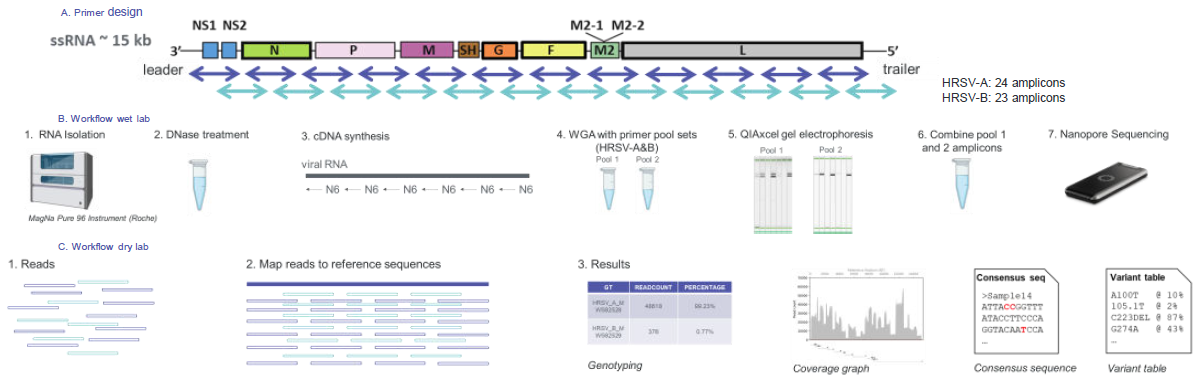
Figure 1. Workflow HRSV WGS assays. Image Credit: Cerba Research
Results
- Successful amplification of all HRSV-A/B ATCC strains, NW isolates, and strain dilution replicates (4.6–7.5 log10 copies/mL) was achieved. This yielded ≥94% complete genome coverage (Figure 2A).
- The majority of sequence errors occurred at frequencies ≤4% for the HRSV strain dilutions. A limited number of errors (n=5) with a frequency of ≥15% were observed in the HRSV-A mid (5.7 log10 copies/mL) and low (4.7 log10 copies/mL) viral load samples (Figure 2B).
- 29 of the 30 NP swabs were verified as positive for HRSV by RT-qPCR.
- Amplification results were acquired for 4/6 (67%) HRSV-A and 13/24 (54%) HRSV-B samples, including one HRSV-A/B co-infected NP swab. Viral loads ranged from 4.60 log10 copies/mL to 7.21 log10 copies/mL.
- WGS reached around >92% coverage for all amplified samples with the exception of the co-infected swab (~5.0 log10 copies/mL), which produced 80% coverage for HRSV-A (Figure 2A).
- The median sequencing depth per nucleotide position across all 11 ORFs was found to be in the range between 3.5 and 4.6 log10 reads (Figure 2C and 2D).
- Full-length F-gene sequences were acquired across all samples, with the exception of the co-infected NP swab, which demonstrated 92% F-gene coverage for HRSV-A.
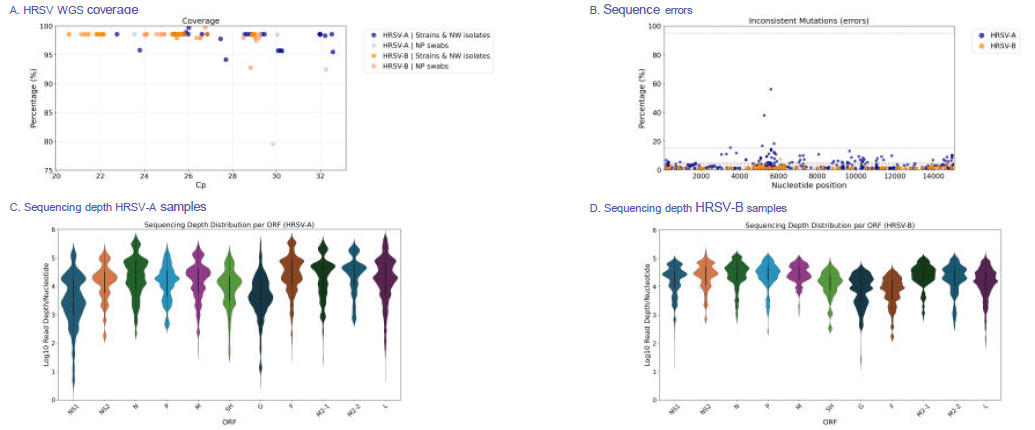
Figure 2. The HRSV WGS coverage for ATCC strains, NW isolates, strain dilutions and NP swabs (A). Sequencing errors for HRSV-A and HRSV-B (B). The violin plots summarize the read-depth distributions per nucleotide position for all HRSV-A (C) and HRSV-B (D) samples. Image Credit: Cerba Research
Conclusion
HRSV-A/B WGS assays have proven to offer superb performance and high sensitivity, making them well-suited for direct application to respiratory samples in large-scale viral genomic surveillance studies and the evaluation of drug-resistant mutations in new antiviral therapies.
About Cerba Research

Cerba Research is a leading specialty laboratory services provider with the capacity and breadth of a global central laboratory network. Their highly qualified scientists provide insight on the latest biomarkers, assays and testing approaches and develop innovative solutions for unique challenges across all research phases, to pharmaceutical, biotechnology, medical device, government, public health, and CRO organizations.
Cerba Research’s extensive capability in laboratory testing and global logistics including Bioanalysis, Flow Cytometry, Histopathology, and Next-Generation Sequencing, enables them to drive operational agility at scale in a wide range of therapeutic areas, with recognized expertise in Virology, Immunology, Oncology and Cell & Gene Therapy.
Cerba Research is part of the Cerba HealthCare Group with 15,000 employees on five continents, driven to advance diagnosis and health.
For more information about Cerba Research, please visit cerbaresearch.com.
Sponsored Content Policy: News-Medical.net publishes articles and related content that may be derived from sources where we have existing commercial relationships, provided such content adds value to the core editorial ethos of News-Medical.net, which is to educate and inform site visitors interested in medical research, science, medical devices and treatments.
Last Updated: Jul 16, 2026
 How to assess clinical response in multiple myeloma