Bruker Corporation today announced new advancements to enable Functional Proteomics 2.0 workflows on the timsOmni™ mass spectrometer to enable disease researchers to move beyond canonical protein lists toward biologically or pathologically functional proteoforms and PTM-resolved peptide variants. New releases in Bruker ProteoScape™, OmniScape™, and GlycoScape™ software now support database-independent PTM discovery, confident proteoform characterization, and eXd-enabled glycoproteomics for deeper biological, disease and drug discovery insights.
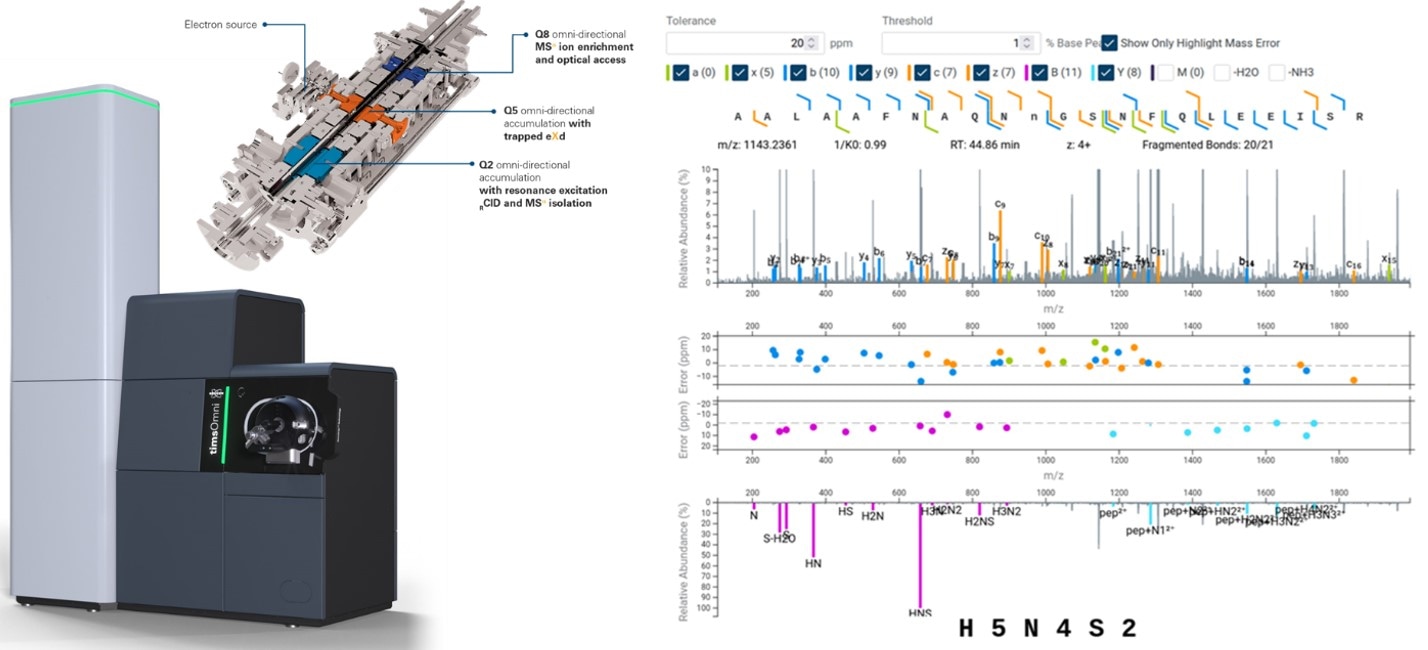 Annotated timsOmni™ glycopeptide eXd spectrum from GlycoScape™ highlighting both glycan fragment ions as well as peptide fragment ions. Image Credit: Bruker Corporation
Similarly, the now enabled timsOmni deep proteoform methods are equally powerful in interrogating drug targets, as well as biologics, including therapeutic antibodies, ADCs, multispecifics, and their PTM distributions and glyco-heterogeneity.
Confident proteoform characterization and eXd-enabled glycoproteomics on timsOmni
The latest version OmniScape™ 2026b strengthens timsOmni proteoform workflows by integrating the novel OmniWave™ algorithm, which enables top-down sequencing and proteoform identification at scale with high-confidence annotation of critical PTMs that drive disease signaling. Researchers can now move beyond protein group read-outs to proteoform-centric mechanisms, e.g., distinguishing signaling relevant protein variants that indicate disease states or treatment response. In biotherapeutics research, OmniScape supports verification of expected sequences and non-canonical modifications and can flag sequence variants or heterogeneity that may affect side effects or efficacy.
Bruker is greatly enhancing glycoproteomics with support for trapped electron‑based dissociation (eXd) data in GlycoScape software, enabling confident glycopeptide characterization while preserving fragile glycan structures and supporting localization and topology insights. GlycoScape also provides interactive visualization of eXd fragment ions within annotated MS/MS spectra to simplify the validation of results.
“The timsOmni gives scientists access to eXd-enabled fragmentation that can resolve complex PTMs and proteoforms with outstanding fidelity,” said Professor Yehia Mechref, Director of the Texas Tech University Center for Biotechnology & Genomics. “The new software capabilities – especially eXd N-glycopeptide analysis and improved top-down workflows – support deeper understanding of disease biology and provide new avenues for target discovery and translational research.”
Bruker ProteoScape™ adds AI‑enhanced de novo peptide sequencing for database‑independent discovery in metaproteomics and immunopeptidomics
Bruker is introducing a new de novo peptide sequencing workflow in Bruker ProteoScape v2026b software that pairs an AI‑enhanced scoring model – trained on more than seven million MS/MS spectra – with a proven dynamic‑programming foundation to deliver accurate de novo sequences from high‑resolution timsTOF data. This supports the demand for database‑independent proteomics, enabling discovery of peptide variants across complex samples in applications such as metaproteomics and immunopeptidomics, including neoantigen research in immuno-oncology.
Researchers are increasingly studying biological systems where reference databases alone do not capture the true molecular diversity.
Our collaboration with Bruker has enabled Novor.AI to take advantage of large, high-quality timsTOF datasets and combine them with our AI model to deliver the speed, confidence, and precision needed for next-generation de novo peptide sequencing applications.”
Bin Ma, Founder, Rapid Novor Inc.
 When Spectrometry bridges the gap between Proteomics and Biology